Recommended Depth and Dimensions for Garden Paths
Selecting the correct thickness and width is the first step in ensuring your concrete path remains durable and safe. The dimensions you choose depend entirely on the expected traffic load and the specific function of the walkway.
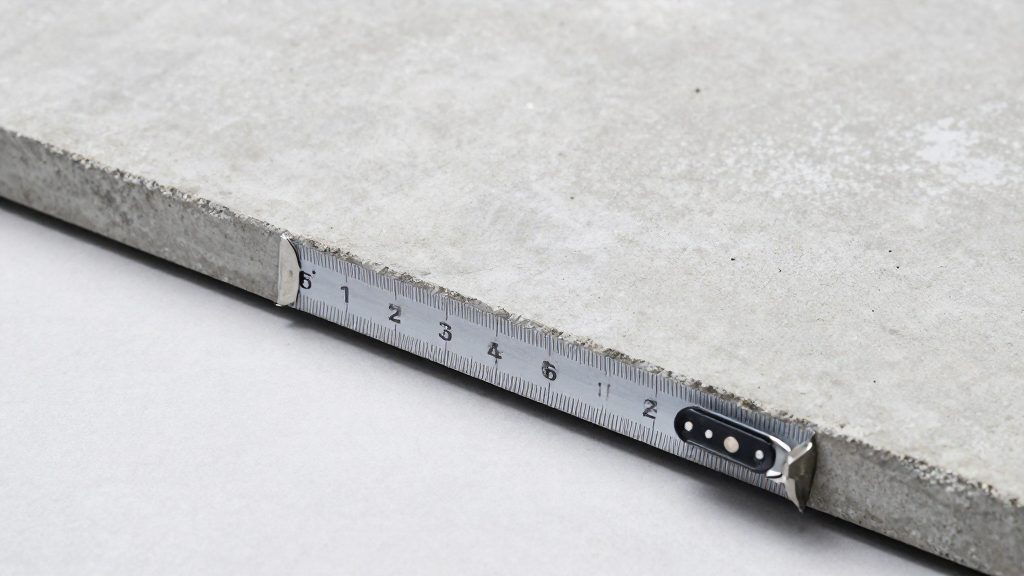
For standard residential use, such as a path leading to a front door or connecting garden beds, a 4-inch thickness is the standard recommendation. This depth provides sufficient structural integrity for foot traffic and light hand tools. It is the most common specification for typical home walkways because it balances material usage with long-term stability.
If your path will support heavier loads, such as a loaded wheelbarrow, a small utility vehicle, or frequent movement of heavy equipment, you should increase the depth to 5 or 6 inches. This additional mass helps distribute weight more effectively and prevents cracking under pressure.
Regarding width, residential paths typically range from a narrow single-file walkway to a wider dual-lane design. A narrower width is suitable for private gardens where only one person passes at a time, while a wider path allows two people to pass comfortably or accommodates a wheelbarrow. Measure your space carefully to ensure the path fits within your available area without encroaching on planting zones or drainage areas.
| Usage Type | Recommended Thickness | Typical Application |
|---|---|---|
| Foot Traffic | 4 inches | Standard residential walkways, garden paths |
| Heavy Loads | 5–6 inches | Paths for wheelbarrows or light equipment |
How to Calculate Concrete Volume in Cubic Feet and Cubic Yards
To determine the amount of concrete needed for a garden path, you must convert linear dimensions into a three-dimensional volume. The process involves three distinct steps: measuring the path, converting units to a common standard, and calculating the final volume.
First, measure the length and width of the path in feet. If your measurements are in inches, convert them by dividing by 12. For example, a path that is 4 inches thick is equivalent to 0.333 feet. This conversion is essential because the volume formula requires all dimensions to be in the same unit.
Next, apply the volume formula for a rectangular prism:
$$ \text{Length (ft)} \times \text{Width (ft)} \times \text{Thickness (ft)} = \text{Cubic Feet} $$
This calculation gives you the total volume in cubic feet. However, concrete is typically sold in cubic yards. To convert cubic feet to cubic yards, divide the total cubic feet by 27, since one cubic yard equals 27 cubic feet.
Understanding this conversion helps you visualize the material quantity. For instance, a standard 4-inch thick slab covers approximately 81 square feet per cubic yard. By mastering these conversions, you can accurately estimate the volume required for any rectangular path, ensuring you purchase the correct amount of material without significant overage or shortage.
| Unit Conversion | Method |
|---|---|
| Inches to Feet | Divide inches by 12 |
| Cubic Feet to Cubic Yards | Divide cubic feet by 27 |
How Many Concrete Bags Are Needed for a Walkway?
Once you have calculated the total volume of concrete required for your path in cubic feet or cubic yards, the next step is determining how many mix bags to purchase. The number of bags depends entirely on the size of the bag you choose and the total volume of the project.
Standard 80-pound bags of concrete mix yield approximately 0.60 cubic feet of mixed concrete. In contrast, standard 60-pound bags yield approximately 0.45 cubic feet. This difference in yield directly impacts the total count needed. For a full cubic yard of concrete, you will need 45 bags of the 80-pound mix or 60 bags of the 60-pound mix.
To find the exact number of bags for your specific path, divide your total calculated volume in cubic feet by the yield per bag. For example, if your path requires 10 cubic feet of concrete, you would divide 10 by 0.60 for 80-pound bags, resulting in approximately 17 bags. Always round up to the nearest whole number, as you cannot buy partial bags.
| Bag Size | Yield per Bag (Cubic Feet) | Bags Needed per Cubic Yard |
|---|---|---|
| 80-pound | 0.60 | 45 |
| 60-pound | 0.45 | 60 |
Accounting for Subbase and Waste Allowance
Calculating the exact geometric volume of your path is only the first step. In practice, you must adjust this figure to account for real-world variables that cause material loss or require extra fill. The primary adjustment is the waste factor, which compensates for uneven ground, spillage, and the difficulty of spreading concrete perfectly within forms.
For residential garden paths, it is standard practice to add a margin of 5 to 10 percent to your calculated volume. This buffer covers three main issues:
- Uneven Subgrade: Even after grading, the ground beneath the forms is rarely perfectly flat. Low spots will consume more concrete than your average thickness calculation suggests.
- Excavation Irregularities: Hand-dug trenches often have slightly irregular depths or widths, leading to minor volume discrepancies.
- Form Spreading: Concrete tends to spread slightly beyond the form lines or stick to the sides, meaning you need a small excess to ensure the surface is fully covered and level.
To apply this, multiply your total cubic feet (or cubic yards) by 1.05 to 1.10. For example, if your path requires 10 cubic yards of concrete based on dimensions, you should order between 10.5 and 11 cubic yards. This ensures you have enough material to fill the entire area without running short, which would require a second, potentially mismatched batch.
| Adjustment Factor | Purpose |
|---|---|
| Waste Factor (5–10%) | Compensates for uneven ground, spillage, and form spreading |
| Subgrade Variance | Accounts for low spots in the excavation that require extra fill |
Worked Examples: Straight and Curved Path Calculations
To determine the concrete volume for a straight path, multiply the length, width, and thickness in feet. For a 20-foot by 3-foot path with a standard 4-inch thickness, first convert the thickness to feet by dividing by 12. This results in a thickness of approximately 0.333 feet. Multiplying 20 by 3 by 0.333 yields a total volume of roughly 20 cubic feet. To convert this to cubic yards, divide by 27, resulting in approximately 0.74 cubic yards.
For a curved path, estimating the area is more complex. A practical method involves dividing the curve into smaller, manageable straight segments or approximating the shape as a series of trapezoids. Calculate the area of each segment individually and sum them to find the total square footage. Once you have the total area, multiply by the thickness in feet to get the cubic feet, then divide by 27 to find the cubic yards. This segmented approach ensures accuracy for irregular shapes.
Finally, calculate the total bag count. If your calculation yields 0.74 cubic yards, you need to account for waste. Adding a standard margin of 5% to 10% for uneven subgrade and form spreading brings the requirement to roughly 0.78 to 0.81 cubic yards. Since one cubic yard of 80-pound bags equals 45 bags, multiply your adjusted cubic yards by 45. For 0.81 cubic yards, this requires approximately 36 bags. Always round up to the nearest whole bag to ensure you have enough material to complete the pour without interruption.
Practical Guidelines for Pouring, Joint Spacing, and Curing
Executing a garden path correctly depends on managing the concrete while it sets. The most critical on-site decision is the placement of control joints. These grooves force the slab to crack in straight, predictable lines rather than randomly as it shrinks. For a standard 4-inch thick path, joints should be spaced at intervals no greater than 4 to 6 feet. A common and effective method is to space the joints at intervals equal to the width of the path itself. This ensures that any cracking occurs at the joint rather than through the center of the slab, maintaining a clean, professional appearance.
Once the concrete is poured and finished, the curing process begins. Curing is not just about waiting; it is an active process of maintaining moisture. To reach standard strength, the surface must remain damp for at least 5 to 7 days. You can achieve this by misting the surface with water regularly or covering it with plastic sheeting or burlap. Allowing the concrete to dry out too quickly during this period can lead to surface dusting, weak spots, or premature cracking.
Temperature is another key factor. Fresh concrete should not be poured when ambient temperatures drop below 40°F (4°C). Cold weather slows the hydration process and can weaken the final product. If you must work in cooler conditions, special precautions such as thermal blankets are necessary to protect the slab.
Frequently asked questions
How thick should a concrete garden path be for foot traffic?
For standard residential walkways designed for pedestrians, a 4-inch thickness is the recommended minimum to ensure structural stability. If you anticipate using the path for heavier loads like loaded wheelbarrows, you should increase the depth to 5 or 6 inches.
How do I convert my path dimensions into the required concrete volume?
Multiply the length, width, and thickness of your path in feet to find the total cubic feet of concrete needed. To convert this figure into cubic yards for ordering, simply divide the total cubic feet by 27.
Do I need to order extra concrete to account for waste?
Yes, it is standard practice to add a 5% to 10% margin to your calculated volume to cover uneven subgrades and form spreading. This buffer ensures you have enough material to fill the entire area without running short during the pour.