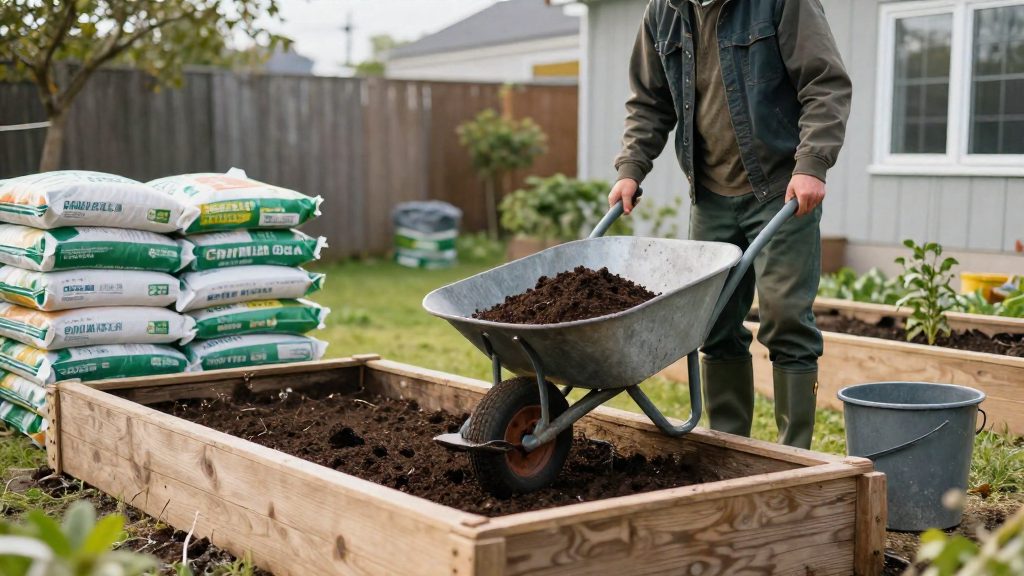
For a new framed raised bed filled with excavated native soil, Oregon State University Extension recommends up to 25% compost by volume. An established bed needs a separate calculation based on the depth of the planned compost addition, rather than its full soil depth. Start by deciding which job you are doing, then measure the bed and calculate the compost alone. Do not fill a raised bed entirely with compost. Oregon State University Extension
How do you choose a compost proportion for a new bed?
A permanent raised bed needs a growing medium that provides a stable root zone as well as organic material. Rutgers Cooperative Extension (2025) explains that mineral soil amended with well-rotted compost can retain its volume and provide drainage, aeration, and nutrient-holding capacity. A compost percentage is a mixing instruction for the whole fill, rather than a recommendation to create a separate compost layer at the bottom. Rutgers Cooperative Extension
Choose the recommendation that matches your starting materials. Iowa State University Extension and Outreach (April 20, 2026) gives approximately 70% topsoil and 30% compost as one raised-bed option. This applies to assembling a soil mix; it is not an annual application rate. Iowa State University Extension and Outreach
For a different situation—new beds over compacted, clay-rich ground—University of Maryland Extension (November 6, 2024) describes compost-to-purchased-topsoil ratios of 1:2 or 1:1 after loosening the underlying soil. Read the ingredient order carefully: compost is the first component. These are installation options for that soil condition, rather than a universal target for every garden. University of Maryland Extension
If you already have a blended raised-bed soil, ask the supplier what it contains before adding more compost. Use the stated composition and local Extension advice to decide whether an additional amendment is appropriate.
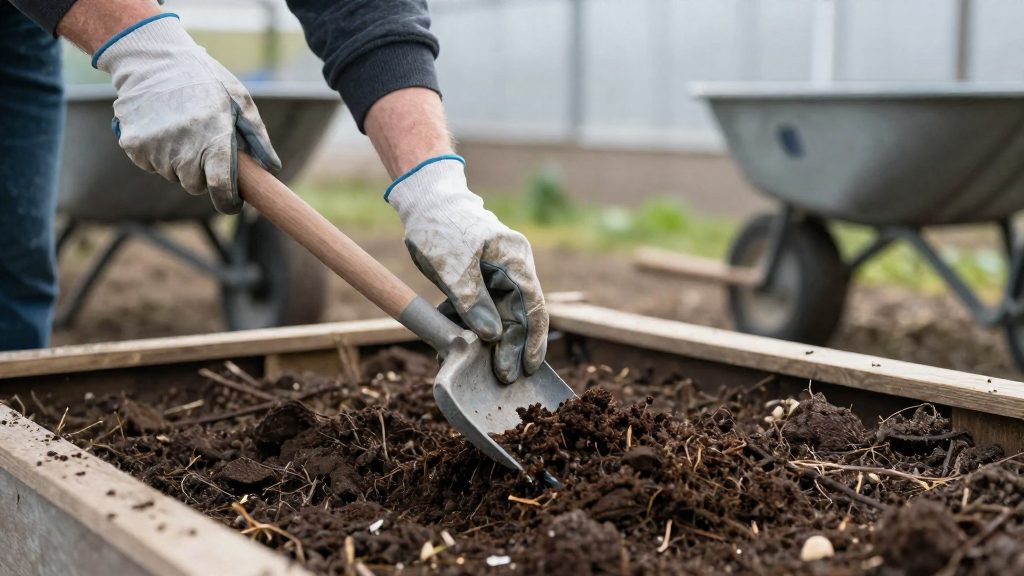
How do you calculate compost volume?
Measure the inside length and width of the planting area. Exterior frame dimensions include the walls and can overstate the space you must fill. For a new bed, measure from the prepared soil surface to your intended finished soil level. For maintenance, use only the thickness of compost you intend to add.
Use these formulas for a rectangular bed:
- Bed area in square feet = inside length in feet × inside width in feet.
- Volume in cubic feet = bed area × depth in inches ÷ 12.
- Compost for a new mix = total fill volume × compost fraction.
- Compost for a surface application = bed area × compost layer depth in inches ÷ 12.
These follow the volume and unit-conversion method published by Iowa State University Extension and Outreach (October 30, 2026). The worked quantities below are calculated examples, not additional application recommendations. Iowa State University Extension and Outreach
For an L-shaped bed, calculate its nonoverlapping rectangular sections separately and add their volumes. For multiple beds with different dimensions or amendment needs, keep separate calculations until you have determined the compost volume for each. Then add the compost totals for your order.
What does a new-bed calculation look like?
Assume a rectangular bed has an interior planting area 4 feet wide and 8 feet long, with a planned soil fill depth of 12 inches. Using the excavated-native-soil option described above, the calculation at its upper compost proportion is:
- Total fill: 4 × 8 × 12 ÷ 12 = 32 cubic feet.
- Compost component: 32 × 0.25 = 8 cubic feet.
- Native soil component: 32 − 8 = 24 cubic feet.
This is a worked application of Oregon State’s raised-bed mixing recommendation.
If you instead choose Iowa State’s topsoil-and-compost option, the same total fill requires approximately 9.6 cubic feet of compost and 22.4 cubic feet of topsoil, calculated as 32 × 0.30 and 32 × 0.70. Keep each recipe intact rather than combining percentages from different recommendations. Iowa State University Extension and Outreach
These estimates describe measured ingredient volumes before filling. Treat the result as an order estimate and check the finished soil level after installation.
When should an established bed receive more compost?
Oregon State University Extension gives an annual compost layer of 1/4 inch to 1 inch for existing vegetable beds. This maintenance guidance is distinct from the initial soil-mixture recipes. Decide whether your bed needs an addition before choosing a depth within that guidance. Oregon State University Extension
University of Minnesota Extension’s soil-testing guidance, reviewed in 2023, stresses that repeated compost applications can build up phosphorus and potassium. Its soil-building advice also distinguishes non-manure compost from composted manure, which should be treated as a nutrient source. Record what you have added previously, especially manure-based material, and use the soil-test recommendations to guide the next application. University of Minnesota Extension
If the laboratory identifies excessive nutrients, pause routine compost additions and ask how to maintain soil condition without adding more of the surplus nutrients. A bed that looks lower than last season may need replacement growing mix; the missing height does not automatically represent a compost requirement. University of Minnesota Extension
How much compost covers an existing 4-by-8-foot bed?
The following table uses a calculated area of 32 square feet and the surface-application formula above. Select the depth based on the bed’s amendment needs first; the table only converts that decision into a volume.
| Planned compost depth | Calculated compost volume |
|---|---|
| 1/4 inch | About 0.67 cubic foot |
| 1/2 inch | About 1.33 cubic feet |
| 1 inch | About 2.67 cubic feet |
These are calculated quantities using Iowa State’s volume method. Results are rounded for readability. Carry the unrounded result into your bag calculation when possible, then round the final purchase quantity upward. Do not round the application depth upward simply to use a whole bag.
How do you convert the volume into bags or cubic yards?
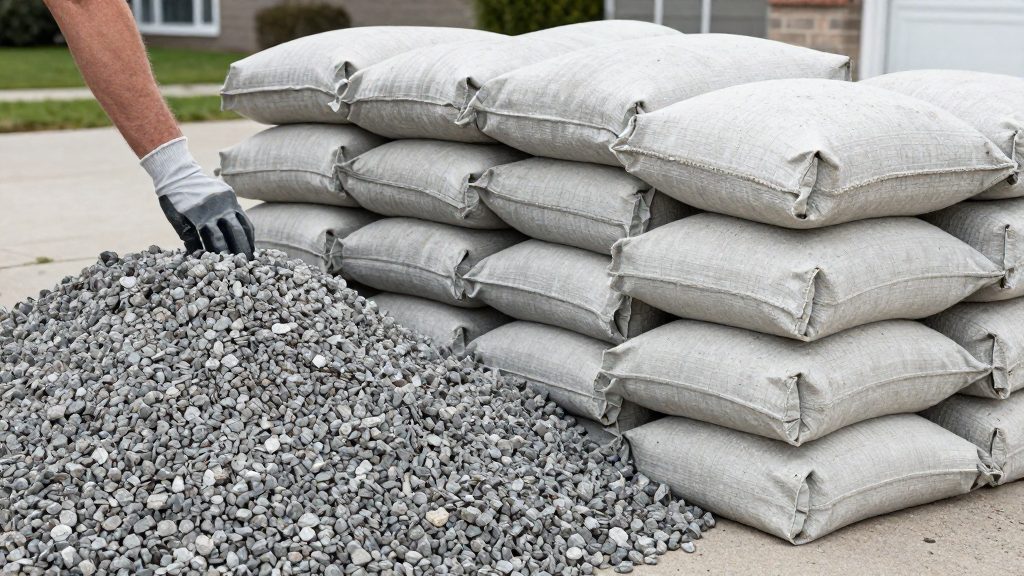
For bagged compost, read the package volume and use matching units:
Number of bags = required cubic feet ÷ cubic feet per bag.
To supply the new-bed example’s 8 cubic feet, bags labeled 1.5 cubic feet would require 8 ÷ 1.5 = about 5.33 bags. Round up to 6 whole bags to obtain enough material. Those bags contain 9 cubic feet altogether, leaving approximately 1 cubic foot outside the planned mix. Measure out the required amount rather than adding every purchased bag.
For bulk orders, cubic yards = cubic feet ÷ 27. The same compost requirement equals 8 ÷ 27 = approximately 0.30 cubic yard. These examples use the bag-division method and cubic-yard conversion published by Iowa State University Extension and Outreach (October 30, 2026). Iowa State University Extension and Outreach
Ask the supplier about available order increments and distinguish the compost order from the total soil-mix order. If purchasing a finished blend, order the required blend volume rather than ordering that volume again as separate compost.
If a listing gives pounds only, request its volume or the supplier’s density information for that material. Iowa State notes that moisture, organic content, and compaction affect weight per cubic foot. A fixed weight-to-volume shortcut can leave you with an incorrect quantity. Iowa State University Extension and Outreach
What should you check before spreading compost?
Check the material as well as the arithmetic. Iowa State’s raised-bed guidance specifies mature compost without excessive salts and cautions against bringing in contaminated topsoil. Ask where the ingredients came from and request available quality-test information when buying fill. Iowa State University Extension and Outreach
Finished compost should be crumbly and smell earthy. Oregon State advises against compost with ammonia, sulfur, or foul odors because these indicate incomplete composting. Oregon State University Extension
If your homemade material is still actively heating or contains recognizable undecomposed chunks, keep composting it before using it as a planting amendment. University of Minnesota Extension’s excess-compost guidance, reviewed in 2021, calls for fully completed compost. University of Minnesota Extension
For a bed with unexplained poor growth or a history of heavy additions, tell the testing laboratory what the growing medium contains. Rutgers explains that mostly organic growing media and compost need a different analysis from mineral soil. Follow the laboratory’s sampling instructions instead of assuming an ordinary garden-soil test suits every raised bed. Rutgers Cooperative Extension
When excess compost is already causing trouble, Minnesota Extension recommends testing first and choosing corrective action from the results. Do not try to flush an affected bed indiscriminately: the university warns that flooding to reduce salts can also cause nitrate leaching. University of Minnesota Extension
How do you fill the bed and manage settling?
For a ground-connected bed on suitable, uncontaminated soil, avoid a sharp boundary between existing soil and the imported mix. Iowa State recommends incorporating some of the incoming mix into the underlying soil before completing the fill, because distinct soil layers can hinder water movement and root growth. Iowa State University Extension and Outreach
Blend the measured soil and compost components throughout the new fill rather than leaving concentrated pockets. Spread maintenance additions evenly across the intended area, checking the depth at different points so that a mound in the center does not disguise thin coverage along the edges.
Wear gloves when handling compost and wash your hands afterward, especially before eating or drinking, following University of California Cooperative Extension’s compost-handling guidance, updated January 2015. University of California Cooperative Extension
Oregon State notes that newly filled beds can sink as compost decomposes and advises refilling as needed. Recheck the soil level and measure the actual deficit before ordering more material. Keep your bed dimensions, ingredient quantities, and soil-test results together so the next calculation reflects the bed you have. Oregon State University Extension
Frequently asked questions
Can I use the same soil recipe in an elevated planter with a solid bottom?
Treat a planter that functions as a container separately from a ground-connected raised bed. Iowa State recommends potting soil for containers, so check the planter’s growing-medium and drainage instructions before using a topsoil-based recipe. Iowa State University Extension and Outreach
Will compost supply all the fertilizer my vegetables need?
Do not assume it will. Compost’s nutrient supply varies, and nitrogen can remain insufficient even where phosphorus or potassium has accumulated. Follow crop-specific soil-test recommendations for any supplemental fertilizer. University of Minnesota Extension
Can adding compost make contaminated ground suitable for growing vegetables?
A compost application does not establish that contaminated ground is safe. Seek site-specific testing and local Extension advice before growing food; contaminated sites require a separate plan for clean growing soil and isolation from the affected ground. Rutgers Cooperative Extension