How much water does a shower use?
The water used by a shower depends on two things: the flow rate of the showerhead, measured in gallons per minute (gpm), and how long the water runs. Multiply them and you have the total for one shower:
Gallons per shower = flow rate (gpm) × minutes
The U.S. Environmental Protection Agency (EPA) reports that showering accounts for nearly 17 percent of residential indoor water use, so it is one of the most important indoor uses to understand.
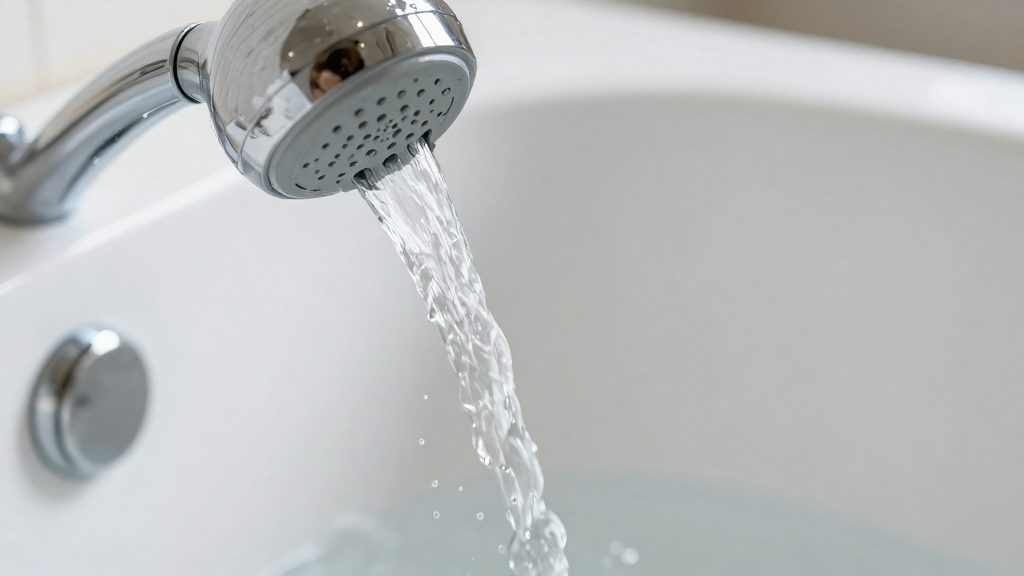
What do the 2.5 and 2.0 gpm limits mean?
Federal rules limit the maximum water use of showerheads manufactured after January 1, 1994 to 2.5 gpm when measured at a flowing pressure of 80 pounds per square inch (psi). This is the reference point for a standard head. The rule governs what manufacturers may sell; it does not tell you what the head already installed in your home delivers.
The EPA WaterSense label is stricter. A labeled showerhead must demonstrate that it uses no more than 2.0 gpm. Going from 2.5 to 2.0 gpm is a 20 percent reduction in flow (0.5 ÷ 2.5 = 0.2). A head older than 1994 may deliver more than 2.5 gpm, so check yours before relying on any figure.
How do I find my showerhead’s flow rate?
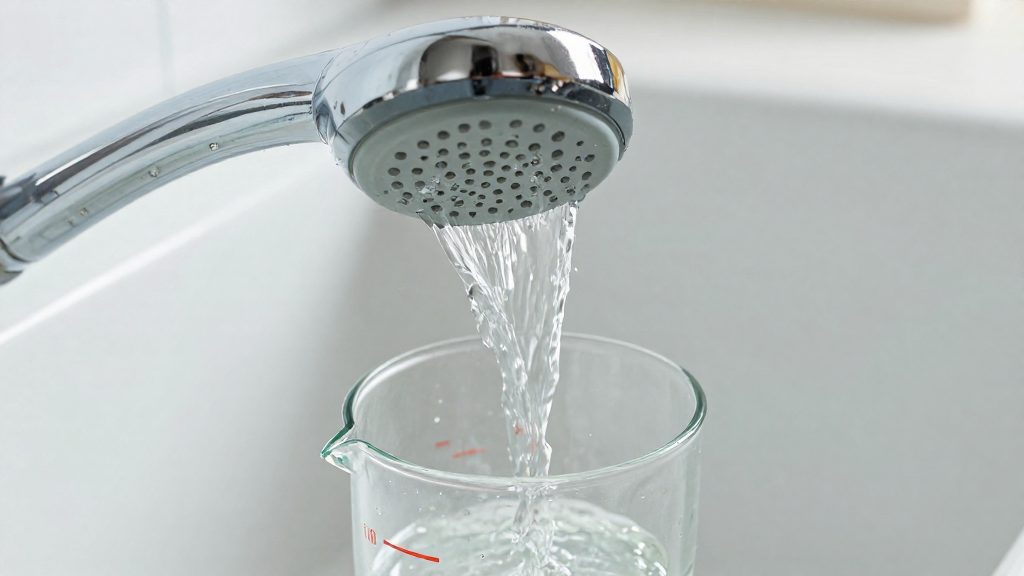
Start by checking the marking on the head or its packaging, where the gpm rating is often printed. If there is no marking, measure it yourself with a bucket test:
- Use a bucket with a clearly marked 1-gallon line.
- Hold it under the showerhead with the water running at the setting you normally use. If the head has a pulse or massage mode, test that mode separately.
- Time how many seconds it takes to fill the bucket to the line.
- Calculate: gpm = gallons ÷ seconds × 60.
For example, if the bucket fills to one gallon in 20 seconds, the flow is 1 ÷ 20 × 60 = 3.0 gpm. That is above the 2.5 gpm federal maximum, which suggests the head is older or does not meet the current standard. Repeat the test at a different time of day, because the flow you get depends on your household pressure.
Calculator: gallons per shower
Use your own numbers in the formula above. For comparison, here is an 8-minute shower. Eight minutes is an illustrative length chosen for the example, not a recommended one:
| Showerhead | Calculation | Gallons per shower |
|---|---|---|
| 2.5 gpm (federal maximum) | 2.5 × 8 | 20 |
| 2.0 gpm (WaterSense maximum) | 2.0 × 8 | 16 |
| Your head | your gpm × your minutes | ? |
The difference in this example is 4 gallons per shower.
Worked example: a family of four over a year
Assume four people, one 8-minute shower each per day, every day of a 365-day year:
- At 2.5 gpm: 4 × 365 × 20 = 29,200 gallons per year
- At 2.0 gpm: 4 × 365 × 16 = 23,360 gallons per year
- Difference: 5,840 gallons per year
EPA estimates that the average family could save 2,700 gallons per year by installing WaterSense-labeled showerheads. That national estimate rests on EPA’s own assumptions. Your result will differ because it depends on the number of people, showers per day, minutes per shower, and the flow of your current head. Replace the example numbers with your household’s figures.

How long should a shower be to save water?
The formula shows that only two things control the total: flow rate and time. Every minute at 2.5 gpm uses 2.5 gallons, and every minute at 2.0 gpm uses 2.0 gallons. Shortening a shower by one minute therefore saves the flow of that minute.
No single recommended length can be given here, because the right duration depends on the people using the shower and their needs. To find your own baseline, time a few showers with a timer and compare them with the calculation. If you want to cut use further, turn off the water while you lather or shampoo. The flow is then zero for that period, and you can calculate the saving with the same formula.
Does low pressure change the water used?
Yes, it can. The gpm rating assumes the head is tested at a specified pressure. The federal test is 80 psi. WaterSense also requires pressure compensation, meaning the head must provide a minimum flow across a range of household water pressures. That is a minimum, not a guarantee that the flow stays constant. In a home with low pressure, the actual flow may be lower than the rating, so the formula with the printed gpm will overestimate the water used. Use the bucket test in your own home and apply the result.
If the spray is weaker than before, check for mineral deposits or debris in the head and clean it according to the manufacturer’s instructions. Do not remove or modify the flow-restricting part of the head to gain pressure. That part is designed to limit flow, and changing it may cause the head to exceed the rating or leak.
Where do showers fit in total indoor water use?
The EPA reports that showering accounts for nearly 17 percent of residential indoor water use. To see your own share, compare your calculated gallons per shower with your total indoor use, which you can read from your utility bill or water meter over a month. The shower figure counts only water passing through the head. It does not include the energy used to heat that water, which is a separate figure you can find in your water heater’s documentation.
Safety precautions for testing and replacement
- Test the water temperature by hand before stepping in. Children and older adults are at higher risk of scalds, so take extra care with them.
- Set the water heater according to the manufacturer’s instructions and local guidance. If you are unsure what setting is appropriate, ask a licensed plumber. A thermostatic mixing valve or anti-scald valve can help control the temperature at the shower.
- Before replacing a showerhead or working on the valve, turn off the water supply and open a tap to relieve the pressure. Use thread sealant on the threads, and tighten by hand before using a wrench.
- If you are unsure how to handle the pipes or valve, call a licensed plumber rather than working on a live supply.
Frequently asked questions
Does a bath use less water than a shower?
It depends on how full the bath is and on your shower’s flow rate and length. Estimate the bath volume from its size and fill level, then compare that figure with your gallons-per-shower result from the formula.
Does the energy to heat shower water count in this calculation?
No. The formula counts only the water that passes through the showerhead. The energy needed to heat that water is a separate figure, and you can find it in your water heater’s documentation.
Why does my shower feel weaker after I install a low-flow head?
A labeled low-flow head is designed to use less water, so a lower spray is expected to some degree. If the spray is weak beyond that, check for debris and follow the head’s manufacturer documentation.