How much paint does an exterior wall need?
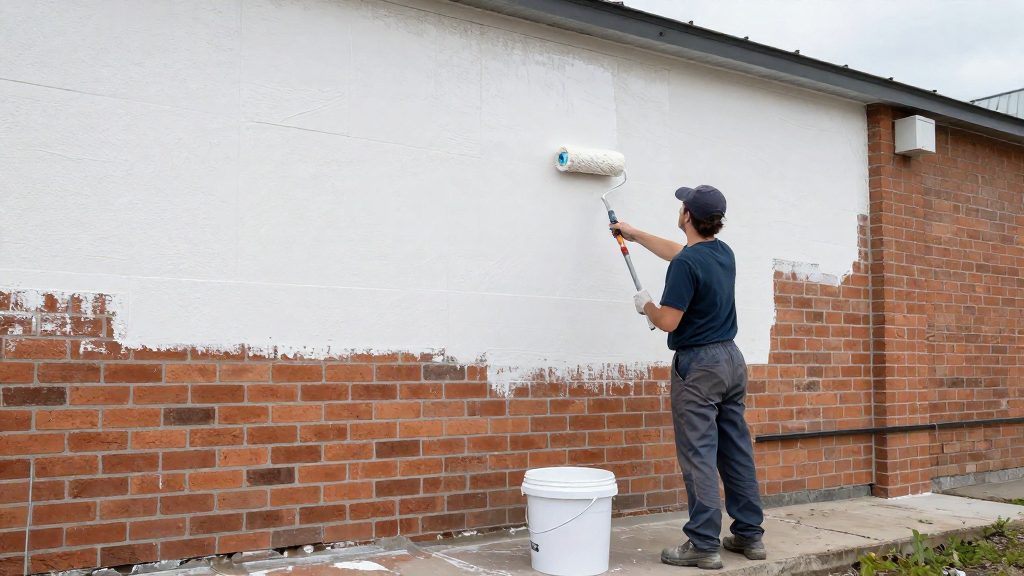
To buy the right amount of paint for an exterior wall, you need four inputs: the net area of the wall, the number of coats, the coverage printed for your product, and a small margin for waste. The basic formula is:
Gallons = (net wall area × number of coats) ÷ coverage per gallon
Then round the result up to the next whole container. The rest of this guide explains how to get each input right.
What do you need before you start calculating?
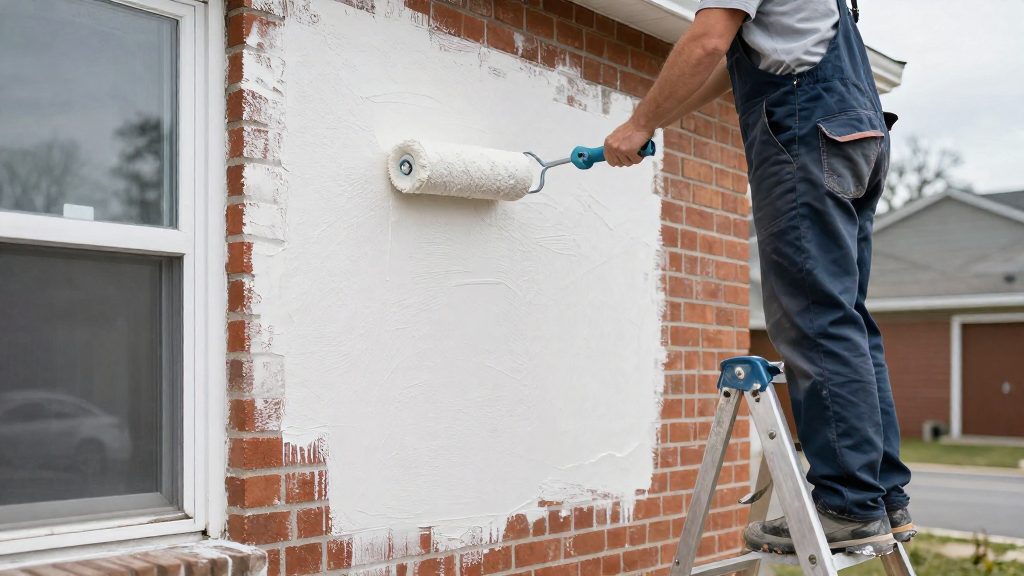
Gather three things before you measure. First, the product data sheet or the label of the paint you plan to use, because coverage belongs to the product, not to a general rule. Second, a tape measure, a notepad, and a simple sketch of each side of the house. Third, the age of the house, since older buildings raise safety questions that come before any painting (see the last section).
How do you measure the wall area?
Measure each wall separately. For a rectangular wall, multiply the length by the height. Measure the length from corner to corner and the height from the foundation line to the top of the wall. Write each figure on your sketch so you do not count the same wall twice.
Gable ends are triangular at the top. Split the gable into a rectangle and a triangle, calculate each part, and add them together. A triangle’s area is half its base multiplied by its height. Once every wall of one side is measured, add the results to get the total for that elevation.
What do you subtract for windows and doors?
Subtract every opening you will not paint. Measure each window, door, or garage door in width and height, multiply them, and add the results. Then subtract that total from the wall area. A large picture window or a sliding glass door is a significant deduction, so do not estimate it by eye.
Trim, fascia, soffits, and shutters are often painted with a different product or a different sheen. Calculate them separately rather than adding them to the wall total, so you do not buy the wrong quantity for either job.
Why does the surface change how much paint you need?
Coverage is not a fixed number. The manufacturer’s consumer guide for exterior paint gives a range of 250 to 400 square feet per gallon for one coat. Use a figure near the top of that range only for smooth, sealed, previously painted surfaces that have been prepared as the label describes.
Rough siding, stucco, masonry, and bare or unpainted wood absorb more paint and reduce coverage. A dramatic color change, such as a dark color over a light one, also tends to need more material. If your surface is one of these, plan with the lower end of the range and confirm the figure in the product’s data sheet.
When do you need primer or an extra coat?
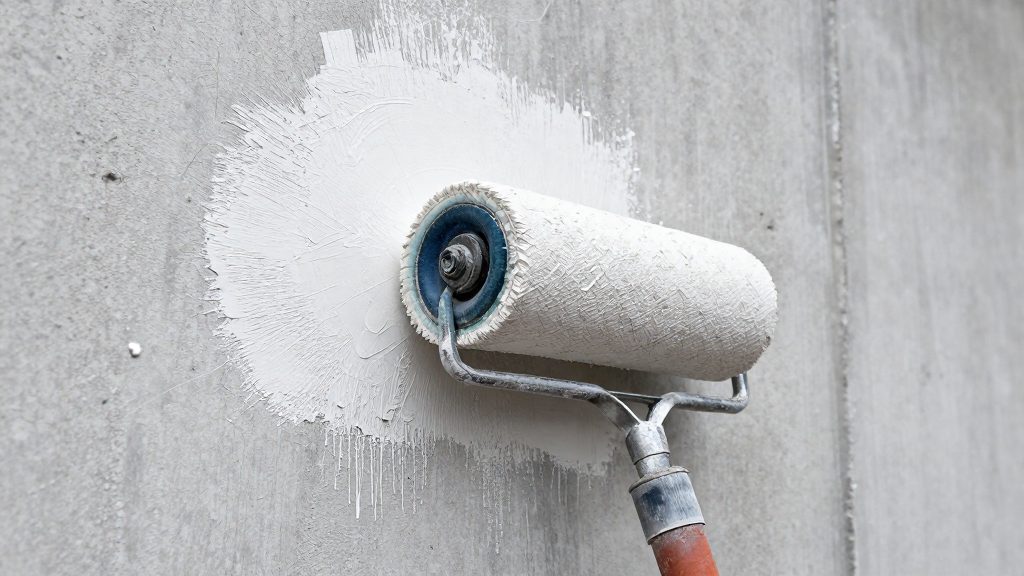
The number of coats and whether you need a primer depend on the surface and the product. Bare wood, new siding, patched areas, and surfaces with stains or chalky old paint often need a primer or sealer first. Read the data sheet for the recommended number of coats and for any preparation step your surface requires.
If the data sheet calls for a primer, calculate its coverage separately from the topcoat. Each product has its own rate, so do not assume one figure covers both. Check the temperature and humidity conditions printed on the data sheet, and avoid starting a job when rain is forecast before the coating has had time to dry.
Worked example: a 40-foot wall
Take one side of a house that is 40 feet long and 8 feet high. It has one window measuring 3 by 4 feet and one door measuring 3 by 7 feet. The gable is excluded from this example.
- Wall area: 40 × 8 = 320 square feet.
- Openings: window 3 × 4 = 12 square feet, door 3 × 7 = 21 square feet, total 33 square feet.
- Net area: 320 − 33 = 287 square feet.
- Two coats: 287 × 2 = 574 square feet to cover.
- Divide by coverage. At 350 square feet per gallon, 574 ÷ 350 = 1.64 gallons, which rounds up to 2 gallons.
Now take the same wall on a rough, porous surface, using 250 square feet per gallon. 574 ÷ 250 = 2.30 gallons, which rounds up to 3 gallons. The figure of 350 is an assumed value inside the manufacturer’s range, not a figure for any particular product, so replace it with the coverage printed for your paint before you buy.
How much margin should you add?
Add a margin for waste, touch-ups, spills, and the uneven absorption of the surface, then round up to whole containers. The margin matters most when your result sits just above a whole number. In the example, 1.64 gallons rounds up to 2 gallons, and any margin that keeps the total below 2 gallons still gives 2. That limit is about 21 percent extra. Once the calculation crosses into 2.1 gallons or more, you need a third container.
Textured surfaces and first-time painters usually justify a larger margin. Keep the leftover paint sealed and labeled, and store it as the label directs, so it is usable for touch-ups later.
Why does a house built before 1978 need lead precautions?
Before scraping, sanding, or removing any paint, find out when the house was built. If you cannot determine its age, assume lead-based paint is present. Lead dust from old paint is a serious hazard, especially for young children and pregnant people.
Under the U.S. Environmental Protection Agency’s Renovation, Repair and Painting rule, a homeowner doing the work on an owner-occupied pre-1978 home generally is not covered. The rule does apply if you rent out all or part of the home, run a childcare center there, or buy, renovate, and sell houses for profit. If you hire a contractor to disturb painted surfaces, that contractor generally must be certified, and EPA recommends hiring a lead-safe certified firm.
Even when certification is not required for your own work, use do-it-yourself lead-safe practices. Keep children and anyone not working out of the work area and post warning signs. Remove furniture, cover floors with plastic sheeting, seal doors, close windows, and tape plastic over heating and cooling vents. Wear a disposable N-100 respirator, disposable coveralls, gloves, and eye protection. Do not eat, drink, or smoke in the work area.
Mist surfaces before scraping, sanding, drilling, or cutting. Use HEPA-filtered vacuum attachments on power tools. If you remove paint with a heat gun, keep it on a low setting below 1,100°F. Bag debris and used sheeting in heavy plastic, seal the bags, and check local disposal rules. At the end of each day, HEPA-vacuum the work area, wipe surfaces with wet disposable cloths until they come up clean, wash your hands and face, and wash work clothes separately from the family’s laundry.
Stop work if dust or paint chips spread beyond the area you can contain, or if you cannot be sure the paint is lead-free. In that case, hire a certified lead-safe contractor rather than continuing on your own.
Frequently asked questions
Can I use the same paint for the trim and the walls?
You can if the data sheet allows it, but trim is often painted with a different product or sheen. Calculate trim separately and confirm the product suits both the surface and the finish you want.
Do I need a permit to repaint the outside of my house?
Painting an existing exterior usually does not need a permit, but local rules vary, especially in historic districts or for homeowner association properties. Check with your local building office before you start.
Does spraying change how much paint I need?
Yes. Spraying can waste paint through overspray, so allow a larger margin than you would for brushing or rolling. Follow the application instructions on the manufacturer’s data sheet for the equipment you use.