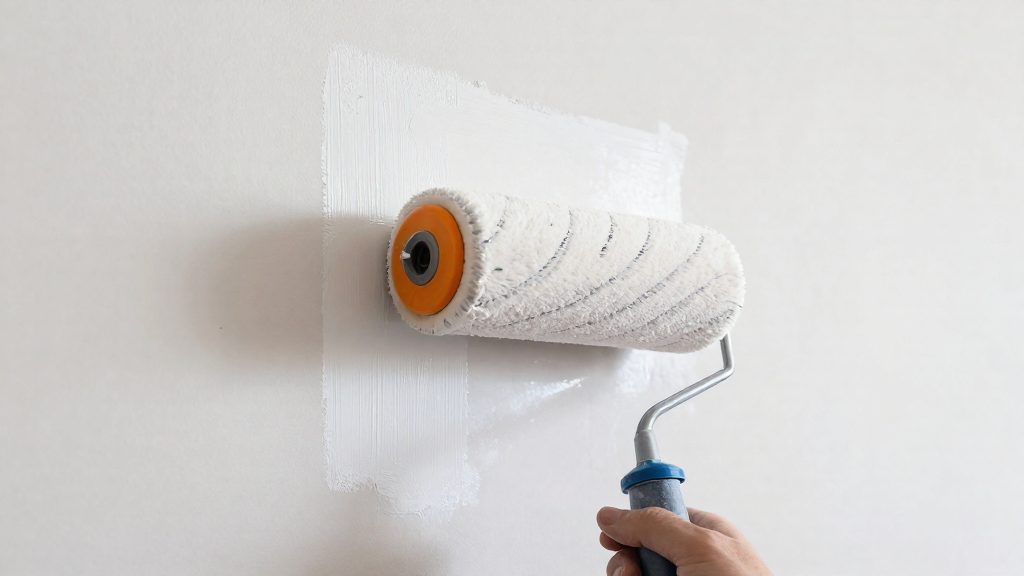
What the coverage rate on the label means
Every primer and paint container states a coverage rate, usually in square feet per gallon (sq ft/gal). It is the area one US gallon covers in one coat, at the dry film thickness the manufacturer assumes. Primer and finish paint have different rates, so calculate each product separately instead of using one figure for the whole job.
Rates vary a lot between products. The product page for one drywall primer lists 350 to 450 sq ft per gallon and recommends one or two coats. That range applies only to that product. For your purchase, use the rate printed on your container or in the manufacturer’s technical data sheet for that exact product. The sheet also gives the recommended number of coats and the surfaces the product suits.
Where the number comes from
Coverage depends on two things: volume solids and dry film thickness. Volume solids is the share of the liquid, by volume, that stays on the wall as dry film once the solvent or water has evaporated. Dry film thickness is the thickness of that remaining film. It is measured in mils (thousandths of an inch) or in microns, where 25 microns make one mil.
A US gallon holds 231 cubic inches. Spread over one mil (0.001 inch), it covers 231,000 square inches, which is 1,604 square feet. From that, the theoretical coverage of a coating is:
Coverage (sq ft/gal) = 1,604 × volume solids (%) ÷ 100 ÷ dry film thickness (mils)
For a coating with 50% volume solids applied at 5 mils dry, the theoretical coverage is 1,604 × 0.50 ÷ 5 = 160 sq ft per gallon. Double the film thickness and the area halves. A heavy coat therefore covers less wall than a thin one, even from the same can.
Wet film is thicker than dry film because the solvent or water leaves. Wet film thickness equals dry film thickness divided by volume solids. The same 5-mil dry film from a 50% product is 10 mils wet. A wet film gauge measures this during application, and it explains why a product with low volume solids needs more material for the same dry film.
Why you cover less area than the label suggests
The formula assumes a perfectly smooth surface, perfect transfer and no waste. A coatings specification manual published by a New Zealand paint manufacturer describes a practical method: practical coverage equals theoretical coverage multiplied by a surface roughness factor and an application condition factor. I use it here only for the calculation method. It is not a rule that applies to you. Its listed application factors are 0.90 for brush or roller, 0.80 for interior spraying and 0.70 for exterior spraying, which drops further in wind.
Applied to the example above, a brush or roller leaves about 0.90 of the theoretical value. The same 5-mil film then gives about 144 sq ft per gallon instead of 160.
Porous or rough surfaces lower the rate further. New drywall, plaster, bare wood, concrete block and stucco absorb more material and have a texture that adds area. The manual does not give one fixed value for this effect, so take the figure from your product’s technical data sheet. If the sheet gives a range, plan with the lower end for these surfaces. If the surface soaks up the first coat and looks patchy, the sheet’s guidance on coats and drying applies before you add more paint.
Calculating how much to buy
Use this sequence for each product:
- Measure the walls. Multiply the room’s perimeter in feet by the wall height in feet. For a ceiling, multiply length by width.
- Subtract openings you will not paint. A standard 3 ft by 7 ft door is 21 sq ft and a 3 ft by 5 ft window is 15 sq ft. Measure your own openings.
- Multiply by the number of coats that the product’s sheet recommends for your surface.
- Divide by the coverage rate you are using. Use the label rate for a smooth surface, or a lower planning rate for a porous one.
- Round up to whole gallons. Buying slightly more is safer than running short of the same batch.
Worked example: a room 50 feet around and 8 feet high has 400 sq ft of wall. Subtract two doors (2 × 21 = 42 sq ft) and two windows (2 × 15 = 30 sq ft), which leaves 328 sq ft to paint.
- Primer, one coat: the container says 350 sq ft per gallon, but this is new drywall, so use 300 sq ft per gallon as a planning rate. 328 ÷ 300 = 1.09, so buy 2 gallons. At 350 the result would be 0.94, which rounds to 1 gallon. The planning rate makes the difference.
- Paint, two coats at 350 sq ft per gallon: 328 × 2 = 656, and 656 ÷ 350 = 1.87, so buy 2 gallons.
The figures 350 and 300 in this example are inputs chosen for illustration, not published values for any product. Replace them with the rates on your own containers.
A ceiling works the same way. A room 15 feet by 12 feet has 180 sq ft of ceiling. One coat at 350 sq ft per gallon needs 180 ÷ 350 = 0.51, so buy 1 gallon.
A change from a dark colour to a light one, or a stained surface, may need an extra coat, so add one coat to the count in those cases. Check the sheet for the recommended number of coats in that situation.
When the label gives no rate
If the container has no coverage rate, or you are using an unfamiliar product, do not guess. Find the technical data sheet for the exact product name and version on the manufacturer’s website. If you still have no figure, apply one coat to a test area of known size and weigh the can before and after. Use the density given in the sheet to convert the weight lost into volume, then divide the area covered by that volume. Use this result only as a planning figure and confirm it with the manufacturer’s rate.
Safety before you prime
A house built before 1978 may contain lead-based paint. If you cannot tell the age of your home, EPA recommends assuming that the area you are renovating contains lead-based paint and using lead-safe practices. Apply these steps before scraping, sanding or cutting old paint:
- Mist the surface with water before sanding, scraping, drilling or cutting, to keep dust down.
- Keep children and anyone not working on the job out of the work area, and protect furniture and fixtures.
- Vacuum the work area often with a HEPA vacuum, then vacuum all remaining surfaces and objects with it.
- Finish by wiping every surface with wet disposable cloths until the cloths come away clean.
- Bag and seal your waste according to local rules.
For pre-1978 homes, EPA recommends hiring a contractor certified in lead-safe work practices. The federal RRP rule generally does not apply to owner-occupants working in their own home. It does apply if you rent out all or part of the home, run a child care business there, or renovate to sell for profit. If old paint is cracking or peeling and you cannot confirm whether it contains lead, stop and have it tested before you disturb it.
Many primers, especially solvent-based products, give off vapours and are flammable. Open windows, run an exhaust fan and keep heaters, open flames and sparks away from the work. Keep containers closed when not in use. Rags soaked in oil-based products can heat up and catch fire as they dry, so spread them flat outdoors or put them in water in a sealed metal container until disposal. Read the safety data sheet for each product before you start.
Checking the result
After the first coat, look at the surface in raking light. If the old colour, stains or patches still show through, or the finish looks uneven, the film is probably thinner than the plan assumed. Recheck the coverage rate and the number of coats on the sheet before you buy more. Keep the batch or lot number from the container so you can match any later purchase.
Frequently asked questions
Should I buy a tinted primer?
A tinted primer can help when you move from a dark colour to a light one or cover stains, because the finish coats then hide more easily. Check the technical data sheet for the tint limits and the number of finish coats it recommends.
How long should I wait between the primer and the paint?
Follow the drying and recoat times in the technical data sheet for your exact product. Humidity and temperature change those times, so check the surface is dry and firm before you paint, rather than relying on the clock alone.
Can I skip primer on a wall that is already painted?
It can be possible if the existing paint is sound, firmly bonded and in a colour close to the new one. Check the manufacturer’s guidance for painted surfaces, and test adhesion on a small area before you commit to the whole wall.
What if I run out before I finish the room?
Buy the remaining paint from the same batch or lot number if the store has it, because shades can vary between batches. If you cannot match the batch, stop at a natural break such as a corner or the edge of a wall so that any difference is less visible.