Standard Paint Coverage Rates and Units
To estimate paint volume, understand baseline coverage rates for smooth, sealed drywall. The primary unit is the US gallon, though quarts suit smaller projects.
For a single coat on a smooth interior surface, one gallon covers 350 to 400 square feet. Most projects require two coats for uniform color, reducing net coverage to 175 to 200 square feet per gallon. This halving occurs because the second coat consumes the same volume for the same area.
For smaller areas or color matching, paint by the quart. One US quart covers 87 to 100 square feet with a single coat, or roughly 45 to 50 square feet for two coats.
| Container Size | Single Coat Coverage | Two-Coat Coverage |
|---|---|---|
| 1 Gallon | 350–400 sq ft | 175–200 sq ft |
| 1 Quart | 87–100 sq ft | 45–50 sq ft |
These are baseline rates for smooth surfaces. Textured or porous materials require additional volume.
How to Calculate Wall Surface Area
Start by measuring the perimeter of the room. Measure the length of each wall individually and add them together. This ensures accuracy in irregular shapes or alcoves where simple length-times-width fails.
Next, measure the ceiling height. Standard residential ceilings are typically eight feet, but verify this, as newer constructions may differ. If height varies, measure at the highest point for a conservative estimate.
Multiply the total perimeter by the ceiling height to get the gross square footage of all four walls. For example, a 40-foot perimeter with 8-foot ceilings yields 320 square feet. This figure represents total surface area before deducting openings.
This gross figure is the baseline for your calculation. It does not yet account for doors or windows, which are deducted in the next step.
Calculating Ceilings, Doors, and Trim
Adjust the gross wall calculation by accounting for fixed architectural elements. Calculate the ceiling independently by multiplying room length by width. Add this to your wall area total, as ceilings typically require the same number of coats.
Subtract the area occupied by doors and windows from the gross wall square footage. Standard interior doors measure around 3 by 7 feet; deduct 20 to 21 square feet per door. Standard windows are approximately 3 by 4 or 5 feet; deduct 12 to 15 square feet per window. These deductions prevent buying excess paint for unpainted surfaces.
Address trim and baseboards by calculating total linear footage and multiplying by the average trim width in feet. For example, 100 linear feet of 4-inch-wide trim (0.33 feet) equals 33 square feet. Include this area to ensure enough paint for a complete job.
How Much Paint Is Needed for Common Room Sizes?
Estimating paint volume applies coverage rates to typical dimensions. With two coats required, effective coverage is 175 to 200 square feet per gallon. This allows quick estimation for common residential spaces.
A small bedroom (10 x 12 ft, 8-ft ceilings) has a wall area of approximately 352 square feet. After deductions, this space requires roughly two gallons for two coats. One gallon may suffice for a single coat on smooth walls, but two gallons ensure proper film build.
A medium living room (14 x 18 ft, 8-ft ceilings) presents about 512 square feet of wall area. Accounting for deductions and two coats, this room generally consumes 3 to 4 gallons. The larger perimeter makes it essential to round up to the nearest whole gallon.
A large master bedroom (16 x 20 ft, 9-ft ceilings) yields 648 square feet of wall area. This size typically demands 4 to 5 gallons for a complete two-coat application. Buying in gallon increments reduces the risk of color-batch mismatches compared to mixing quarts.
| Room Type | Typical Dimensions (ft) | Estimated Wall Area (sq ft) | Recommended Paint Volume (2 Coats) |
|---|---|---|---|
| Small Bedroom | 10 x 12 x 8 | ~350 | 2 Gallons |
| Medium Living Room | 14 x 18 x 8 | ~510 | 3–4 Gallons |
| Large Master Bedroom | 16 x 20 x 9 | ~650 | 4–5 Gallons |
Adjusting Quantities for Texture, Porosity, and Coats
Base calculations assume smooth, sealed drywall. Real-world surfaces often demand more material due to texture, porosity, and coat count.
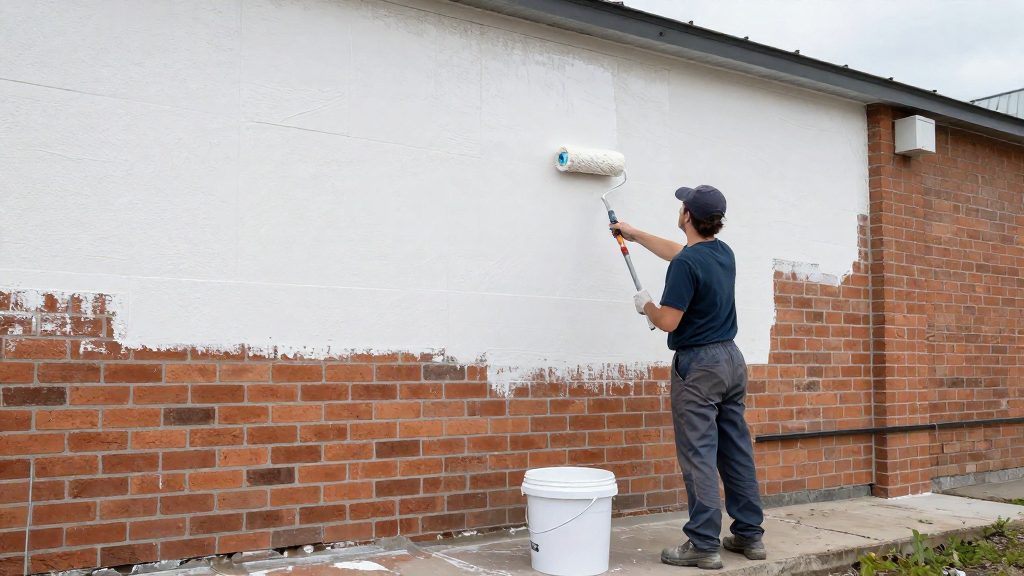
Surface texture alters effective area. Textured finishes like knockdown or masonry create peaks and valleys, increasing the area to be covered. Increase your calculated paint quantity by 10% to 20% for textured walls or masonry to account for paint trapped in recesses.
Porosity is a major variable. Unprimed drywall is highly absorbent. The first coat acts as a primer, soaking into the core rather than forming a visible film. If painting over unprimed surfaces, expect the initial application to consume more paint than standard rates suggest. Priming first mitigates this, but skipping it requires factoring in higher absorption.
The number of coats directly impacts consumption. Two coats are standard for uniform color and durability. Since net coverage per gallon is halved for two coats, always calculate for both to avoid running out mid-project, which can lead to visible color mismatches.
Step-by-Step Worked Calculation Example
Apply the formulas to a specific scenario: a rectangular room measuring 12 feet by 15 feet with an 8-foot ceiling.
First, calculate the gross wall area. The perimeter is the sum of all wall lengths: two 12-foot walls and two 15-foot walls total 54 linear feet. Multiply this perimeter by the 8-foot ceiling height to get 432 square feet of gross wall surface.
Next, subtract unpainted areas. Assume one standard interior door and two standard windows. Deduct the standard allowances for the door and windows from the gross area to yield the net paintable wall area.
Determine the final gallon count. Use the net coverage rate per gallon for two coats. Divide the net paintable wall area by this rate to find the required volume.
For the ceiling, multiply the room length by the width to find ceiling square footage. Apply the single-coat coverage rate to this area to determine ceiling paint quantity.
| Calculation Step | Action | Result |
|---|---|---|
| Perimeter | Sum of all wall lengths | 54 feet |
| Gross Wall Area | Perimeter × Ceiling Height | 432 sq ft |
| Deductions | Subtract door and window areas | 387 sq ft |
| Paint Volume | Net Area ÷ Net Coverage Rate | 2 Gallons |
Frequently asked questions
How many coats of paint are needed for a room?
Most interior projects require two coats to achieve uniform color and proper film build. This requirement effectively halves the net coverage rate, meaning one gallon covers only 175 to 200 square feet of wall area instead of the single-coat maximum.
How do I account for doors and windows in my calculation?
Subtract the area of openings from your total wall square footage to avoid buying excess paint. Use a standard deduction of 20 to 21 square feet for each interior door and 12 to 15 square feet for each standard window.
Does wall texture affect how much paint I need?
Yes, textured or porous surfaces like masonry or unprimed drywall absorb more material than smooth walls. You should plan for 10% to 20% more paint to compensate for the increased surface area and porosity.