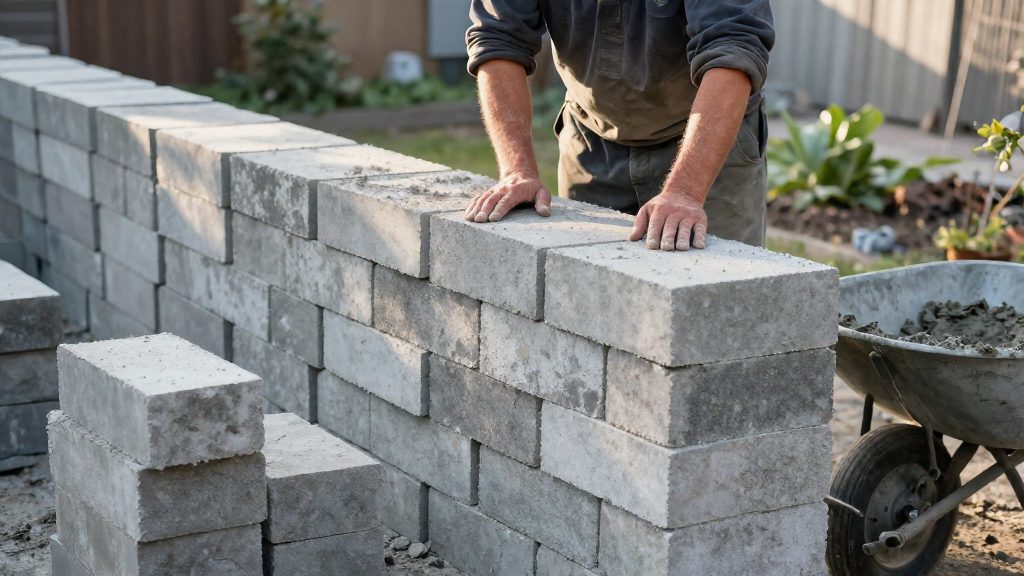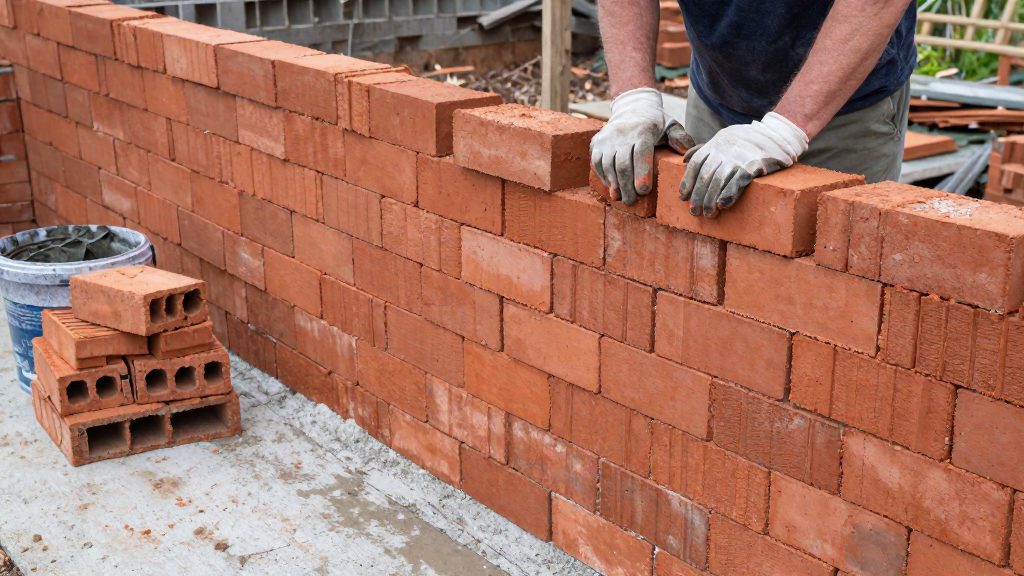
For a standard modular brick, 3 5/8 in thick, 2 1/4 in high and 7 5/8 in long, laid with a 3/8 in mortar joint, a wall needs about 6.86 bricks per square foot of face. A standard non-modular brick, 8 in long, needs about 6.55 per square foot. Multiply the wall’s area in square feet by the figure for your brick, subtract door and window openings, and you have the basic count before any allowance for breakage and cuts.
How do you calculate bricks per square foot?
Each brick occupies a face area equal to its length plus the joint, multiplied by its height plus the joint. Divide that area in square inches by 144 to get square feet, then divide 1 by the result. This is the same logic as the wall method described by Hunker: wall area in square feet divided by the area of one brick face.
For a modular brick, the length plus a 3/8 in joint is 7 5/8 in + 3/8 in = 8 in. The height plus the joint is 2 1/4 in + 3/8 in = 2.625 in. The face area is 8 × 2.625 = 21 square inches. Dividing by 144 gives 0.1458 sq ft, and 1 ÷ 0.1458 = 6.86 bricks per square foot.
For a non-modular brick, the length plus the joint is 8 in + 3/8 in = 8.375 in. The face area is 8.375 × 2.625 = 21.98 square inches, which gives 0.1527 sq ft, and 1 ÷ 0.1527 = 6.55 bricks per square foot.
These figures count bricks on the visible face only. A wall one brick thick needs one face count. A wall two bricks thick needs roughly twice the count, because each layer is counted separately, and the exact number depends on the bond pattern.
Which brick size does your project use?
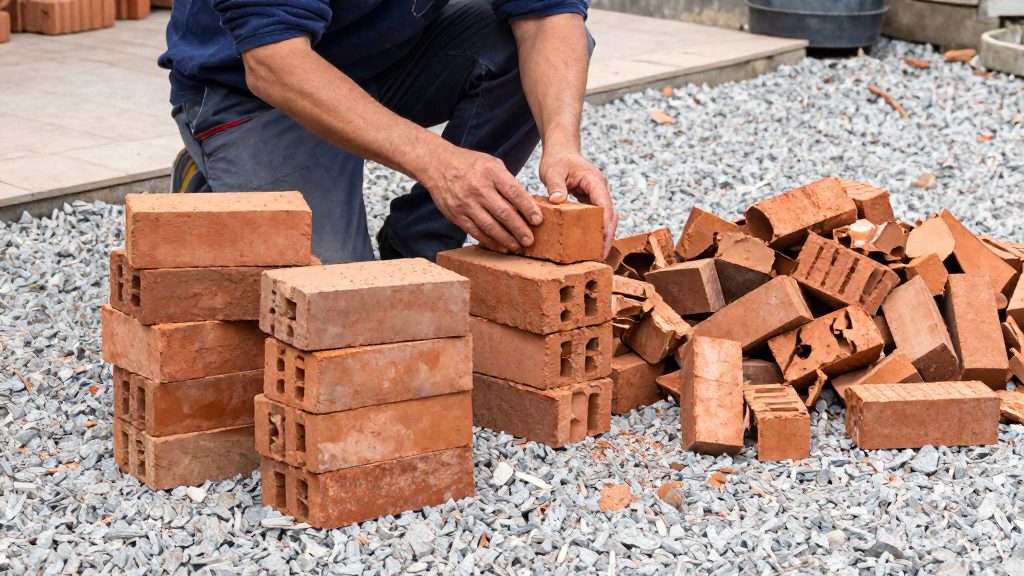
The Brick Industry Association’s technical note on dimensioning masonry (2009) explains that a modular unit is sized so that its specified dimension plus the intended mortar joint equals a nominal dimension on a grid. A non-modular unit does not fit that grid, so the same wall built with it needs a different count. The name on the bag matters less than the real size, so measure a sample or read the product’s data sheet before you order.
Canadian dimensions for fired clay brick are set in the CSA A82 series. The official sources consulted for this article do not list the unit sizes sold in a given region, so confirm them with your supplier. Metric units use the same method: add the joint to the unit’s face dimensions in millimetres, divide the wall area by one brick’s face area, and use the joint width in your project specification.
Worked example: a 10 ft × 8 ft wall
The wall area is 10 × 8 = 80 sq ft. With modular bricks, 80 × 6.86 = 548.8, so you need about 549 bricks for one face. With non-modular bricks, 80 × 6.55 = 524 bricks.
Now add a door opening of 3 ft × 7 ft, which is 21 sq ft. The net wall area is 80 − 21 = 59 sq ft. With modular bricks, 59 × 6.86 = 404.7, so you need about 405 bricks. Always deduct openings first, because a count made on the full wall area overestimates the bricks needed.
Why does the mortar joint change the count?
The joint width changes the module, so it changes the count. Hunker notes that a 3/8 in joint is the most common, but a 1/2 in joint is also used in brickwork. With a 1/2 in joint, a modular brick’s length plus joint is 8.125 in and its height plus joint is 2.75 in. The face area is 22.34 square inches, which gives 0.1552 sq ft, and 1 ÷ 0.1552 = about 6.44 bricks per square foot. That is roughly 6 per cent fewer than with a 3/8 in joint.
The joint width must match what the mason will actually build. Do not assume it. Check the project specification or ask the mason before ordering, because a wall built with a different joint will be short or long compared with your estimate.
Which laying pattern changes the count?
The count assumes the face shown in the calculation. Hunker explains that laying orientation changes how many bricks fit in a given area: a brick laid on its end shows a different face than one laid flat. If your design uses headers, soldier courses or a decorative bond, redo the calculation for that pattern rather than adjusting the basic figure.
How much extra should you order?
The official sources consulted do not specify a waste percentage, so this article does not give one. The extra you need depends on breakage during transport and handling, cut bricks at openings, corners and the top of the wall, and the variation between production batches. Add a margin for these, and ask your supplier about the return policy for unused, unbroken units. Order the full quantity from a single production run where possible, because colour and size can vary between batches.
When does a patio or walkway change the calculation?
Unmortared pavers laid flat are counted from their actual face dimensions plus the joint width used at installation, which is usually a sand gap rather than a mortar joint. The face count is therefore not the same as for a mortared wall. Check the manufacturer’s coverage figures and installation guidance, because the base, edge restraint and drainage affect the materials you need beyond the paver count.
When should a wall be checked by a professional?
A wall that carries a load, retains soil, or forms part of a chimney or a tall fence needs an engineer’s design and possibly a permit. The brick count is only a quantity estimate and does not check structural adequacy. Permit requirements depend on your municipality, so check before you dig a footing or start laying.
When you cut masonry, wear eye protection and a dust mask, and use wet cutting where possible to limit silica dust. Lift pallets with a cart or with a second person, and keep fresh mortar off your skin with gloves, because it is caustic.
Frequently asked questions
Can I use the same figures for metric bricks?
Use the same method with the unit’s face dimensions in millimetres and the joint width from your project specification. The figures in this article apply to imperial sizes only.
Should I buy all my bricks from one batch?
Yes, where possible. Colour and size can vary between production runs, so a single batch gives a more uniform wall, and it is easier to match any replacement units later.
How do I know how many courses fit a given wall height?
Count courses using the unit height plus the joint, then check a coursing chart from the manufacturer or a mason, because standard coursing does not always match a simple sum.
Does a different mortar change the brick count?
The count depends on the joint width, not on the mortar type. Check the specification for the joint width, since the mortar mix itself does not change the figures in this article.