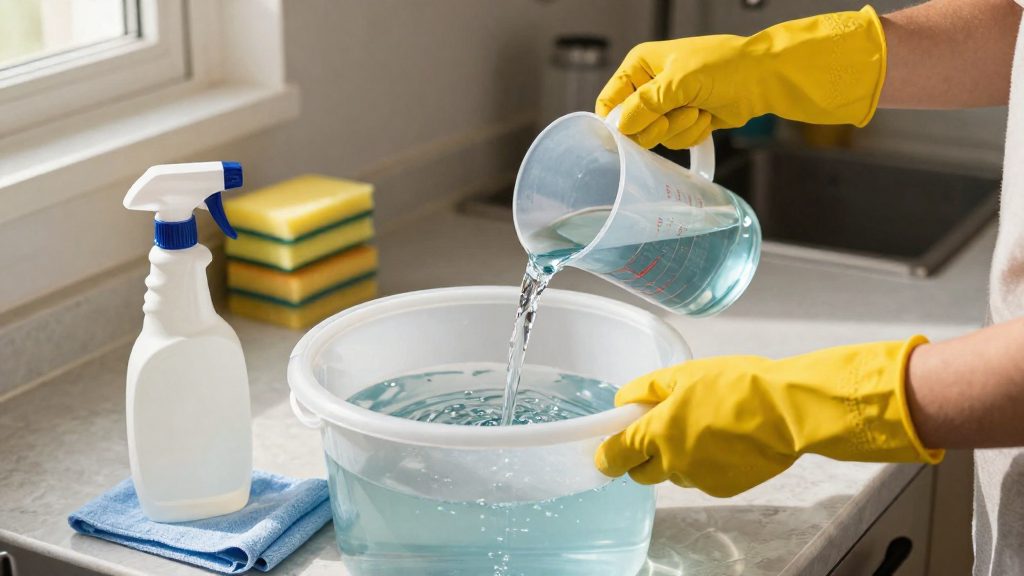
For a mild disinfecting solution, the ratio is 5 mL (1 teaspoon) of bleach in 250 mL (1 cup) of water, which scales to 20 mL (4 teaspoons) of bleach in 1 L (4 cups) of water. Chicken Farmers of Canada attributes these amounts to Government of Canada guidance and says to follow the product label first. In practice, the mix is about 1 part bleach to 50 parts water, or roughly 0.1 per cent sodium hypochlorite when the bleach is about 5 per cent strength. Stronger or weaker bottles need different amounts, so the formula below is the tool to use.
How do you calculate any bleach dilution?
Public Health Ontario’s chlorine dilution calculator is built on one equation: C1 × V1 = C2 × V2 (Public Health Ontario, 2020). Each letter has a fixed meaning:
- C1 is the strength of the bleach you start with, as printed on the label, for example 5 per cent.
- V1 is the volume of bleach you need to add. This is the unknown.
- C2 is the strength you want in the finished solution.
- V2 is the total volume of solution you are making, bleach and water together.
Rearranged to find the bleach volume: bleach volume = (target strength × total volume) ÷ label strength.
Keep the units consistent. Percentages work for both strengths, and millilitres work for both volumes. The calculator converts household measures with approximate values: 1 drop ≈ 0.05 mL, 1 teaspoon ≈ 5 mL, 1 tablespoon ≈ 15 mL and 1 cup ≈ 250 mL. These are approximations, not calibrated measures, so they suit a household disinfecting job but not precise dosing.
Why does the mild ratio work out to about 0.1 per cent?
Put the guidance figures into the formula. With bleach at 5 per cent and 1 L of finished solution, the target strength is 5 × 20 ÷ 1,000 = 0.1 per cent. Since 1 per cent equals 10,000 parts per million (ppm), that is about 1,000 ppm of sodium hypochlorite.
The smaller recipe lands in the same place. Five millilitres of bleach in 250 mL of water gives a total of 255 mL, and 5 × 5 ÷ 255 comes to about 0.1 per cent. Both versions are therefore one part bleach to roughly 50 parts water, which is why the teaspoon-and-cup version and the millilitre-and-litre version agree.
How do you measure bleach accurately at home?
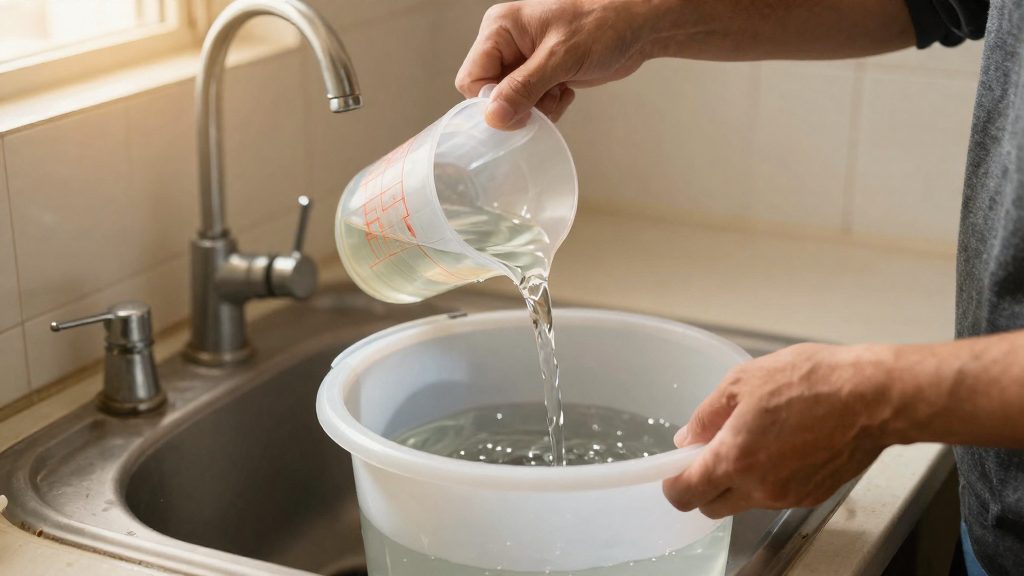
Measure in millilitres with a marked measuring cup or a graduated syringe whenever you can. A kitchen teaspoon is close to 5 mL but varies from spoon to spoon. Drops are the least reliable measure: at about 0.05 mL per drop, 20 mL means roughly 400 drops, which is easy to miscount. Measure the water with the same care so the proportions stay right. Keep the measuring tools you use for bleach separate from food utensils and label them clearly.
What do worked examples look like for a spray bottle and a bucket?
The examples below assume bleach at 5 per cent and a target of 0.1 per cent. Round to the nearest measure you can read accurately.
- Spray bottle, 500 mL total: 0.1 × 500 ÷ 5 = 10 mL, which is 2 teaspoons. Pour in about 250 mL of water, add the bleach, then top up to the 500 mL mark.
- Litre jug, 1,000 mL total: 0.1 × 1,000 ÷ 5 = 20 mL, which is 4 teaspoons, matching the guidance.
- Bucket, 4 L total: 0.1 × 4,000 ÷ 5 = 80 mL, which is 5 tablespoons plus 1 teaspoon.
- Bottle labelled 3 per cent, 1 L total: 0.1 × 1,000 ÷ 3 = 33 mL, about two-thirds more than the 20 mL needed at 5 per cent.
The last example shows why the label matters. Using the 5 per cent figure on a weaker bottle leaves the solution below the target strength.
Why clean a surface before you disinfect it?
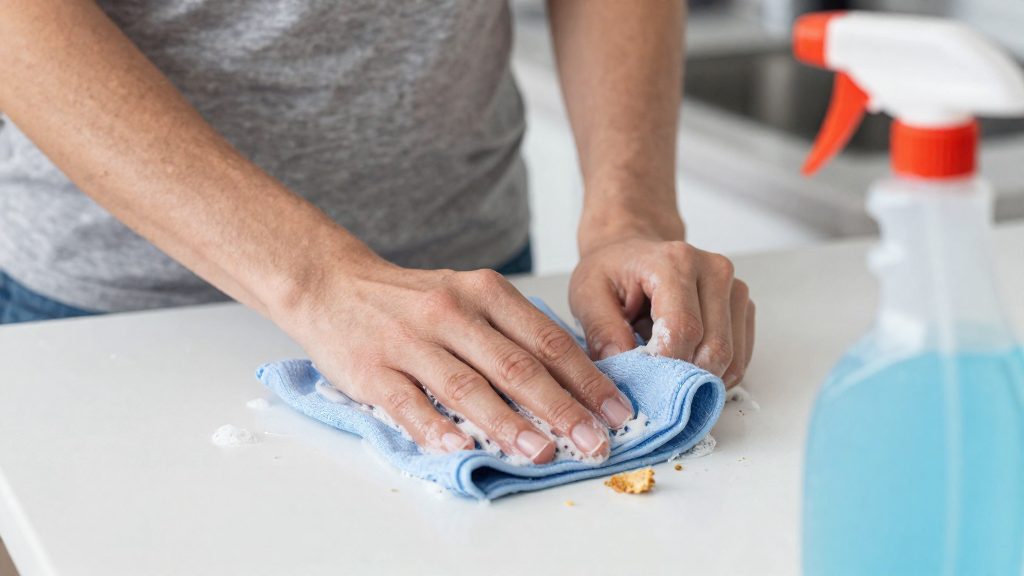
Dirt and grease can sit between the disinfectant and the surface, so wash visibly dirty areas with your usual detergent, rinse, and then apply the disinfectant. The official sources consulted do not give a full cleaning procedure, so follow the product label for any step beyond this basic order. Wiping a surface with a disinfectant that has not been cleaned first is a common reason a result looks worse than the mix should deliver.
When should you not stretch this ratio?
The mild solution is a general-purpose mix. The guidance cited here does not give stronger dilutions for heavy soil, spills of body fluids or other specific tasks, and the official sources consulted do not specify them either. For those jobs, follow the product label or the advice of your local public health unit. Do not double or halve amounts by guesswork, and do not add extra bleach in the hope of a stronger result. A stronger mix raises the risk from fumes and skin contact without guaranteeing better disinfection.
Why should you mix a fresh batch every day?
Public Health Ontario advises against premixing water and bleach, because the solution loses potency over time (Public Health Ontario, 2020). Chicken Farmers of Canada gives the same advice: for best results, mix a fresh batch each day and dispose of any leftovers. Mix only what you need for the day, and do not keep a diluted bottle for next week.
The concentrated bottle also has a shelf life. Check its expiry date, because the calculation depends on the strength printed on the label.
How do you mix and use bleach safely?
Follow these steps every time:
- Wear gloves, eye protection and a mask when you make and use the solution.
- Work in a well-ventilated room. The guidance says the solution should never be used in small or enclosed spaces.
- Add bleach to water, never water to bleach. Pour in the measured water first, add the bleach, then top up.
- Never mix bleach with ammonia, which creates dangerous chlorine gas. Keep it away from acidic cleaners such as vinegar, and away from alcohol, which the page says converts to chloroform.
- If solution splashes into your eyes or onto your skin, rinse with plenty of water and follow the first-aid advice on the product label. If you notice strong fumes or breathing discomfort, leave the room, get fresh air and seek medical advice.
Store the concentrate and the diluted solution out of reach of children and pets, in clearly labelled containers.
Frequently asked questions
Can I use this solution on food-contact surfaces?
The guidance reviewed does not specify food-contact use. Check the product label and your local public health advice before using it on dishes, cutting boards or food-preparation surfaces.
Does a bleach solution kill every germ?
The official sources consulted do not list results for specific germs or viruses, so do not assume a particular organism is covered. Follow the label’s instructions for contact time and use.
Can I use bleach solution on fabrics?
The official sources consulted do not address fabrics. Bleach can damage many textiles, so check the care label and product instructions before trying it.