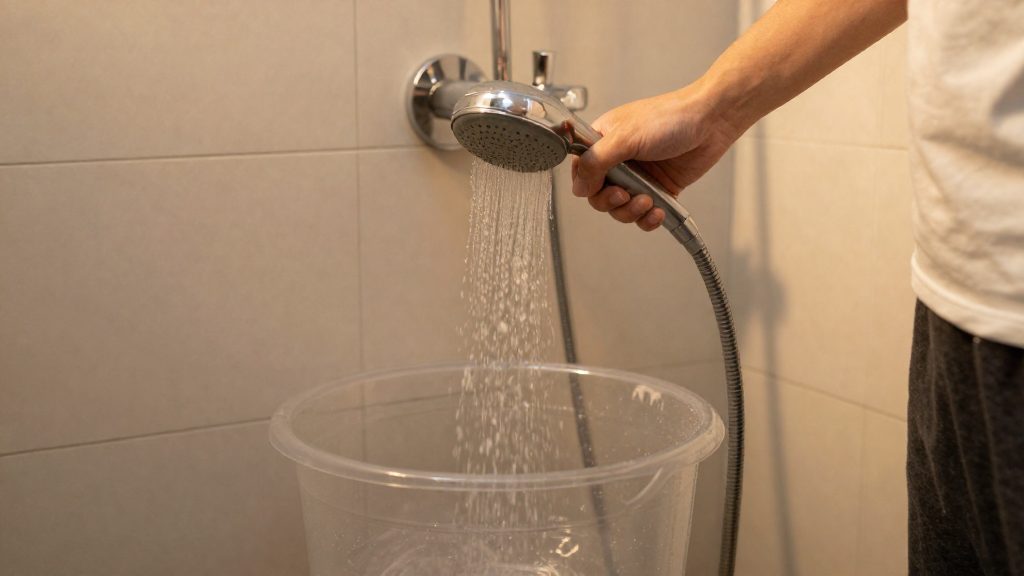
A typical shower uses roughly 47.5 litres of water when the head runs at 9.5 litres per minute for the five-minute average shower described by the County of Kings. A Water Research Foundation study covering households in the United States and Canada reports an average of about 60 litres per shower, lasting 7.7 minutes at about 7.9 litres per minute. Your own figure depends on only two numbers: the flow rate of your showerhead and how long the water runs. Multiply them and you have your litres.
How many litres does a shower use?
The official sources consulted do not give a single national average for showers in Canada. The County of Kings, in Nova Scotia, uses a standard head rate of 9.5 litres per minute and a five-minute average shower, which sends just under 50 litres down the drain. The Water Research Foundation’s 2016 study, which included 762 households in the United States and Canada, found an average shower of about 60 litres, lasting 7.7 minutes at about 7.9 litres per minute, as summarised on Wikipedia. Because that sample is not Canada-only, treat 60 litres as a benchmark rather than a Canadian statistic. Most of the gap between the two results comes from shower length: five minutes in one case, 7.7 minutes in the other.
For scale, Statistics Canada (2022) reports that residential water use per person per day fell 14% between 2011 and 2019, to 215 litres. That total covers drinking, cooking, laundry, toilets and every other household use, so a single 47.5-litre shower is about a fifth of one person’s daily average. The same Statistics Canada article reports that 52% of households used a low-flow showerhead. The year is not stated directly, but the passage follows its 2019 data.
How do you calculate litres per shower?
Use this formula:
flow rate (litres per minute) × shower time (minutes) = litres per shower
Flow rate comes from the showerhead and, to a lesser degree, from your water pressure. Shower time is the period the water is actually running over you, not the total time you spend in the bathroom.
Take a family of four who each shower once a day, using a standard head at 9.5 litres per minute for five minutes:
- Step 1: 9.5 × 5 = 47.5 litres per shower.
- Step 2: 47.5 × 4 = 190 litres per day for the household.
- Step 3: 190 × 365 = 69,350 litres per year, or about 69.4 cubic metres.
With a showerhead rated at 7.0 litres per minute and the same five minutes, the same family uses 35 litres per shower, 140 litres per day and 51,100 litres per year. The head alone accounts for a difference of 18,250 litres a year.
One caveat applies to the example. The Water Research Foundation sample averaged about 12.4 showers per week across households of 2.65 people, which is well under one shower per person per day. If your household showers less often, scale the yearly total down accordingly. If you use the 60-litre average instead, the same four people would use 240 litres per day, but that figure describes an average sample, not your home.
What is the flow rate of your showerhead?
Check the flow rate printed on the showerhead, on its packaging or in the manufacturer’s documentation. If no figure is available, measure it with the bucket test described below. Two reference points are useful:
- Federal limit for new products: Natural Resources Canada sets a maximum of 7.0 litres per minute (1.8 US gallons per minute), measured at 552 kPa (80 psi), for showerheads manufactured on or after July 1, 2026. An IAPMO press release confirms the same limit and effective date.
- Older standard: the County of Kings uses 9.5 litres per minute as the rate for a standard head, which is about 2.5 US gallons per minute. Showerheads installed before the change may still run at or near that rate.
The Natural Resources Canada page ties the requirement to the manufacturing date. The official page consulted does not say what it means for showerheads already installed in a home, so a fitting’s age is not a reliable guide to its flow. Measure it.
Why does shower length change the total so much?
Each minute adds litres at the head’s flow rate. At 9.5 litres per minute, every minute adds 9.5 litres; at 7.0 litres per minute, every minute adds 7.0 litres. A 7.7-minute shower at 9.5 litres per minute therefore uses about 73 litres, while a five-minute shower at the same rate uses 47.5 litres.
If your showers regularly run past the five-minute average, time is the variable you control most directly. The County of Kings recommends pairing a low-flow head with a time limit. Any timer works, including a kitchen timer or a phone. Set a target, check your usual time for a week, and adjust.
How do you measure your own shower with a bucket?
This test takes a few minutes and gives you the flow rate at your actual pressure.
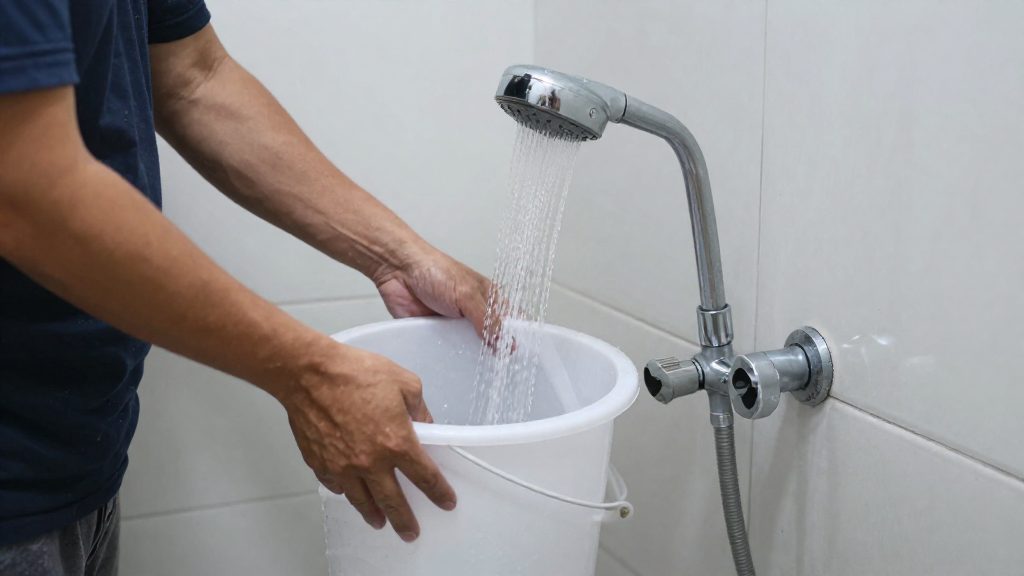
- Choose a container with a known volume, such as a 10-litre bucket with a marked line at 10 litres. If you have no marked container, fill a known volume and pour it into a measuring jug.
- Run the shower at your usual temperature and pressure. Do not change any setting for the test.
- Hold the container under the spray, start a timer when the water hits it, and stop when the level reaches 10 litres. Record the seconds.
- Calculate: 10 × 60 ÷ seconds = litres per minute. For example, 80 seconds gives 7.5 litres per minute.
- Repeat the test twice, average the results, and multiply by your usual shower time to get litres per shower.
Safety comes first during the test:
- Check the water temperature with your hand before you hold the container in the spray. Keep your hands clear of the hot-water side of the mixing valve, and do not adjust the water heater to run the test.
- Stand firmly in the tub or shower, because the surface is slippery when wet. Do not climb on the edge or stand on a stool to reach the head.
- A 10-litre container weighs about 10 kilograms when full. Empty it into the tub, or use a smaller container and repeat the fill, to avoid straining your back.
- If you have an electric shower, its flow is set by the unit. Check the manufacturer’s documentation for its rated flow before testing, and do not open the unit.
- Stop immediately if the water becomes too hot or you feel unsteady.
Frequently asked questions
Does water pressure change the flow rate?
Yes. The federal figure is measured at 552 kPa (80 psi), so a showerhead can run differently at your home’s pressure. The bucket test gives the flow at your actual pressure, which is the number to use in the formula.
Does an electric shower follow the same formula?
The formula still applies, but the official sources consulted do not give flow figures for electric showers. Use the rated flow in the manufacturer’s documentation or measure it with the bucket test.
How do I estimate how much water a bath uses?
The official sources consulted do not give a bath volume. Time how long your tap takes to fill a 10-litre container to find its flow rate, then multiply by the minutes the tap runs to fill the tub.