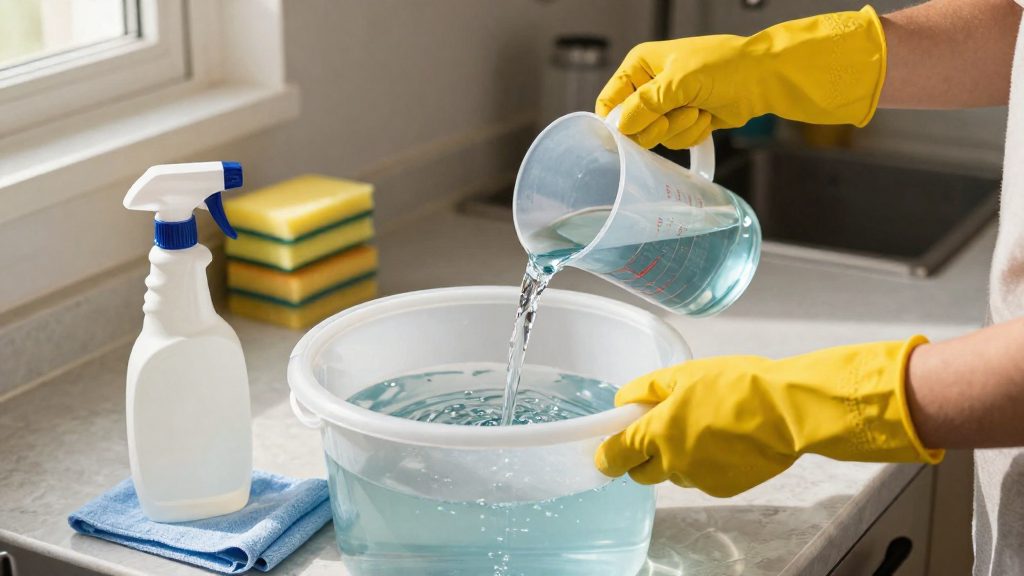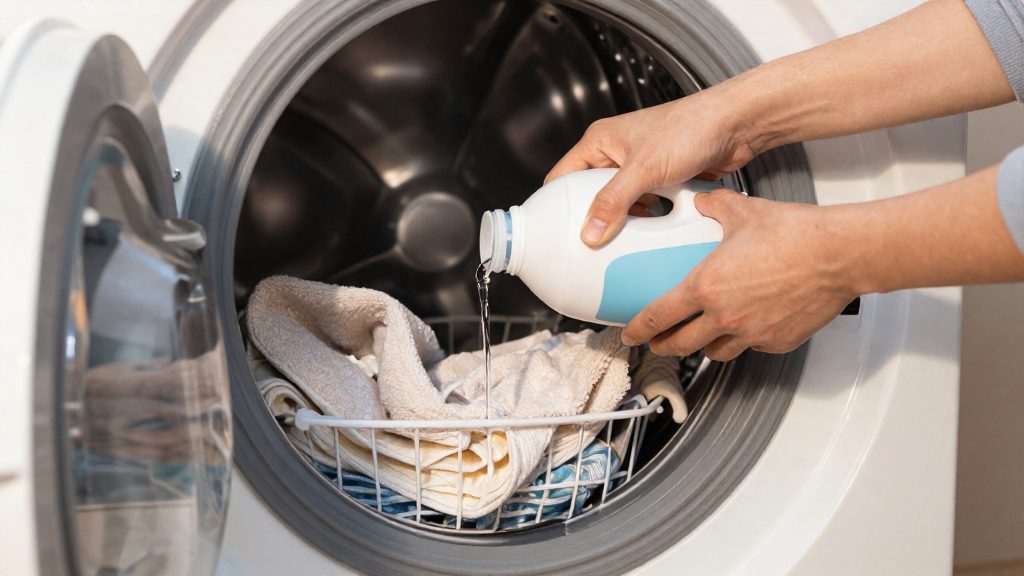
There is no single correct amount of laundry detergent for every load. The dose depends mainly on the product’s concentration, the size and soil level of the load, the hardness of your water and the type of washer you use. For a concentrated liquid, the bottle usually gives you the answer: divide the bottle size in fluid ounces by the number of loads printed on the label, then read the matching dose range. A 2X liquid, for example, falls between 44.4 and 73.6 ml per load. The sections below explain how to check that figure against your machine, your water and your clothes.
How do you work out the dose from the label?
Many concentrated liquids state their concentration, such as 2X or 3X, on the bottle. When the label does not give one, use the arithmetic method. The product help documentation of one washer manufacturer describes it like this:
bottle size in fluid ounces ÷ number of loads on the label = fluid ounces per load
Then match the result to the concentration row:
- 1.5 to 2.49 fl oz per load (2X): 44.4 to 73.6 ml
- 0.9 to 1.49 fl oz per load (3X): 26.6 to 44.1 ml
- 0.7 to 0.89 fl oz per load (4X): 20.7 to 26.3 ml
- 0.5 to 0.69 fl oz per load (5X): 14.8 to 20.4 ml
- 0.3 to 0.49 fl oz per load (6X): 8.9 to 14.5 ml
This table comes from a single manufacturer’s documentation for a washer with a bulk dispenser. Treat it as a method rather than a universal table, and check your own bottle’s instructions, because the official sources consulted do not set a national dosing table for consumer detergents. If your measuring cap is marked in millilitres, measure to the figure that matches your range.

Why does concentration change the dose?
Concentration describes how much cleaning ingredient a product contains in each millilitre. A more concentrated product needs a smaller measure, which is why a 6X dose is much smaller than a 2X dose. On a washer with a bulk dispenser, the concentration setting changes the size of each dose; it does not change how many doses the machine dispenses. The manufacturer’s guidance is simple: if cleaning is poor, choose a lower concentration number, which dispenses a larger dose. If there are excess suds, choose a higher number. The steps for changing the setting are in the control panel menu described in your manual.
Worked example: a 40 fl oz bottle with 20 loads
Suppose a liquid bottle holds 40 fluid ounces and its label says 20 loads. Dividing 40 by 20 gives 2.0 fl oz per load. That result falls in the 1.5 to 2.49 range, so the product is treated as a 2X liquid, with a dose of 44.4 to 73.6 ml. Two fluid ounces is about 59 ml, which sits inside that range. For a first test in a standard load of lightly soiled clothes, use about 44 ml, the bottom of the range, and check the results after a full cycle. If the clothes come out dull or dingy, move toward the top of the range or, on a bulk dispenser, set a lower concentration number. If you see excess suds, use less.
When does an HE washer need less detergent?
High-efficiency washers use less water per cycle than standard machines, so the detergent has less water to work in. Natural Resources Canada states that an ENERGY STAR certified clothes washer uses 33% less water than a standard model and 25% less energy, on average. Detergents sold for HE machines are formulated to produce fewer suds, which suits a machine that uses less water. Look for HE or high-efficiency wording on the bottle and follow the washer manual. Using a regular detergent in an HE machine can produce too many suds, so if your manual specifies HE detergent, use only that product. The official sources consulted do not give a universal HE dose in millilitres, so the label and manual are the reference.
How do load size and water hardness change the dose?
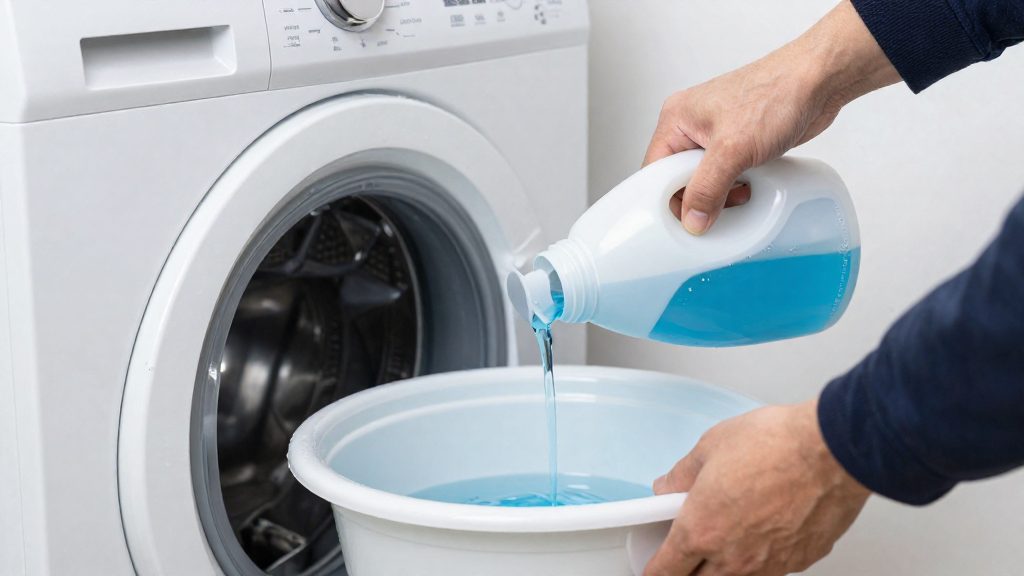
Load size is the simplest factor. A small load of lightly soiled clothing needs less detergent than a full load of heavily soiled work clothes, so adjust within the range rather than always using the same measure. Water hardness matters more than many people expect. Hard water contains more calcium and magnesium, which bind with detergent and reduce its cleaning power, so harder water generally calls for more detergent and softer water for less. Hardness varies across the country. Your municipal water utility can tell you the hardness of your supply, and the product’s own instructions often show how to adjust the dose for it. The official sources consulted do not give a national hardness scale for laundry, so your local water report is the best starting point.
What are the signs you are using too much?
Excess detergent shows up in a few ways. Foam still present in the drum at the end of the rinse, or suds that spill from the dispenser, means the dose is too high for the machine and the water. Residue on dark clothes, a stiff feel on towels and a musty smell from the drum or dispenser drawer can also point to product that is not rinsing away. Check the dispenser drawer and the door seal for buildup, and wipe them dry after washing. If you see these signs, reduce the dose first. If cleaning is poor and suds are not the problem, try a lower concentration setting before adding more detergent.
How should you store detergent safely?
Keep all laundry detergent, including single-dose packs, in a locked cabinet or drawer, out of reach of children. Health Canada’s notice on miniature detergent packs, posted on 20 August 2013 and now archived, advises storing them this way and suggests a child safety latch as an alternative. The notice warns that brightly coloured packets with a soft, squishy texture attract young children, and that a child who swallows a pack may have severe abdominal pain, vomiting or breathing difficulty. Keep products in their original containers, never in food or drink containers, and keep measuring caps clean and dry between uses.
Frequently asked questions
Can I use the same dose chart for powder laundry detergent?
The chart above applies to concentrated liquids labelled by concentration. Powders are usually measured by weight or by a scoop, so follow the instructions on the package, because the official sources consulted do not give a powder conversion.
Does a cold-water wash need a different amount of detergent?
The official sources consulted do not specify a cold-water dose. Check the product’s instructions for cold-water use and the washer manual for the cycle you choose.
Can I use laundry detergent in a dishwasher?
No. Dishwasher and laundry products are formulated differently, so use only the product made for each appliance.
What should I do if a child swallows a detergent pack?
Contact your provincial poison centre or emergency services right away, and keep the packaging so the product can be identified.