
What a serving means on the label
Every Nutrition Facts panel is built around one serving, but a serving is not a recommendation. The U.S. Food and Drug Administration explains that serving sizes are set by law based on the amount people typically eat, not on how much they should eat. Each serving appears as a common household measure, such as a cup, tablespoon, piece, slice or jar, followed by its weight in grams. Every calorie and nutrient on the panel refers to that one serving.
For one person, this has two practical consequences. First, if a package holds four servings and you finish it, you have eaten four servings, so you must multiply the per-serving calories and nutrients by four. Second, some labels show a second column for the whole package. If you plan to eat everything in one sitting, read that column instead of doing the multiplication yourself.

Start from your daily target, not from the package
The Dietary Guidelines for Americans, published on realfood.gov by the U.S. Department of Agriculture and the Department of Health and Human Services, describe a flexible framework rather than fixed meals. The current guidance lists daily targets of 3 servings of vegetables, 2 servings of fruit and 2 to 4 servings of whole grains for adults. For protein, it gives a range of 1.2 to 1.6 grams per kilogram of body weight per day.
The protein range is easy to convert into a personal number. Take a 70 kg adult. At 1.2 g per kg, the daily target is 84 g; at 1.6 g per kg, it is 112 g. If you spread that across three meals, each meal carries roughly 28 to 37 g of protein. These are general figures. If you have a kidney condition, diabetes or another health issue, or if you are pregnant, ask your doctor or a registered dietitian before you set a target.
A simple calculator for any food
You can work out the portion for almost any food with four steps.
- Set the daily target for the food group, such as protein or vegetables.
- Split it across the eating occasions you actually have. Divide the daily target by the number of meals and snacks where that food appears.
- Read the household measure and gram weight on the label to know what one serving looks like and weighs.
- Count the servings you need. For a nutrient, divide your per-meal target by the amount of that nutrient in one serving.
Here is an illustration with made-up label figures. Suppose one serving of a food lists 10 g of protein, and your per-meal target is 28 g. Divide 28 by 10 to get 2.8 servings. Round to the nearest practical amount, which here is about three servings, and then check how the result fits the rest of your day. Always use the numbers printed on your own label, because they differ from product to product.
Measuring without wasting food
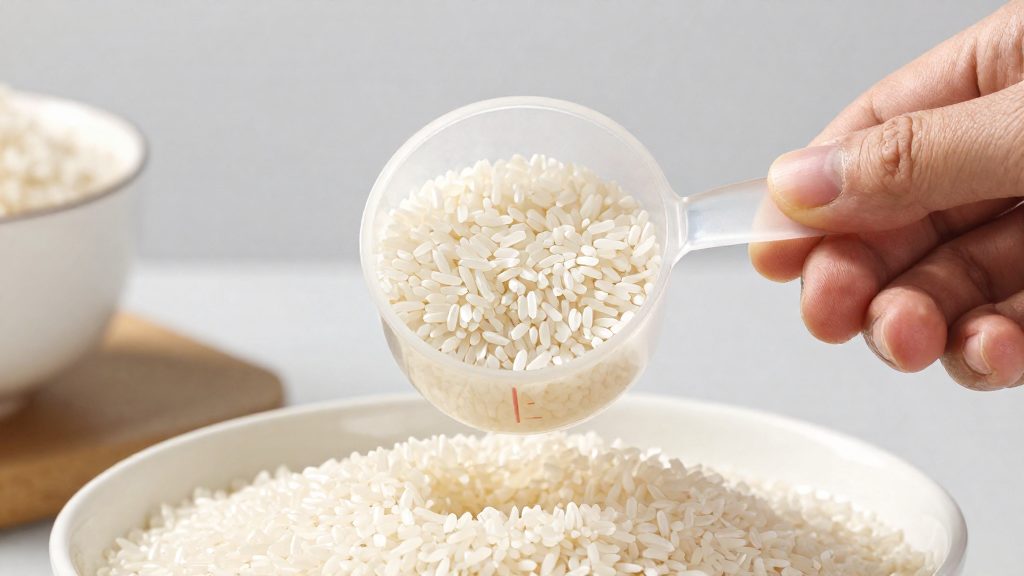
Use a kitchen scale for the first few weeks. Scales are more accurate than cups for loose foods such as rice, cereal, nuts or grated cheese, because the same cup can hold quite different weights depending on how the food was packed. Check whether the label weight refers to the food as sold or as prepared, since cooking changes weight, mostly through water loss. Weigh your food the same way every time, either raw or cooked, and use the same method when you compare with the label.
Hand-based or eyeball estimates can help when you are away from home, but they vary a lot with hand size and appetite. Calibrate your eye once with the scale, then recheck from time to time.
Cooking for one without leftovers going bad
Cooking for one often means leftovers. Cool them quickly and keep them safe. The USDA Food Safety and Inspection Service advises refrigerating perishable food within 2 hours of cooking or serving. If the room is above 90 °F, the limit drops to 1 hour. Spread hot food in shallow containers so it cools faster, rather than leaving a large pot to cool slowly. Reheat leftovers until they reach 165 °F. Refrigerated leftovers are generally best eaten within 3 to 4 days. Portion the rest into freezer-safe containers as soon as they cool, label them with the date, and use them within a few months for the best quality.
Discard any food that has been left out longer than the safe window, even if it looks and smells fine. Tasting food to check it is never a safe test.
When a standard portion does not fit you
The calculations above help you plan, but they do not replace individual advice. Very active people, people recovering from illness and older adults can have different needs. People with diabetes, kidney disease, heart conditions or a history of an eating disorder should adjust portions only with their care team. Likewise, if you take a medicine that interacts with certain foods, follow the advice you were given about those foods rather than changing your portions on your own.
Review your portions every few months. If your weight, activity level or appetite changes, redo the four steps with your new numbers. Keep the same method and only update the inputs.
Frequently asked questions
Why does a label serving look smaller than what I usually eat?
Because the serving size is set by law from typical consumption, a single serving can look small or large depending on the product. Multiply the calories and nutrients by the number of servings you actually eat.
Can I use the adult daily targets for a child or teenager?
No. The daily targets in the body are for adults. Children and teenagers have different needs, so ask a pediatrician or dietitian before you set their portions.
Should I weigh every meal forever?
Not necessarily. Weigh your food for a few weeks to learn what a portion looks like, then check your estimates from time to time with the scale.
Is it safe to eat leftovers from a recipe I cooked days ago?
Only if they were cooled, refrigerated and reheated according to the timings in the body. If the food was left out too long or stored past the safe window, throw it away.