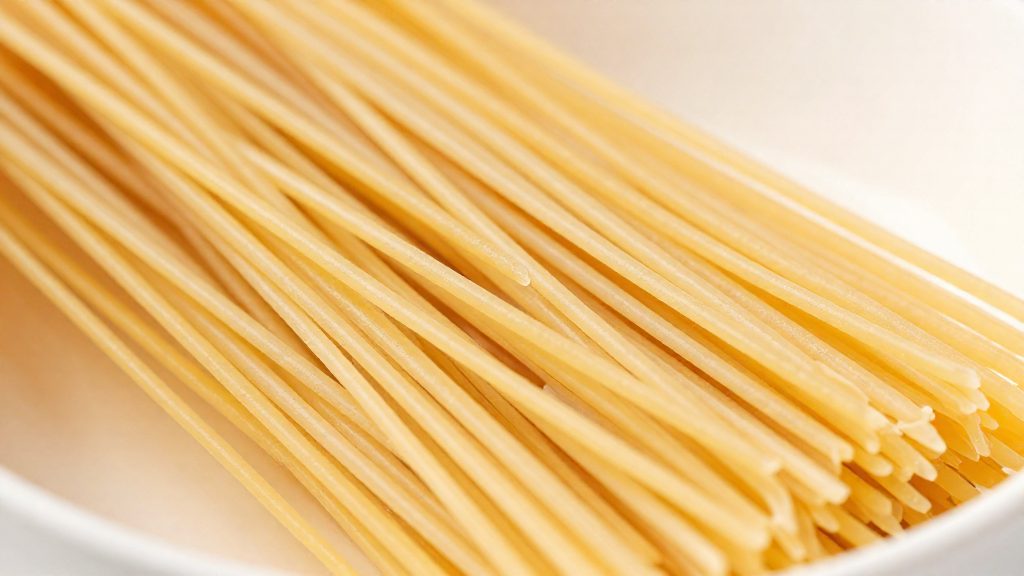
How much dry spaghetti per adult?
When spaghetti is the main dish, plan 2 ounces (56 grams) of dry pasta per adult. That is the standard amount. If pasta is the only main dish and your guests are hungry, plan 3 ounces (85 grams) instead.
The 2-ounce figure lines up with the U.S. Food and Drug Administration’s labeling reference. Under 21 CFR 101.12, the reference amount for plain pasta is 55 grams dry, or 140 grams once prepared, and the household measure for dry spaghetti is 2 ounces (56 grams). Those amounts come from national food consumption surveys. They are a labeling convention that describes what people commonly eat in one sitting. They are not a recommendation for your dinner, but they give you a sound starting point.
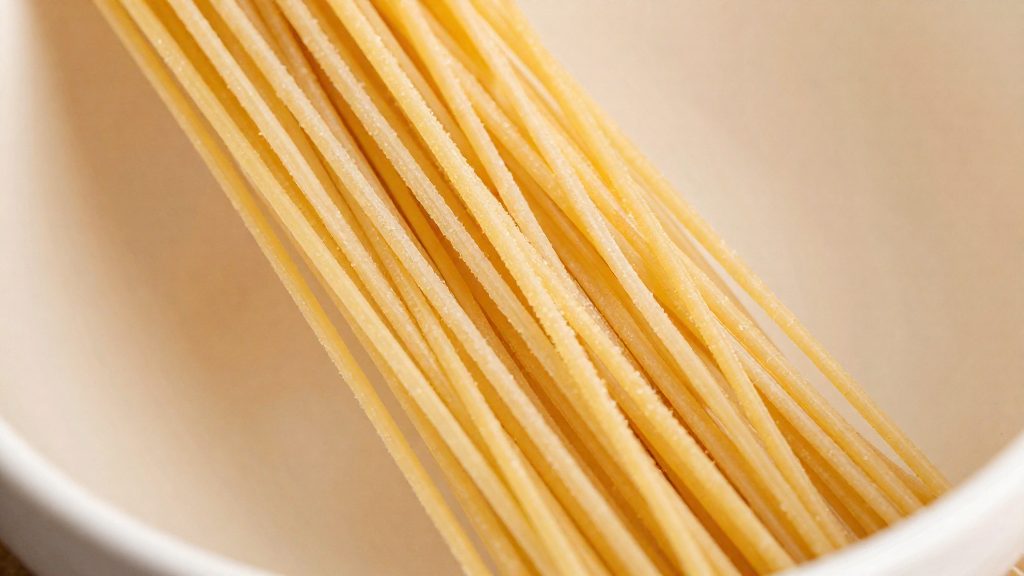
Why dry weight matters more than cups
Dry spaghetti grows as it cooks, and the cooked volume depends on how you measure it. Use weight to buy and divide, and use cooked volume only to check that your pot and serving dishes are big enough.
Two reference points help. The USDA’s FoodData Central record for cooked enriched spaghetti (without added salt) lists 1 cup of spaghetti not packed at 124 grams, and 1 cup packed at 151 grams. Packing the cup can therefore add about 22 percent more food by weight. The New Mexico State University extension table In a Pinch Food Yields says that 1 pound of spaghetti cut into 2-inch pieces yields 9 to 10 cups cooked.
The USDA’s MyPlate guidance, in an archived 2011 copy, treats ½ cup of cooked pasta as 1 ounce dry in the grains group, so 1 cup cooked equals 2 ounces. That is a nutrition equivalent, not a cooking yield. For planning how much to cook, the extension table gives a more realistic picture: 2 ounces of dry spaghetti produces about 1 to 1¼ cups cooked.
Step-by-step calculation
- Count your adults. Count teenagers as adults if they eat like adults. Count young children separately and plan less for them, adjusting to their appetite.
- Multiply by the amount per person. Use 2 ounces for the standard plan or 3 ounces for the hearty plan.
- Convert to grams if needed. One ounce equals about 28.35 grams.
- Round to your package size. A standard package is often 1 pound (16 ounces, or 454 grams). Check the net weight printed on your package, because sizes vary.
- Check the cooked volume. Multiply the dry ounces by the cooked yield (about 0.56 to 0.63 cup per ounce, from the 9 to 10 cups per pound figure) to confirm your pot will hold the result.
Quick reference for common group sizes
| Adults | Standard plan (2 oz each) | Hearty plan (3 oz each) |
|---|---|---|
| 4 | 8 oz (227 g), about 4½ to 5 cups cooked | 12 oz (340 g), about 6¾ to 7½ cups cooked |
| 6 | 12 oz (340 g), about 6¾ to 7½ cups cooked | 18 oz (510 g), about 10 to 11¼ cups cooked |
| 8 | 16 oz (454 g), about 9 to 10 cups cooked | 24 oz (680 g), about 13½ to 15 cups cooked |
| 10 | 20 oz (567 g), about 11¼ to 12½ cups cooked | 30 oz (851 g), about 17 to 18¾ cups cooked |
Worked example: six adults
Say you are feeding six adults with a tomato sauce, a green salad, and bread. Pasta is the main dish, but the salad and bread add to the meal, so the standard plan fits.
Six adults at 2 ounces each is 12 ounces, or 340 grams of dry spaghetti. That cooks to about 6¾ to 7½ cups, enough for six 1-cup portions with a little left over.
Now suppose you are serving spaghetti alone, with no salad or bread, to hungry guests. Six adults at 3 ounces each is 18 ounces, or 510 grams. That cooks to about 10 to 11¼ cups. Cook it in batches if your pot cannot hold that volume comfortably, and keep the batches warm, as described below.
The sauce is separate from the dry weight. Plan it from your recipe, not from the pasta figure.
What changes the amount
- Other starches. Bread, potatoes, rice, or a starchy dessert mean guests will eat less pasta. Use the standard plan.
- Rich or heavy sauce. A very rich meat sauce can satisfy guests sooner. If the sauce is the star, the standard plan is usually enough.
- Whole-grain or gluten-free spaghetti. Cooking time and yield can differ from regular spaghetti. Follow the cooking chart printed by the pasta maker, and weigh the dry amount rather than trusting a cup measure.
- Packing. Long spaghetti packs loosely or tightly depending on how you fill the cup. Weighing avoids that difference.
Cooking and serving safely
Boiling water causes serious burns. Fill the pot only as full as you need, turn the handles inward so no one bumps them, and use dry, thick oven mitts. Drain pasta in a colander set in the sink, pouring away from your face and hands to avoid the steam.
Keep cooked spaghetti hot and covered until you serve it. Do not leave cooked pasta or sauce at room temperature for more than 2 hours. This is the same limit that applies to leftovers.
For leftovers, refrigerate them within 2 hours of cooking, or within 2 hours of removing them from a warming appliance. Spread the pasta and sauce into shallow containers so they cool quickly. Refrigerated leftovers keep for 3 to 4 days. Reheat them until they reach 165°F, measured with a food thermometer in several spots, and bring sauce to a rolling boil before serving. If the pasta has been left out too long or has an off smell, discard it.
Frequently asked questions
Can I cook the spaghetti ahead of time for a party?
Cook it as close to serving time as you can. If you must cook ahead, cool it promptly, store it in shallow containers, and reheat it fully using the safety steps above.
How do I measure 2 ounces without a scale?
A kitchen scale is the most reliable tool. Without one, divide the net weight printed on the package by the number of guests, and check the pasta maker’s cooking chart for the yield.
Should I plan less pasta for children?
Usually yes, but the right amount depends on age and appetite. Start with a smaller portion and let children ask for more, rather than measuring a fixed amount.
Does the amount change when the pasta is baked with cheese?
Baked pasta dishes are often served as a main on their own, so the planning depends on the rest of the menu. Check the recipe’s yield and serving count, and compare it with the guest count.