For a 200 sq ft floor laid with 12 × 12 in tiles in a straight grid, you need 200 tiles before allowing for cuts and breakage, and about 220 tiles once a 10% waste allowance is added. That 220 is the figure to convert into boxes, and the box count depends on how many square feet each box covers. The steps below explain how to get the number, how it changes with tile size and layout, and how to round up to whole boxes.
How do you calculate the number of tiles?
Start with the room area. Multiply length by width in feet: a room measuring 20 ft by 10 ft is 200 sq ft, and so is one measuring 16 ft by 12.5 ft. Then divide that area by the area of one tile. To find a tile’s area, convert each side from inches to feet by dividing by 12, then multiply the two sides.
The basic formula is: number of tiles = room area ÷ area of one tile. The result is rounded up to the next whole tile, because any partial tile still has to be cut from a whole one. A flooring guide published in October 2025 gives this method and the same rounding rule.
For a 12 × 12 in tile, each side is 1 ft, so the area is 1 sq ft and 200 sq ft needs 200 tiles. For a 6 × 6 in tile, each side is 0.5 ft, so the area is 0.25 sq ft and the same floor needs 800 tiles. Tile size therefore changes the count far more than most people expect, as the table further down shows.
Why add a waste allowance?
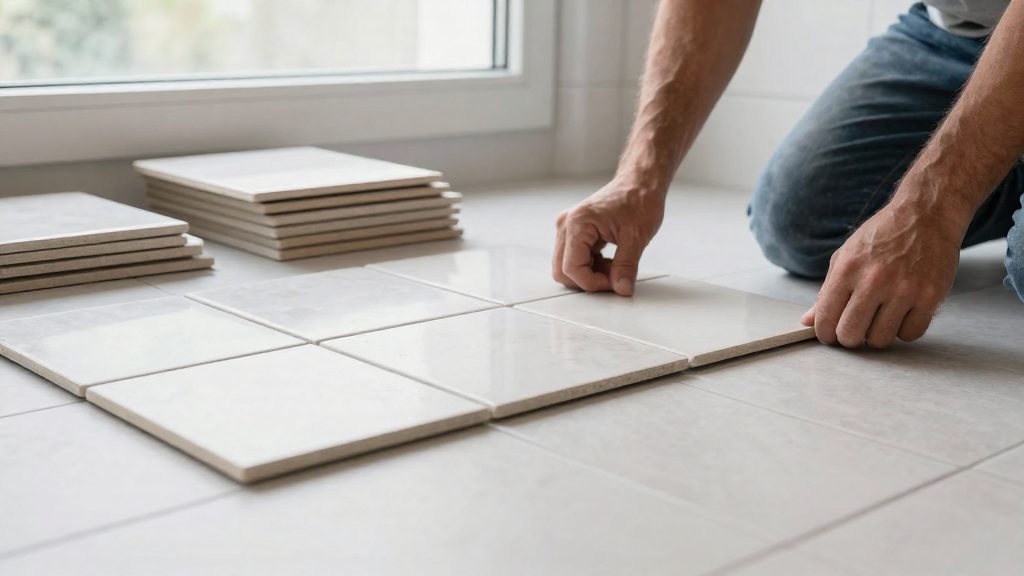
The base count assumes every tile is used whole. In practice, tiles are cut along walls, around doorways and into corners, and some break during handling or cutting. A tile manufacturer’s guide describes the base figure as the minimum to buy and recommends adding a percentage on top. The calculation is: base count × (1 + waste rate) = total tiles to order.
The guides consulted do not agree exactly on the percentages, so compare the ranges before choosing one:
| Layout or tile type | Tile manufacturer’s guide | Flooring guide (2025) |
|---|---|---|
| Straight grid | 10% | 5% to 8% |
| Diagonal | 15% | 10% to 15% |
| Herringbone | 18% to 20% | Not stated |
| Mosaic or small tile | Not stated | 10% to 20% |
| Natural stone | Not stated | 10% to 15% or more |
| Large format | Standard allowance plus 5% | 5% to 8% |
For a straight layout with 12 × 12 in tiles, the 10% figure sits above the flooring guide’s range and matches the manufacturer’s figure, which leaves a margin for breakage. Where a tile maker publishes pattern-specific guidance for its own product, that guidance takes priority over any general percentage, including the ones in this article.
How does the 200 sq ft example work with 12 × 12 in tiles?
- Base count: 200 sq ft ÷ 1 sq ft per tile = 200 tiles.
- Add waste: 200 × 1.10 = 220 tiles.
- Convert to boxes: assume the box label states 10 sq ft per box. 220 ÷ 10 = 22 boxes, exactly.
If the same room were laid diagonally, use 15%: 200 × 1.15 = 230 tiles, which is 23 boxes at 10 sq ft each, one box more than the straight layout. The 10 sq ft per box is an example value. Coverage varies by product, so read the figure from your own box before you order.
How many boxes should you buy?
Tiles are sold by the box, and each box states its coverage in square feet and the number of pieces it contains. Divide the total tiles needed, including waste, by the coverage per box, and always round up. For example, if a job needs 225 tiles and each box holds 10, the answer is 22.5, which means 23 boxes. Rounding down would leave you short partway through the job.
200 sq ft is about 18.6 square metres (200 × 0.0929), so if your box label gives metric coverage, run the same division with those figures.
Buy the whole order at once and from one production batch. Colour and finish can vary slightly between batches, so a second order placed later may not match the first.
Does tile size change the count?
Yes, substantially. Each row below applies the same method to 200 sq ft:
| Tile size | Area per tile | Base count | Waste used | Total with waste |
|---|---|---|---|---|
| 6 × 6 in | 0.25 sq ft | 800 | 10% | 880 |
| 12 × 12 in | 1 sq ft | 200 | 10% | 220 |
| 18 × 18 in | 2.25 sq ft | 89 | 10% | 98 |
| 24 × 24 in | 4 sq ft | 50 | 15% | 58 |
For 18 × 18 in tiles, the base count is 88.9, rounded up to 89, and the total is 97.8, rounded up to 98. For 24 × 24 in tiles, the 15% comes from the manufacturer’s rule of adding 5% to the standard 10% for large tiles, and 57.5 rounds up to 58. Small tiles and mosaics need more waste because each piece brings more joints and cuts, and the flooring guide places them at 10% to 20%.
What if the room is not a simple rectangle?
Split the floor into rectangles, measure each one, and add the areas. An L-shaped room of 12 ft by 10 ft, plus an alcove of 6 ft by 4 ft, has 120 + 24 = 144 sq ft. With 12 × 12 in tiles and 10% waste, 144 × 1.10 = 158.4, which rounds up to 159 tiles. At 10 tiles per box, that is 15.9, so you would order 16 boxes.
Rooms with many corners, alcoves or angled walls usually mean more cuts, so lean toward the upper end of whichever range you chose.
When should you add more than the standard allowance?
Use a higher allowance when cuts are more numerous or the tiles are less forgiving:
- Diagonal or herringbone patterns, where edges need angled cuts.
- Natural stone, where each piece varies in colour and shape.
- Mosaics and small tiles, where each sheet has many joints.
- Large-format tiles, where each cut wastes more area.
- Rooms with many corners, alcoves or angled walls.
If you are installing the tiles yourself for the first time, the sources consulted do not give a figure tied to installer experience. A higher allowance than the minimum is still the safer choice, because a shortfall partway through a job can mean tiles from a different batch.
What should you check before ordering?
- Measure the room twice, wall to wall, and write down both sets of dimensions.
- Confirm the coverage per box on the label or in the tile maker’s documentation.
- Buy the whole order in one batch.
- Plan the lifting: tile boxes can be heavy, so lift with your legs and ask for help with large-format boxes.
- When cutting ceramic or stone, use a wet saw where possible. Dry cutting creates fine dust, so wear eye protection and a dust mask suitable for fine particles.
Frequently asked questions
Can I use leftover tiles from a previous project?
Yes, if they are the same product and batch and are in good condition. Count them against the total before you order. The official sources consulted do not give a rule on this.
How many spare tiles should I keep after installation?
The sources consulted do not specify a retention period. Keeping surplus tiles from the same batch helps with future repairs. Store them dry and follow the tile maker’s storage guidance.
How do I count tiles for a border or feature strip?
Measure the strip as its own area, apply the same formula and a waste rate, and add the result to the main count. The sources consulted do not give a separate rate for borders.
Does the same count work for a bathroom floor with a shower?
The sources consulted do not give a figure for wet areas. Check the tile maker’s installation documentation before choosing an allowance for a shower area.