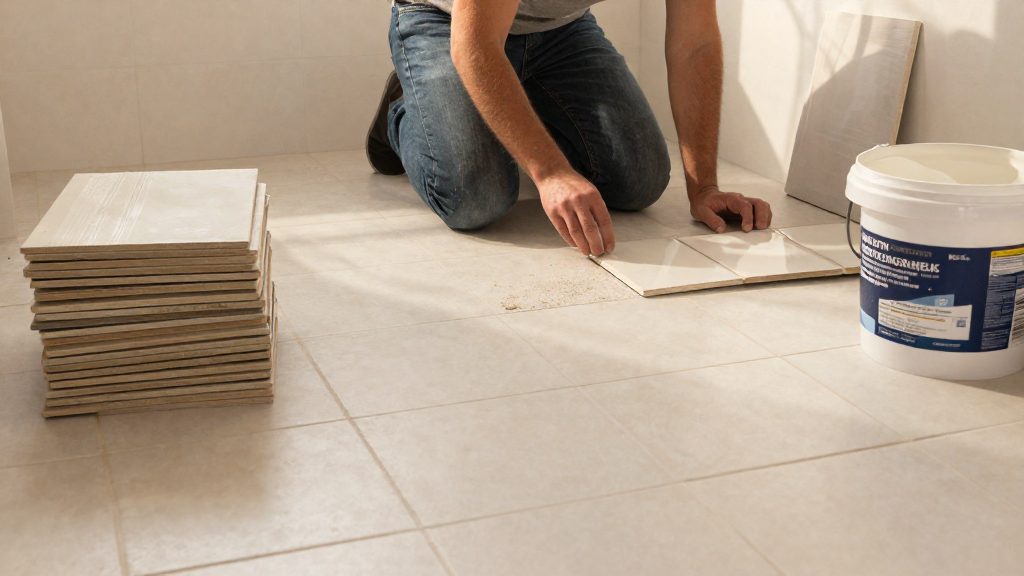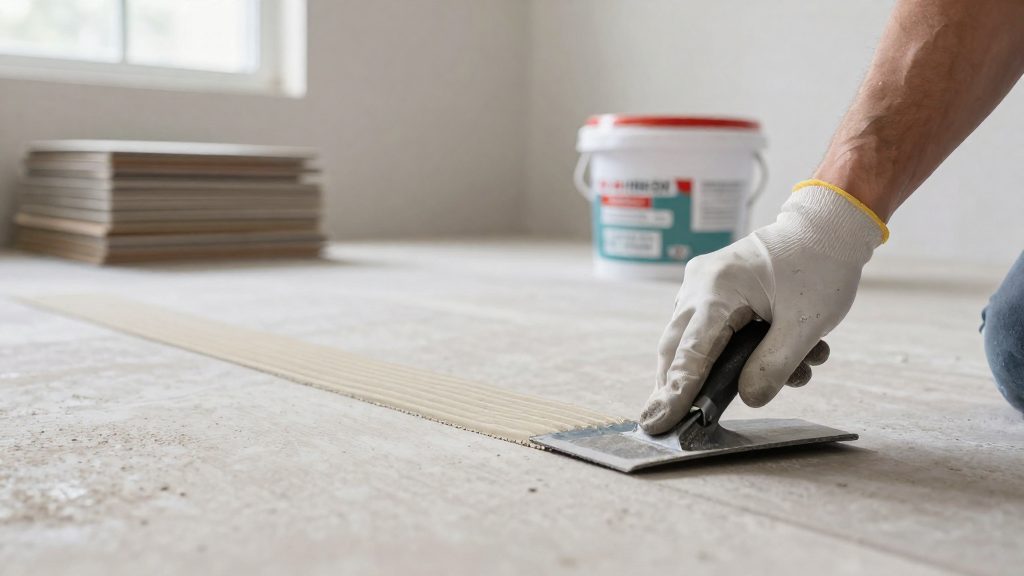
For a bathroom floor, order about 10 to 15% more tile than the measured area. Use 10% only for a plain rectangle with few obstacles, and 15% when a toilet, vanity and tub create many cuts. A diagonal layout starts at 15%, and a mosaic or natural stone accent needs more: 20% on the mosaic and 15% on the field tile in the worked example below. Calculate the area in square metres, apply the percentage, then round up to whole tiles and whole boxes.
How much overage does a bathroom floor need?
Overage, also called waste factor, is the extra tile bought on top of the measured area. It covers cuts, breakage during installation and offcuts too small to reuse. Flooring Clarity (2025) gives ranges by layout: 5 to 7% for a straight layout in a large room, 7 to 10% for a typical residential room with some cuts, 10 to 15% for diagonal or patterned layouts, and 15 to 25% for mosaics, natural stone or tile with high variation. For showers and bathrooms, the same guide advises at least 10 to 15%, because of the many cuts and angles. Small or irregular rooms with many obstacles fall between 10 and 20%.
The official sources consulted do not specify a single overage figure for bathroom floors. The Tile Council of North America publishes an installation handbook that many installers refer to, but the ranges in this article come from a planning guide, not from that handbook. If the manufacturer’s installation instructions for your tile give a waste recommendation, follow it and use the ranges here only as a check.
How do you calculate the tiles to order?
Start with the area to be tiled. Measure the length and width of each rectangle, multiply them, and add the results together. Subtract only areas that will never receive tile, such as the footprint of a shower base or tub set on the floor and not tiled beneath it. Do not subtract the space under a vanity or toilet: it is usually simpler to tile that area before the fixtures are installed.
Then apply the overage with this sequence:
area to be tiled × (1 + overage) = area to order
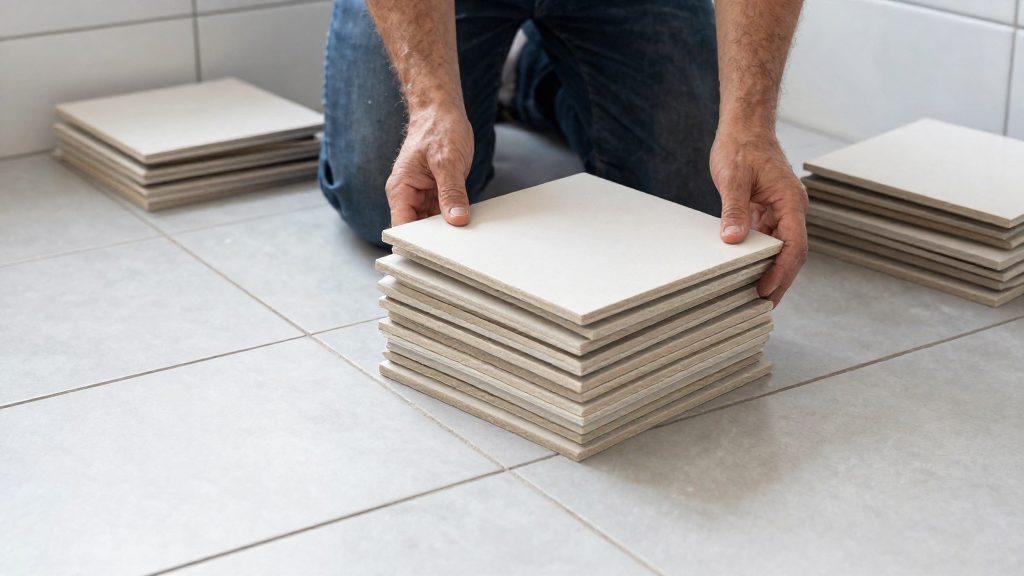
Divide the result by the area of one tile and round up to the next whole tile. Divide that count by the number of tiles in a box and round up again to whole boxes. For a 30 cm by 30 cm tile, one tile covers 0.09 m².
Take a bathroom measuring 1.5 m by 2.4 m (about 5 by 8 feet). Its area is 1.5 × 2.4 = 3.6 m². Without overage, that needs 3.6 ÷ 0.09 = 40 tiles. A 10% margin gives 3.6 × 1.10 = 3.96 m², or 44 tiles. Because this room holds a toilet, vanity and tub, the 15% margin is more suitable: 3.6 × 1.15 = 4.14 m², or 4.14 ÷ 0.09 = 46 tiles to order.
Why do bathrooms need more tile than a simple room?
A bathroom contains far more cut pieces per square metre than a large open room. Each wall corner, door frame, toilet flange and tub edge can require a piece cut to an angle or with a notch. Offcuts that are too small to reuse become waste, and a tight room leaves little space to manoeuvre a tile or a saw, which raises the chance of chipping an edge.
Plan the layout before cutting. Lay out a dry run from the doorway to see where the smallest cuts will fall, and place cut edges under the vanity or against a wall where they are least visible. Cutting tile creates fine dust and sharp edges, so wear eye protection and a dust mask, work in a ventilated room, and use wet cutting where the saw allows it. Follow the saw and tile manufacturer’s instructions for blade type and water use.
Why do mosaics and natural stone need a larger margin?
Mosaics are sold as small pieces fixed to a mesh sheet. A sheet cut to fit a wall, corner or niche wastes more tile than a single piece, and a damaged sheet cannot always be replaced piece by piece. Natural stone adds variation in colour and veining, so more pieces may be rejected for appearance. Flooring Clarity (2025) gives 15 to 25% for mosaics, natural stone and high-variation tile, and its bathroom example uses 20% for mosaic packs and 15% for the field tile.
Take a bathroom with a 0.6 m² mosaic accent strip. Subtract the strip from the floor area first: 3.6 - 0.6 = 3.0 m² of field tile. At 15%, the field tile needs 3.0 × 1.15 = 3.45 m², or 39 tiles of 0.09 m² after rounding up. The mosaic needs 0.6 × 1.20 = 0.72 m² with a 20% margin.
Batch variation affects every tile but matters most here. Tiles from different production runs can differ in colour, sheen, shade, thickness and size. Confirm the lot or batch number when you buy, and keep the surplus from that lot.
When should you keep a spare box?
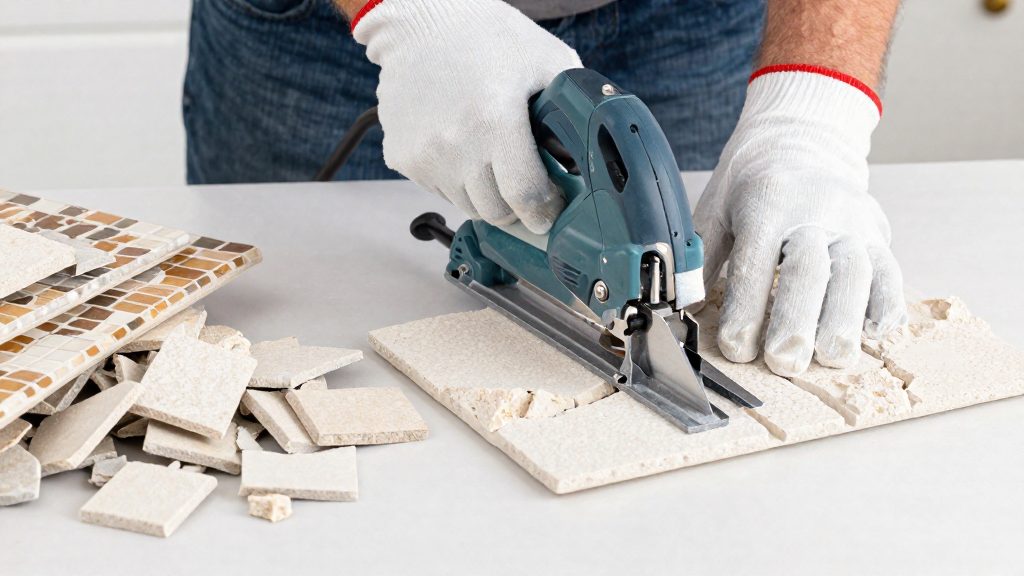
Keep at least one full, unopened box in reserve for future repairs in a small room. Flooring Clarity (2025) advises two or more boxes for large rooms or for tile with high variation. A spare box is the most dependable way to match a replacement tile later, because a new order may differ in shade or size. Count the spare box on top of the calculated order rather than treating it as part of the overage, since the overage is consumed during installation.
Store the box indoors, in a dry place where it will not freeze, and label it with the room, the tile code and the lot number.
What about trim and bullnose pieces?
Trim and bullnose pieces run out faster than field tile and are harder to match, so order them separately rather than taking them from the field count. Measure the total exposed edge length, such as the edges of a tiled step or a shower entry, and divide by the length of one piece. For example, 6 m of exposed edge using 30 cm pieces needs 6 ÷ 0.3 = 20 pieces. Then add the extra pieces you choose, rounding up to whole pieces, and store spare trim with the spare box.
Frequently asked questions
Does this overage apply to bathroom walls too?
The ranges here apply to the floor. Wall tile usually has more openings and niches, so measure each wall separately, subtract the openings and plan a margin for that wall on its own, following the manufacturer’s instructions for the tile you choose.
How much adhesive and grout should I buy?
Those amounts depend on the product, the tile size, the joint width and the substrate. Use the coverage figures given in the manufacturer’s installation instructions.
Can I return unused tile?
Return policies depend on the seller and on whether the tile has been opened or damaged. Read the terms before ordering, and keep the original packaging and receipt.
Can I use an online tile calculator instead?
A calculator is useful only if it accepts your chosen overage percentage and your tile size. Check that it rounds up to whole tiles and whole boxes.