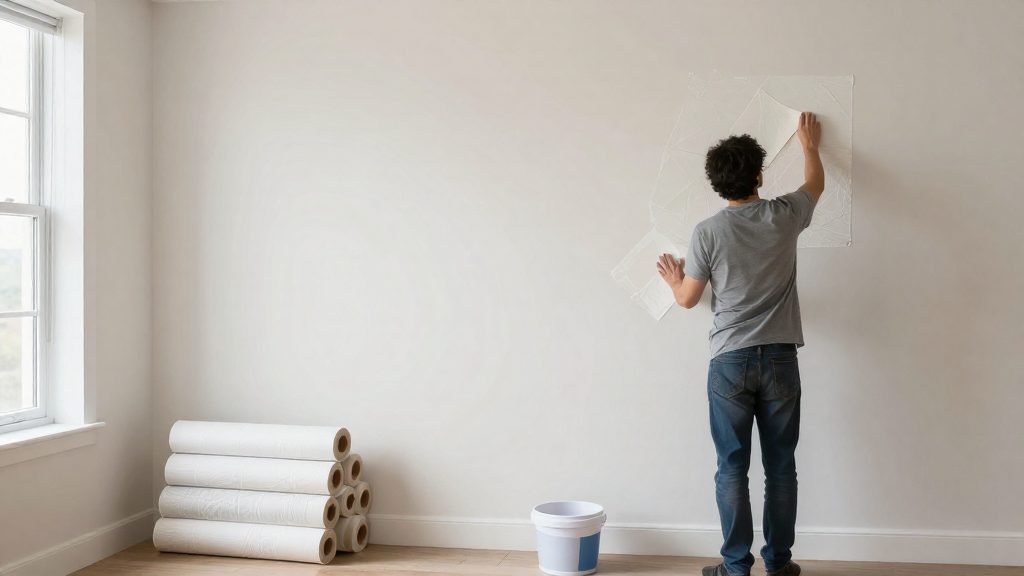
For a 10 ft (3.05 m) ceiling, the roll count depends on the room’s perimeter, not on the height alone. In a 12 ft by 14 ft room, the walls total 52 ft, or 15.85 m. With a standard Euro roll of 10.05 m by 0.53 m, that room needs 10 rolls before any waste margin, and 11 rolls once you add 10% for plain paper. The steps below show how to reach that figure for your own room, why whole strips matter, and what to change for large patterns, openings or North American bolts.
How do you measure the walls for a 10 ft ceiling?
Start with the perimeter, which is the total length of all walls at floor level. Measure each wall from corner to corner, write the figures down in one unit only, and add them. Round the total up rather than down, so that small measuring errors do not leave you short.
The height is the second measurement. A 10 ft ceiling is 3.05 m. A wallcovering maker’s guidance advises adding about 5 cm (2 in) to the room height so that the top edge of each strip can be trimmed without a tight cut (2026). That gives a working strip length of 3.10 m, or about 10 ft 2 in. Write this figure down, because every later step depends on it.
Why does roll size decide the count?
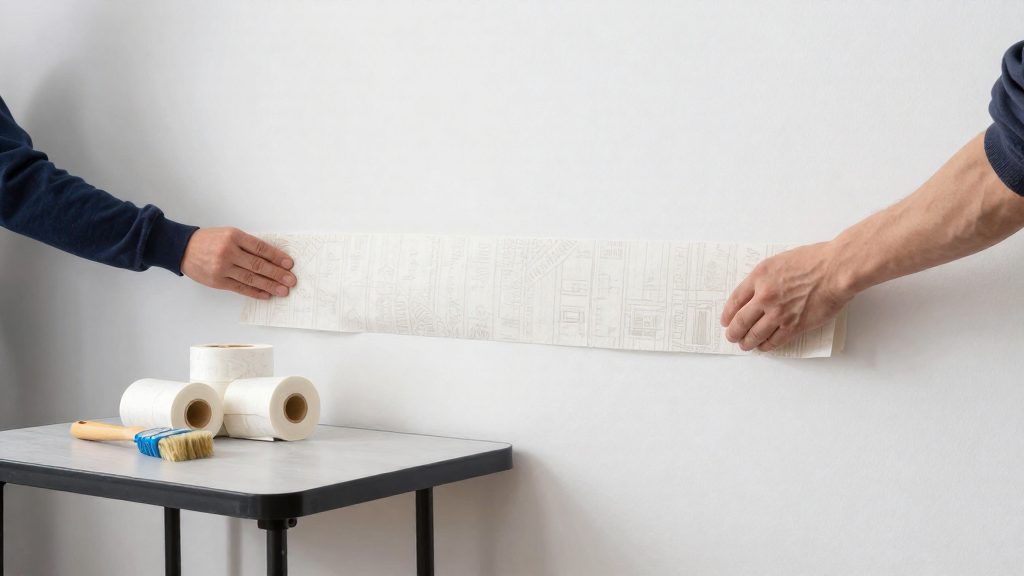
The numbers printed on the roll label matter more than the name on the packaging. A standard Euro roll is 10.05 m long and 0.53 m wide, which covers about 5 m² of wall once you allow for trimming. A North American bolt is 20.5 in wide and 33 ft long, or 56 sq ft, according to a North American wallcovering maker’s calculator (2026).
Each unit system needs its own count. Do not mix a metric width with an imperial length, and do not carry a result from one roll type over to the other. Check the length and width on the label before you start, because the method below uses those two numbers directly.
How do you count strips and rolls?
The calculation has three steps, and you should run them for one roll type at a time.
Step 1: strips = perimeter ÷ roll width, rounded up. For the 52 ft room, 15.85 ÷ 0.53 = 29.9, so you need 30 strips.
Step 2: strips per roll = roll length ÷ strip length, rounded down. For this roll, 10.05 ÷ 3.10 = 3.2, so each roll gives three strips. Three strips use 9.30 m and leave 0.75 m of offcut, which is too short for another 3.10 m strip.
Step 3: rolls = strips ÷ strips per roll, rounded up. For the room, 30 ÷ 3 = 10 rolls.
Some online calculators divide the total wall length by the roll length and stop there. For the 52 ft room, that gives about 9.25 rolls. The difference matters in other rooms. A 50 ft (15.24 m) perimeter gives 28.75 strips, or 8.9 rolls on a continuous calculation, which would round to 9. But each roll yields only three strips, so 29 whole strips need 10 rolls. The published tables from paper makers describe their figures as approximate, so a continuous result can leave you a roll short. Counting whole strips avoids that risk.
Why cross-check with the area method?
A second method gives you a quick check. Multiply the perimeter by the wall height to get the wall area, divide by about 5 m² per roll, round up, and then add 10% for waste (2026). For the 12 ft by 14 ft room, 15.85 m × 3.05 m = 48.3 m². Dividing by 5 gives 9.7, which rounds up to 10 rolls. That agrees with the strip count.
The area method ignores the offcut left on each roll, so it can understate the number of rolls. If the two results disagree, trust the strip count.
When should you add extra rolls for pattern and waste?
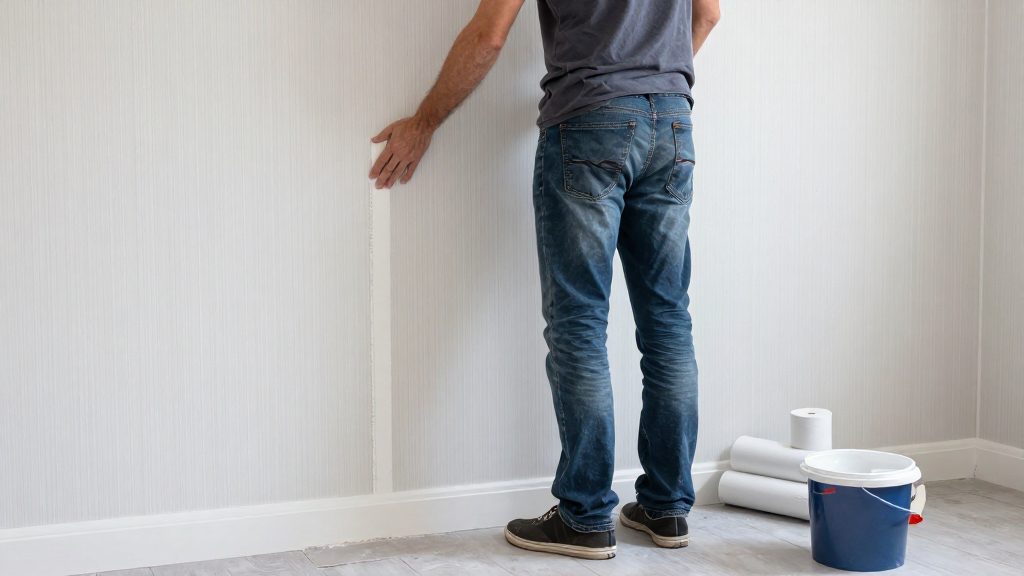
For plain or small-pattern paper, add 10% to the roll count and round up (2026). For the room above, 10 × 1.1 = 11 rolls.
Large patterns waste more. A maker’s guidance warns that you can lose up to a full strip per roll (2026). If every roll loses one strip, each roll gives only two usable strips, and the same 30-strip job would need 15 rolls. The official sources consulted do not give a fixed percentage for large patterns, so take the pattern repeat from the paper maker’s documentation and recount the strips per roll from it.
For spares, the same maker recommends ordering one or two extra rolls from the same batch number, to cover cutting mistakes and to keep colour matched (2026). A second maker recommends one spare roll for later repairs (2026). For plain paper, that means ordering 12 or 13 rolls for the 12 ft by 14 ft room, not the bare 11.
Should you subtract doors and windows?
Only if the chart you are using tells you to. A North American chart deducts one bolt for every four ordinary doors or windows (2026). A European maker handles openings by including spare rolls rather than deducting them (2026), and the official sources consulted do not give a Euro-roll deduction. For a room with two doors and a window, do not subtract. The 10% margin and the spare roll absorb the openings and the trimming waste around them.
What if you are buying North American bolts for a 10 ft ceiling?
The North American chart covers only 8 ft and 9 ft ceilings (2026). The official sources consulted do not give a count for a 10 ft ceiling, so do not apply the 9 ft figure to a taller wall, because that would leave you short at the top of each strip. Ask the manufacturer’s documentation or the seller for a 10 ft count before you order, and check how the bolt length fits a strip of 10 ft plus trimming allowance.
Which quick chart works for a 10 ft ceiling?
The table below applies to Euro rolls of 10.05 m by 0.53 m, with strips of 3.10 m, plain paper, and no deduction for openings. Perimeters are rounded up to the next row, and metric figures are rounded to two decimals.
| Perimeter (ft) | Perimeter (m) | Whole strips | Rolls | Order with 10% margin |
|---|---|---|---|---|
| 30 | 9.14 | 18 | 6 | 7 |
| 40 | 12.19 | 24 | 8 | 9 |
| 50 | 15.24 | 29 | 10 | 11 |
| 60 | 18.29 | 35 | 12 | 14 |
| 70 | 21.34 | 41 | 14 | 16 |
| 80 | 24.38 | 47 | 16 | 18 |
The rolls column is strips ÷ 3, rounded up. The last column is the rolls column × 1.1, rounded up. Add spare rolls on top of that column for large patterns or repairs.
Why does a 10 ft ceiling change the safety picture?
Hanging paper at ceiling height means working on a ladder near 3 m. CCOHS advises a harness and tie-off on a portable ladder when you work 3 m (10 ft) or more off the ground, or when you work with both hands (2026). Hanging a strip uses both hands, so treat the tie-off requirement as applying to the whole job, not only to the top rungs.
Alongside the harness, follow the same guidance. Do not work from the top three rungs of a portable ladder. Do not carry rolls or tools while climbing; hoist them up or attach them to a belt. Set the ladder on firm, level footing with slip-resistant feet, and inspect it before and after each use. Measure the walls from the floor, not from the ladder, and ask a second person to hold the ladder and pass strips up. CCOHS guidance is written for workplaces, but the same falls happen in a home, so it is the right standard to follow. If you cannot tie off safely, a professional installer is the safer choice.
Frequently asked questions
Does a sloped or vaulted ceiling change the roll count?
Yes. The method assumes walls of one height. Measure the tallest and shortest points, count each section separately, and add the results. The official sources consulted do not give a method for vaulted ceilings.
Can I return unopened rolls if I over-order?
The official sources consulted do not address returns. Check the seller’s policy before you buy.
What if my perimeter falls between two chart rows?
Use the next row up, or work through the three steps with your own measurements. Rounding up keeps you from running short.