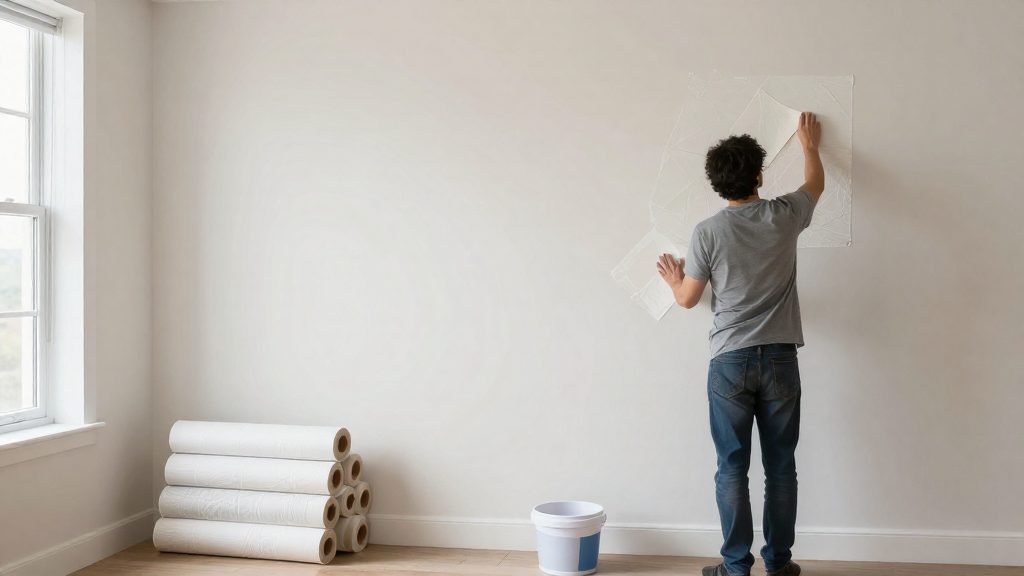
To work out how much wallpaper a feature wall needs, count strips rather than square metres. Divide the wall width by the width of one roll and round up to get the strips needed. Each strip is the wall height plus the pattern repeat, so divide the roll length by that strip length and round down to get the strips per roll. Divide the strips needed by the strips per roll and round up. For a 3.60 m wide wall, 2.40 m high, using a 53 cm by 10 m roll and a 60 cm repeat, you need 3 rolls, and one spare brings the order to 4.
How do you measure a feature wall?
Measure the width of the one wall you are papering, from corner to corner along the floor, in metres, and write it down before you do anything else. Do not add any other wall to the figure, even if it meets the feature wall at a corner.
Measure the height at the tallest point. If the ceiling slopes, is vaulted, or simply sits lower at one end, the highest measurement is the one to use, so that no strip ends up short. Round both measurements to the nearest centimetre and keep the notes with the roll labels.
Do not deduct windows or doors. A home-improvement guide consulted for this article advises against subtracting them, and says you cut the paper around them as you hang it. The extra paper this leaves is the buffer you will need for cutting and matching.
Why does the pattern repeat change the count?
The pattern repeat is the vertical distance after which a design starts again. Each strip must show a complete design from top to bottom, so each strip has to be longer than the wall by one full repeat. A plain or striped paper has no repeat, which is why its strips are shorter and more of them fit on each roll.
The repeat figure is printed on the label or in the product’s technical details. Always use the number for your own paper, because repeats differ widely between designs. The official sources consulted do not specify a default value, so if the figure is missing, ask the manufacturer or seller before you order.
The method in the guide mentioned above treats the repeat as covering both matching and trimming. Other manufacturers specify a separate trimming margin at the top and bottom of each strip. If your paper’s instructions give one, add it to the strip length before dividing. For a rough check, one manufacturer’s guide estimates about three drops per roll for small repeats, four for striped papers and two for large repeats, in a standard 2.4 m high room. Treat that as a cross-check, not a substitute for your own count.
How many strips fit on one roll?
Divide the roll length by the strip length and round down, because a partial strip cannot be used as a full drop. Using the example above, 10 m ÷ 3.00 m = 3.33, so each roll gives 3 full strips. The leftover 1 m can sometimes fill a short gap above a door or a window, but it cannot cover a full strip.
Small changes in the trimming allowance do not always change the result. If a manufacturer asks for a margin of up to 30 cm in total, the strip becomes 3.30 m long, and 10 m ÷ 3.30 m = 3.03, which still gives three strips per roll. Recalculate only when the change pushes the strip length past a point where a roll yields one fewer strip.
Worked example: a 3.60 m feature wall
Here is the full calculation for a wall 3.60 m wide (about 11.8 ft) and 2.40 m high, papered with a 53 cm by 10 m roll and a 60 cm pattern repeat. The 60 cm repeat is an example figure; use the one on your own label.
- Strips needed: 3.60 m ÷ 0.53 m = 6.79, rounded up to 7 strips.
- Strip length: 2.40 m + 0.60 m = 3.00 m.
- Strips per roll: 10 m ÷ 3.00 m = 3.33, rounded down to 3.
- Rolls: 7 strips ÷ 3 strips per roll = 2.33, rounded up to 3 rolls.
- Spare: add one roll, for a total of 4 rolls.
The three rolls give nine strips for seven needed, so the spare roll is a safeguard against mistakes and batch differences rather than a shortfall in the calculation.
The repeat makes a real difference here. If the same wall were papered with a plain paper, the strip would be just the 2.40 m height. Then 10 m ÷ 2.40 m = 4.17, giving 4 strips per roll, and 7 ÷ 4 = 1.75, so 2 rolls would be enough. The 60 cm repeat adds one roll to the order, which is why the repeat should always be read from the label before you buy.
When should you buy spare rolls?
The home-improvement guide consulted advises buying one or two extra rolls beyond the calculated number, to cover mistakes in measuring or hanging. One manufacturer’s how-to recommends adding one roll for trimming, mistakes and batch variation. For a feature wall, where a single error is easy to spot, one spare is usually the minimum.
Order the whole quantity in one go, from the same print batch. Colour can vary slightly between batches, and a missing roll later may not match. Before you open any roll, check the seller’s return policy, because the official sources consulted do not specify a general return period for opened or unopened rolls.
Which safety precautions apply when hanging a feature wall?
A full-height feature wall usually means working at ceiling height, so ladder safety matters as much as the arithmetic. The Canadian Centre for Occupational Health and Safety (CCOHS) advises using a stepladder about 1 m (3 ft) shorter than the highest point you need to reach, because that gives a wider and steadier base. If your hands cannot reach the wall without you climbing above the stepladder’s top cap or losing a handhold, the ladder is too short.
Do not stand, climb or sit on the top of a stepladder or its pail shelf, and do not shift or walk the ladder while standing on it. Check that the load rating marked on the ladder covers your own weight plus the tools and paper you carry. CCOHS cites CSA Z11-18 for ladder grades, so look for the rating and grade on your own ladder’s label.
Before hanging, clear the floor beneath the ladder and keep a second person nearby for long strips. If you need to remove wall plates near switches or sockets, switch off the circuit at the electrical panel first and confirm the outlet is dead before touching it. Check the product’s instructions for any adhesive or paste warnings, and ventilate the room while you work.
Frequently asked questions
Can I order wallpaper by square metres instead of by roll?
Area alone ignores the strip length, the pattern repeat and the roll width, so it can underestimate the number of rolls. Use the strip method above, then compare the result with the total the seller gives, because wallpaper is sold in whole rolls.
Is an online wallpaper calculator reliable?
Use it as a cross-check only. Enter the roll width, roll length and pattern repeat from your own label, and confirm that the result matches the strip count you worked out by hand.
What if the label does not show a pattern repeat?
Do not guess. Ask the manufacturer or seller for the repeat, because the strip length depends on it. The official sources consulted do not specify a default value to use in its place.