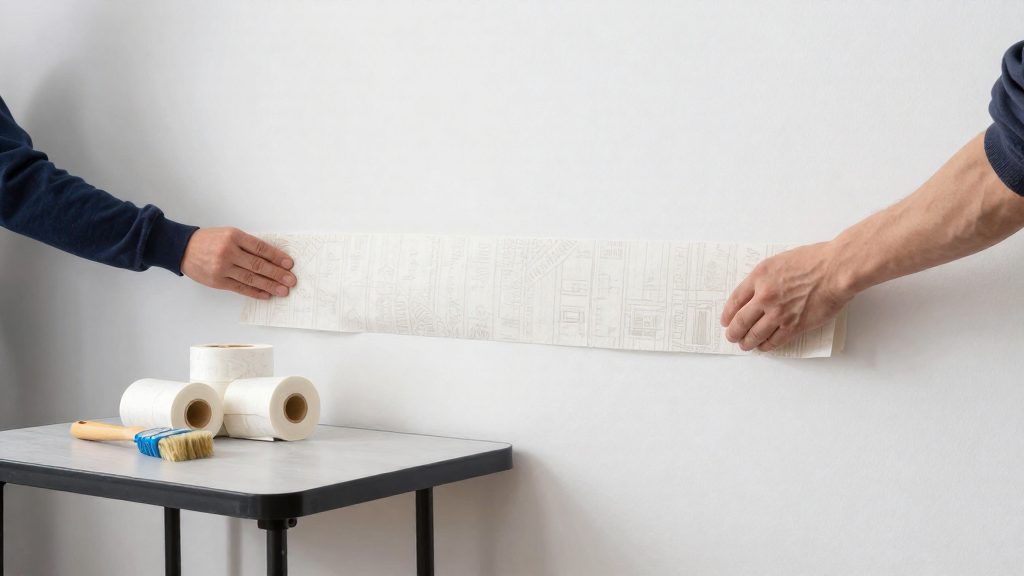
To work out how many wallpaper rolls a small room needs, measure the total wall perimeter and the wall height, count the whole strips you will hang, work out how many strips one roll yields, divide, round up, and add a spare roll. For a room measuring 2.8 m by 2.4 m with 2.40 m walls, this method gives 5 standard European rolls for the walls before the spare. The steps below work through that room, then cover the adjustments for doors, windows and patterns.
How do you measure the perimeter and wall height?
Measure each wall from corner to corner and add the lengths together. Do not subtract openings yet. The example room has two walls of 2.8 m and two of 2.4 m, so the perimeter is 10.4 m.
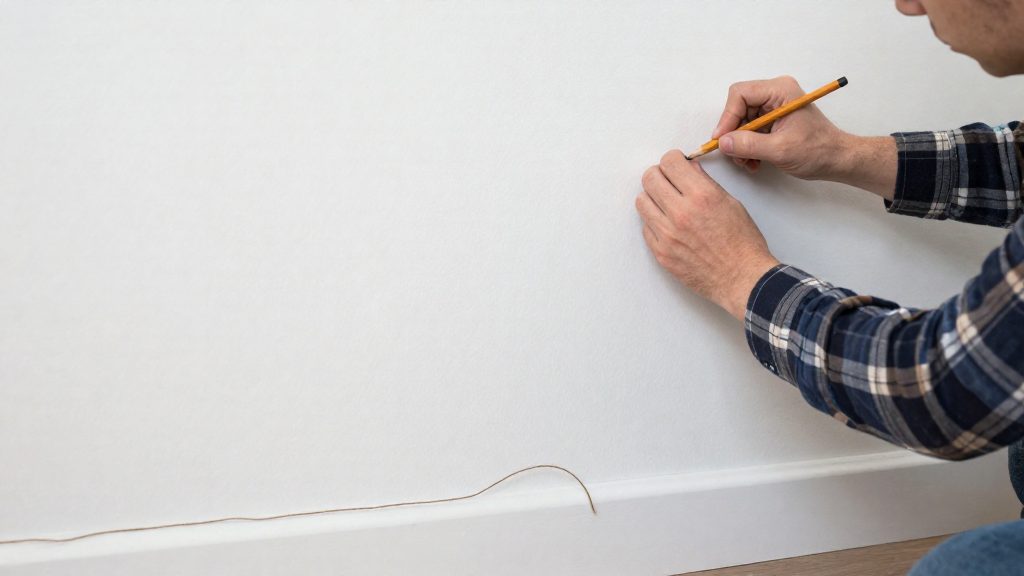
Measure the height from floor to ceiling in several places and use the highest reading. The manufacturer’s guidance recommends adding about 5 cm to the room height to avoid a tight cut at the top. Here, 2.40 m plus 5 cm gives a cut length of 2.45 m. Write each wall length down before adding them, and check the total twice, because one transposed figure changes the roll count.
How many strips does each roll give?
A standard European roll is 0.53 m wide and 10.05 m long. Divide the perimeter by the roll width to get the number of strips, then round up: 10.4 ÷ 0.53 = 19.6, so 20 strips.
A full strip has to come from one roll’s length, so count whole strips per roll rather than dividing total length alone. At a cut length of 2.45 m, 10.05 ÷ 2.45 = 4.1, which gives 4 strips per roll. Twenty strips divided by four per roll is 5 rolls.
The wallcovering guide offers a quicker shortcut: strips × height ÷ roll length. Here, 20 × 2.45 = 49 m, and 49 ÷ 10.05 = 4.9, rounded up to 5. The shortcut matches in this case, but it assumes every leftover metre can be used. It can understate the count when the cut length sits just above the point where one fewer strip fits per roll. At 2.55 m, the shortcut gives 6 rolls, yet only 3 strips fit per roll (10.05 ÷ 2.55 = 3.9), so 20 strips need 7 rolls. Use the whole-strip count whenever the height is close to that threshold.
The manufacturer’s published table lists 5 rolls for a 10 m perimeter at 2.25 m height and 6 rolls at 2.50 m. The page does not explain how those figures were derived, so use the table to check your own result rather than as the order itself.
How do doors and windows change the count?
For strip counting, subtract the width of each door opening from the perimeter. With one 0.80 m door, the perimeter becomes 9.6 m. Then 9.6 ÷ 0.53 = 18.1, so 19 strips, and 19 ÷ 4 = 4.75, which rounds up to 5 rolls. In this room the door does not reduce the count, but a room with several doors may need one fewer roll.
The wall above a door still needs paper. If the door is 2.10 m tall, the band above it is about 0.35 m high. The guidance consulted does not explain how to count that band, so check whether an offcut from the door opening is long enough, from the same batch, and matches the pattern at the join.
Windows are handled differently in the area method. Subtract only the glass area, not the window recess, because the recess is papered. A 1.20 m by 1.00 m pane removes 1.20 m² from the wall area, and the reveal stays in the count.
Why does the pattern repeat change the quantity?
The area method gives a useful cross-check. Multiply the perimeter by the height: 10.4 × 2.45 = 25.48 m². Subtract the door (0.80 × 2.10 = 1.68 m²) and the window glass (1.20 m²), which leaves 22.60 m². Divide by the roughly 5 m² that one roll covers according to the wallcovering guide: 22.60 ÷ 5 = 4.52. Add about 10% for waste and pattern matching: 4.97, rounded up to 5 rolls. That matches the strip count for a plain paper.
Plain and small-pattern papers need only the roughly 10% margin. Large patterns are different. The design has to be matched from one strip to the next, and each roll can lose up to a full strip. If each roll loses one of its four strips, you get three usable strips per roll: 20 ÷ 3 = 6.7, so 7 rolls. Check the pattern repeat on the product label before you calculate, because a repeat that is longer than the cut length wastes more paper.
When should you buy a spare roll?
Order one spare roll beyond the calculated count, ideally from the same batch number, because colour can vary slightly between batches. The manufacturer’s guidance recommends one extra roll for later repairs, and the wallcovering guide suggests one or two. For this room, that means ordering 6 rolls for a plain paper (5 plus one spare) or 8 rolls for a large pattern (7 plus one spare).
Buy the full quantity before you start. If you run short halfway through a wall, a later batch may not match the first one, and the join will show.
How do you calculate for North American roll sizes?
North American rolls are often about 20.5 inches (0.52 m) wide and 33 feet (10.06 m) long, which gives roughly 5.2 m² per length. The manufacturer’s guidance uses 0.53 m by 10.05 m rolls, so apply the same steps with the local width. Here, 10.4 ÷ 0.52 = 20 strips exactly.
Sellers describe these lengths inconsistently. Some treat the 33-foot length as one roll, while others sell it as two 16.5-foot rolls. Check the label for the total length and the coverage stated in square feet. If the length is one piece of 10.06 m, 10.06 ÷ 2.45 gives 4 strips per length, so 20 strips need 5 lengths. If the length is two pieces of 5.03 m, each piece gives 2 strips (5.03 ÷ 2.45 = 2.05), so 4 strips per 33-foot length, again 5 lengths.
How do you work safely while hanging?
Use a stable stepladder or step stool, and do not stand on the top step or cap. Keep your weight centred over the base, and move the ladder rather than leaning sideways to reach a corner. For long strips, ask a second person to hold the top while you position the paper, since a drop of a long, wet strip can unbalance you.
Before removing a switch or socket cover, switch off the circuit at the consumer unit. Keep paste off electrical fittings and do not paste over sockets. Follow the adhesive label for mixing, skin contact and ventilation, and keep the room ventilated while the paste dries. Clean up any drips before they set on the floor, where they can make the ladder slip.
Frequently asked questions
Does the same calculation apply to a ceiling?
The guidance consulted describes walls only. Measure the ceiling area separately and check the manufacturer’s instructions before ordering extra rolls.
How much adhesive do I need?
The calculation covers paper only. Adhesive quantity is set on the product label, which also gives mixing and drying times.
Can I return unused rolls?
Return conditions depend on the seller and the product, and the sources used for this guide do not cover them. Check the terms before you open a roll.