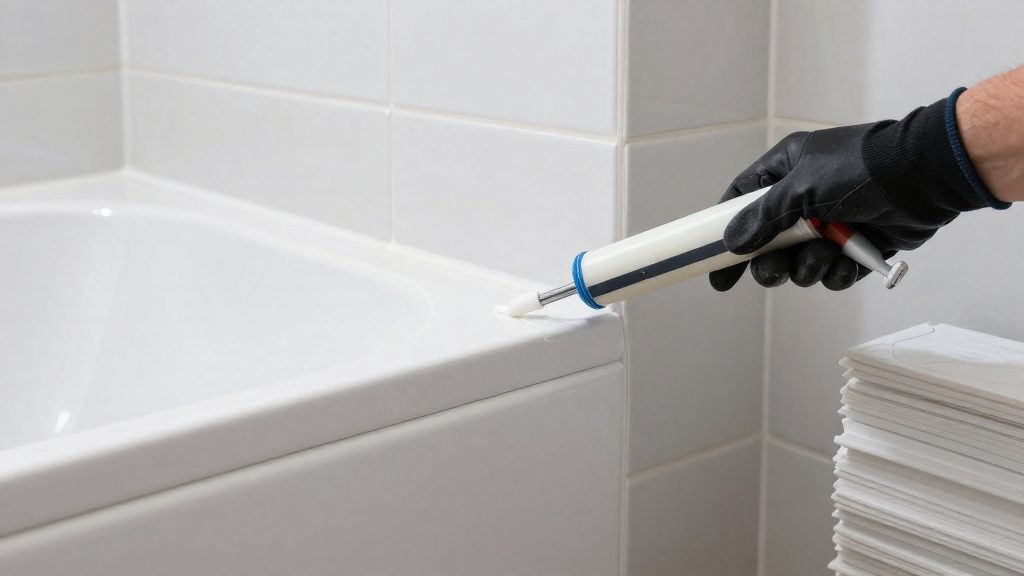
A typical bathtub surround needs about 15 to 20 linear feet of caulk, according to EngineerFix (2025). With a standard 10.1 US fluid ounce cartridge, about 300 mL, and a bead about 1/4 inch (6 mm) wide and deep, one tube covers roughly 24 feet of joint. Add 10 to 15 percent for waste and most tubs need one tube. Plan for two if you use a larger bead, have many corners or fixtures, or caulk a shower enclosure at the same time.
How do you measure the seams around a tub?
Measure every joint you plan to fill, in feet, and add the lengths together. The usual joints are the long back edge where the tub rim meets the wall, the two short end joints, the tile-to-tub joints above the rim, and the corners of any alcove or niche. Measure along each joint rather than across it, so curved or angled corners count at full length. Include joints around a nearby fixture if they are part of the same run. Round each length up to the nearest half foot, write the figures down, and total them.
How far does one tube go?
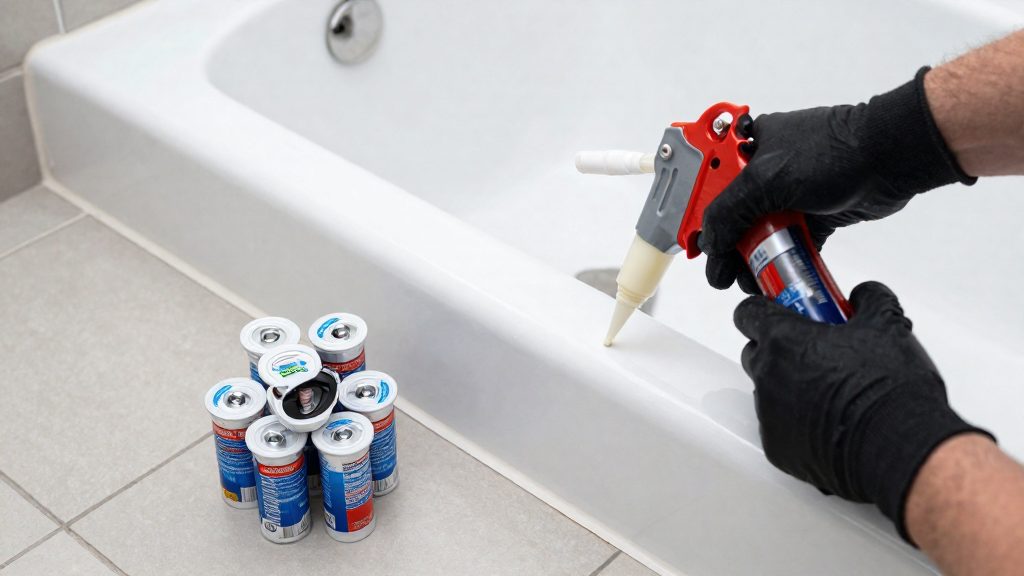
Yield depends on the tube’s volume and the bead’s cross-section. Use this formula: linear feet per tube = (tube volume in cubic inches ÷ bead area in square inches) ÷ 12.
One US fluid ounce equals 1.8046875 cubic inches (NIST Handbook 44, Appendix C), so a 10.1 US fluid ounce tube holds about 18.2 cubic inches. The same tube holds about 29.57 mL per US fluid ounce, which gives roughly 299 mL (NIST SP 811, Appendix B). A bead 1/4 inch wide and 1/4 inch deep has an area of 0.0625 square inches. Dividing gives about 291.6 inches, or 24.3 feet (about 7.4 m).
A rounded bead has less area than a square one of the same width, so it covers more length. A bead shaped into a triangular corner fillet covers about 48.6 feet from the same tube, but a real fillet is rarely a perfect triangle. Use the yield printed on the cartridge for the bead size you plan, and use the formula as a check.
Why does bead size change the number of tubes?
Bead area grows with the square of its width and depth. A 3/8-inch square bead has 2.25 times the area of a 1/4-inch square bead, so the same tube covers less than half the length: about 10.8 feet (3.3 m). A 1/8-inch square bead covers about 97 feet from one tube, but it may be too thin to fill a wider gap. Measure the joint width first, then choose the bead size.
Some published yields for a 3/8-inch bead are far higher than this arithmetic allows. When figures disagree, trust the cartridge label and the formula over a rounded table.
What does a worked example look like?
Take a tub with 18 feet of total seam, inside the 15 to 20 foot range. Add 15 percent for waste: 18 × 1.15 = 20.7 feet.
- With a 1/4-inch square bead, the yield is 24.3 feet. 20.7 ÷ 24.3 = 0.85, so one tube is enough.
- With a 3/8-inch square bead, the yield is 10.8 feet. 20.7 ÷ 10.8 = 1.92, so two tubes are needed.
Always round up to whole tubes. The same tub therefore needs one or two tubes depending on the bead size, so settle the bead size before you buy.
How much waste should you allow?
Allow 10 to 15 percent extra, the range EngineerFix recommends (2025). The allowance covers the start and finish of each run, a corrected section and the bead you smooth again. If your seam total sits just under one tube’s yield, the waste allowance is what pushes the job over into a second tube.
When do you need more than one tube?
You need a second tube when the adjusted length is more than one tube’s yield. This is common with larger beads, several alcoves, or a shower enclosure joined to the tub, which adds joints. A deeper or wider bead also uses more material per foot, so the yield per tube drops. If you need a second tube, buy it at the same time as the first when possible, so the colour and batch match.
Why does moisture behind the caulk matter?
Bathtub caulk is meant to stop water from reaching the gap between the tub and the wall. CMHC guidance for multi-unit residential buildings notes that failure to control moisture can lead to condensation and damage, including mould. The joint is therefore a moisture barrier, not only a cosmetic bead.
If you find mould, soft or stained board, or a joint that has been wet for a long time, stop and investigate before recaulking. Sealing over a hidden leak hides the problem and can let damage continue inside the wall. For water damage that reaches the wall or floor, ask a qualified professional to assess it.
How long before you can use the tub again?
Cure time depends on the product, temperature, humidity and bead depth. One tub-and-tile silicone data sheet gives a cure time of 24 hours at 23 °C and 50 percent relative humidity. The same sheet says cure is significantly slower in cold or dry conditions and depends on the depth of the sealant. Under average conditions it cures about 2 to 3 mm per 24 hours, so a deep bead needs several days to cure through.
Another manufacturer’s specification sheet for a bathroom sealant lists a full-cure range of 1 to 14 days, with the longer times for cold, humid or thick beads.
What safety points apply during the job?
Work with the tub empty and dry, and keep the shower off until the cure time is complete. Ventilate the room while you work, since some sealants give off a strong odour as they cure. Read the product label for recommended gloves and eye protection, and keep tubes and used tools out of reach of children and pets. Do not use a heater or hair dryer to speed the cure unless the label allows it.
Frequently asked questions
Do I need to remove old caulk before applying new?
Usually yes if the old bead is loose, cracked or mouldy. Remove it, let the joint dry, and follow the surface preparation section of the product instructions before applying new sealant.
Can I use the same method for a shower enclosure?
Yes. Measure every joint the same way, add the waste allowance, and divide by the yield for your bead size. Enclosures usually have more joints than a plain tub, so the total can rise quickly.
How long can an opened tube be stored?
The official sources consulted do not specify a storage life for this kind of product. Check the storage and shelf-life instructions on the label or in the manufacturer’s data sheet.