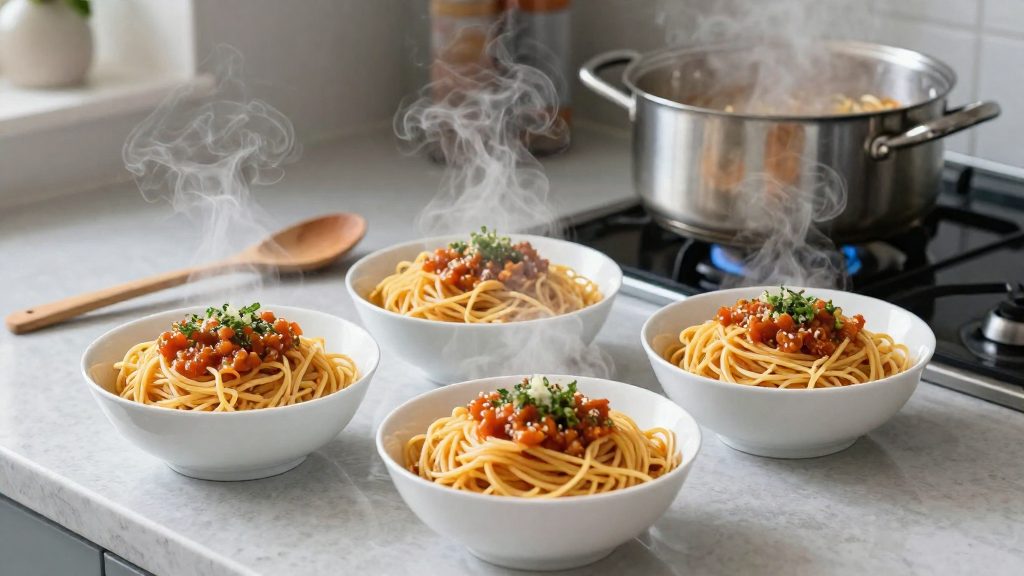
For a family of four, plan about 125 mL (½ cup) of cooked pasta per person as a side or light serving, which comes to 500 mL (2 cups) cooked in total. That figure is the cooked-pasta reference in Health Canada’s older food guide, not a rule for every meal. A larger main-course portion, hungry eaters or a pasta-only dinner call for more, and the dry weight you buy depends on the shape of the pasta and how much it swells in cooking. The steps below show how to scale the amount, convert it to dry weight and handle leftovers safely.
Where does the 125 mL figure come from?
The number comes from the grain-products section of Health Canada’s Eating Well with Canada’s Food Guide, in the edition adapted for First Nations, Inuit and Métis communities. That table lists cooked pasta at 125 mL (½ cup), according to Health Canada (2007). The same table gives cooked rice, white or brown, the same amount, and hot cereal 175 mL (¾ cup). Pasta is therefore treated as one grain among several, not as a food with its own separate rule.
The current Canada’s Food Guide, published in 2019, moved away from numbered servings and uses a plate illustration instead. The official sources consulted do not specify a numeric cooked-pasta amount in that current version, so do not present the 2007 figure as today’s official quantity. If you need the present wording, check the guidance on food-guide.canada.ca. Use the 125 mL figure here as a practical starting point for a home meal, not as a dietary target for any individual.
How do you calculate pasta for four people?
Multiply the per-person amount by the number of people, then convert the cooked volume to dry weight. In plain terms:
People × 125 mL = total cooked volume needed (mL)
Total cooked volume ÷ cooked volume per gram of dry pasta = dry grams needed
For four people at the reference amount, the total is 4 × 125 mL = 500 mL, or about 2 cups of cooked pasta. If you decide on a larger per-person figure, the total scales the same way: double the per-person amount and the total doubles to 1000 mL. The arithmetic stays identical whatever figure you choose.
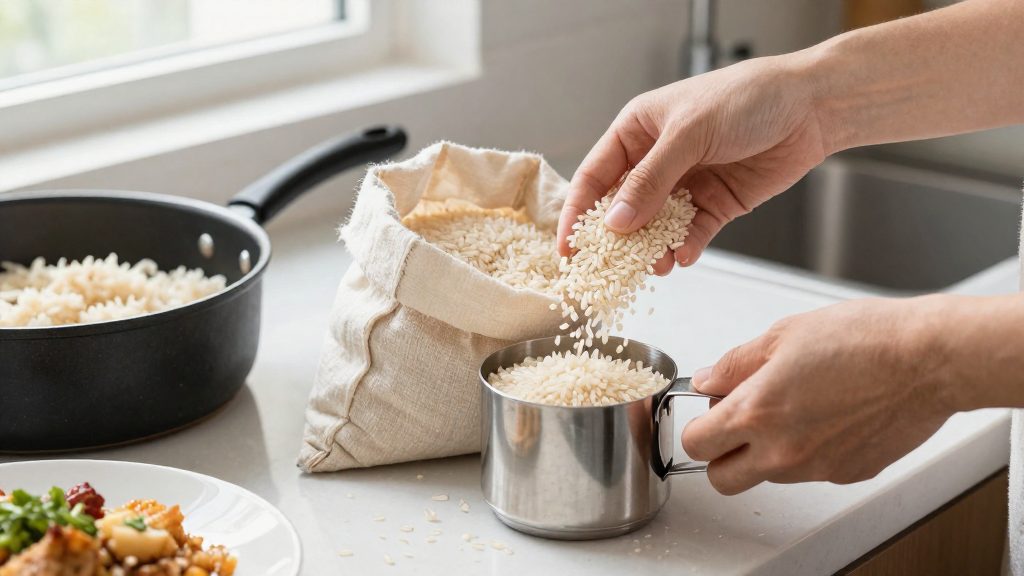
Cooked volume per gram depends on your pasta, so measure it once. Weigh a known amount of dry pasta, cook it following the package directions, drain it well and measure the cooked volume in a graduated measuring cup. Divide the cooked millilitres by the dry grams to get a yield per gram, then divide the 500 mL target by that yield to get the dry grams you need. The manufacturer’s cooking directions are the best source for cooking time and any stated yield. The official sources consulted do not give a universal dry-to-cooked conversion for pasta, so a measured test is more reliable than any general number.
Why does a main course need more than a side?
The 125 mL reference describes one grain serving within a meal. When pasta is the main dish with little else on the plate, the pasta has to carry more of the meal, so the household needs more than the side figure. A side dish served next to a protein and vegetables can stay close to the reference. The sauce matters too. A thick, meat-based sauce can make a modest portion of pasta look generous, while a light sauce on a hungry table may leave people reaching for seconds.
Restaurant portions are often much larger than the home reference, which can make a home serving seem small by comparison. Use the reference as the starting point for a side dish, and increase the amount only when pasta is the centre of the meal and you know how much your household usually eats. Decide first whether the pasta is a side or the main, choose the per-person figure, and only then multiply.
Dry or cooked: which measure should you plan with?
The reference is expressed in cooked volume, but you buy pasta by dry weight, so the two measures must be linked before you shop. Use the calculation above to find the dry grams needed for the whole meal, then buy a package that covers that amount. Packages are sold in set weights, so if your calculated amount falls between two sizes, choose the larger one for the leftovers you will want the next day.
Scoops and cup measures of dry pasta are unreliable. Long strands and short shapes pack very differently, so the same cup can hold quite different weights. A kitchen scale gives a consistent answer for every shape, and it lets you repeat the same figure the next time you cook the same pasta.
How should you adjust for children and big appetites?
The official sources consulted do not specify a separate pasta amount for children, so treat the 125 mL reference as an adult starting point and adjust downward for younger children. Offer a smaller first serving, let them ask for more, and avoid pressure to finish the plate. Teenagers and very active adults may need more than the reference, so increase the per-person figure for them in the same way as for a main course.
Let appetite be the final guide. If there is consistently food left over, lower the target next time; if the pot is empty and people are still hungry, raise it. If a child has a feeding difficulty, a medical condition or a diet prescribed by a health professional, follow that professional’s advice rather than this calculation.
When do leftovers stop being safe?
Cooked pasta is a perishable food, and the time it spends at room temperature matters more than how much you cooked. Health Canada advises throwing away any cooked food left out for more than two hours, and recommends eating refrigerated leftovers within 2 to 3 days or freezing them for later use, according to Health Canada (2010). Cool large batches quickly by spreading them into shallow containers before refrigerating, and reheat leftovers until they are steaming hot.
If you cook for a gathering, time the pasta so it comes out of the pot shortly before the meal and does not sit on the table during long speeches or games. When in doubt about how long a dish has been out, discard it rather than tasting it to decide.
What safety steps apply when cooking for four?
Boiling water is the main hazard when you cook pasta for a family, and scalds are the most common injury. Use a pot large enough that the water does not spill over when the pasta goes in, and turn the handles inward so no one can knock it. Lift lids away from your face, and drain pasta in a sturdy colander set securely in the sink, directing the steam away from you.
Do not carry a full pot of boiling water across the kitchen. Move it when it is empty or ask an adult helper to do the transfer. Keep children and pets away from the stove while the water is hot, and turn off the burner if you need to leave the room. Never leave a pot of boiling water unattended.
How do you check the amount before you serve?
Before the meal, weigh the dry pasta you plan to cook and write the figure on the package or in a note, along with the per-person amount you chose. After serving, look at what remains in the pot and on the plates. If the pot is nearly empty, your target was about right; if a lot is left, reduce the dry weight next time by the same proportion. This method uses your own pasta, your own pot and your own household, so it becomes more accurate with each dinner.
Frequently asked questions
Does fresh pasta need a different amount per person?
The official sources consulted do not specify a fresh-pasta amount. Check the manufacturer’s serving guidance on the package, and measure a test batch the same way you would measure dry pasta.
Does the 125 mL reference include the sauce?
No. The reference describes the cooked pasta itself, so sauce, cheese and side dishes are added on top when you plan the meal.
Can I cook pasta ahead for a party?
It is safer to finish cooking close to serving time so the pasta does not sit at room temperature. The holding limit is explained in the leftovers section above.