For a dinner where rice is one of the starches, plan about 125 mL (½ cup) of cooked rice per person as a starting point. Health Canada’s Food Guide uses that amount as one serving of cooked rice, but it is a unit for measuring, not an official dinner portion. Plan in cooked volume, then convert to dry rice with the cooked yield printed on your package, because yield changes with the type of rice, the water and the cooking method.
How much cooked rice does one serving represent?
In the 2007 edition of Eating Well with Canada’s Food Guide, Health Canada lists cooked rice, bulgur or quinoa at 125 mL (½ cup) as one Grain Products serving. The guide’s meal-counting example treats 250 mL (1 cup) of brown rice as two servings, which means the same 125 mL unit applies to brown rice. The First Nations, Inuit and Métis edition, published in 2007, gives the same 125 mL (½ cup) for cooked white, brown or wild rice, so the unit does not change with the variety.
Two limits apply. Both 2007 editions predate the current guide, and the First Nations, Inuit and Métis edition is now marked as archived. The current Canada’s Food Guide does not give a rice quantity per meal or per day, and the official sources consulted do not set a dinner portion for rice. Use 125 mL as the measuring unit that your plan is built on, then adjust it for the people at your table.
Why plan from the cooked amount rather than the dry amount?
Guests eat cooked rice, so the cooked volume is the quantity that matters at the table. Dry rice is only the input. The same dry measure can produce noticeably different cooked volumes depending on the variety, the water ratio and the cooking method, so a plan written in dry cups alone can be too large or too small once the rice is on the plate. Starting from the cooked total keeps the number you care about fixed, and the conversion to dry rice becomes one step you can check.
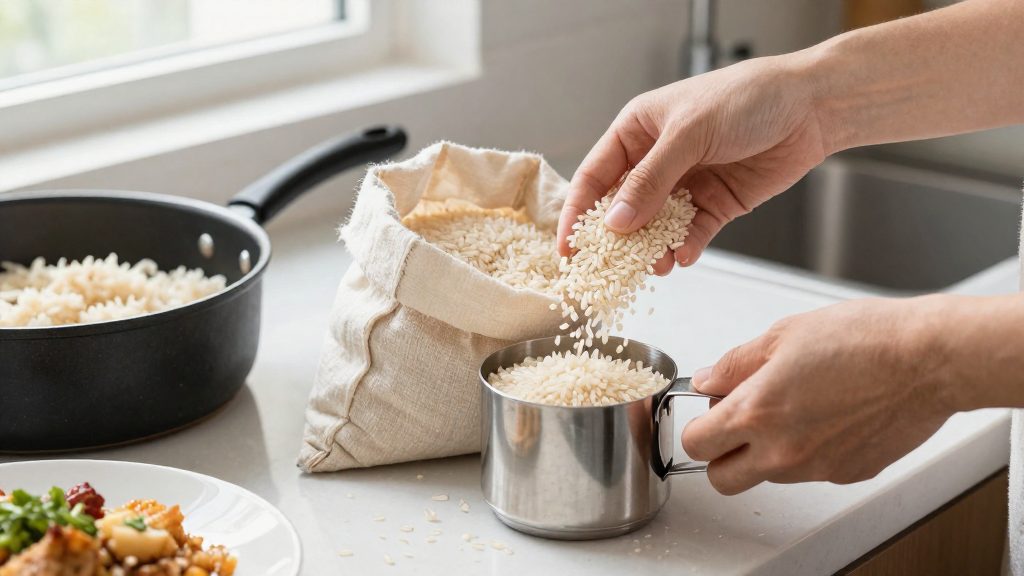
Measuring cooked rice is also more reliable when done with care. Spoon the rice lightly into a ½-cup measure and level the top with a knife. Pressing it down packs more rice into each measure, so every serving becomes larger than planned and the total drifts upward.
How do you convert cooked rice to dry rice?
Take the cooked total and divide it by the cooked volume that one dry measure produces. The formula is: dry amount equals cooked total divided by cooked volume per dry measure. Keep the units the same on both sides, cups with cups or millilitres with millilitres, so the division stays consistent.
The official sources consulted do not give a cooked yield that applies to every rice, so the manufacturer’s directions are the reliable reference. Look on the package for two figures: the cooked volume produced by one dry cup, and the water ratio for cooking. Follow both exactly, because changing the water changes the yield you are relying on.
If the package gives a water ratio but no cooked volume, cook a small test batch in the same pot and by the same method, measure the cooked result, and use that as your yield. Write the figure down so the next dinner is easier to plan. A test batch is also the best way to check the result before you commit to a large quantity for guests.
How do the numbers work for 4, 6 or 10 guests?
Multiply the cooked serving by the number of guests to get the cooked total. At 125 mL per person, the totals are 500 mL (2 cups) for 4 guests, 750 mL (3 cups) for 6 guests, and 1.25 L (5 cups) for 10 guests.
Next, convert each total to dry rice. Call Y the cooked volume in cups that your package gives for one dry cup. The dry cups needed are 2 divided by Y for 4 guests, 3 divided by Y for 6 guests, and 5 divided by Y for 10 guests. Take 6 guests as the working example. If your package gives Y, divide 3 by that number. Then round to a measure you own: a result of 1.4 dry cups becomes one and a half cups, and a result of 0.9 dry cups becomes one cup.
Brown rice follows the same cooked total of 125 mL per person, but its cooked yield is printed separately on its own package. Repeat the division with the figure for that rice rather than reusing the result you got for white rice.
How do you scale rice for a crowd?
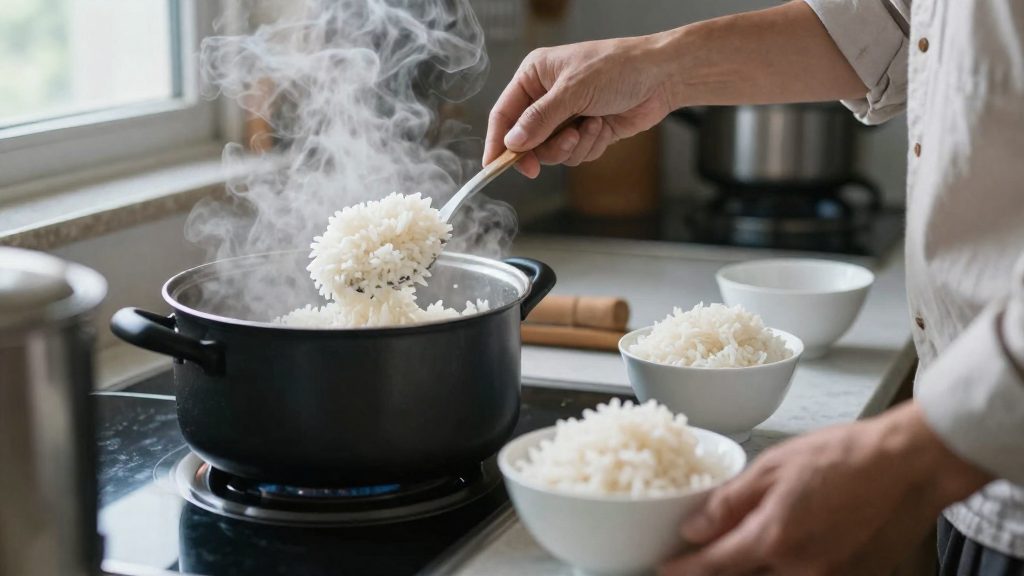
Scaling is multiplication, but the limits are the cooking vessel and the serving time. Calculate the full dry amount first, then decide how many batches your pot can handle. If the dry total is split across batches, divide it evenly, so each batch uses the same dry measure and the same water ratio. Keeping the method identical from batch to batch keeps the texture consistent, and it avoids a dish that is firm at one end of the table and soft at the other.
For a long buffet or a party with a set serving time, plan the rice around the two-hour limit given below. Cook the batch closest to the time you plan to serve it, keep finished rice covered, and do not leave a large dish out while guests are still arriving. If the rice is one dish among several, count the other starches before you finalise the batch sizes, because the two sums are not independent.
When should you adjust for appetite, other dishes and leftovers?
Adjust upward when rice is the main starch and little else is served. Adjust downward when potatoes, bread, pasta or a second grain are also on the table. The 125 mL unit cannot tell you this, so the adjustment is a judgement based on the people you are cooking for. If your guests are known to eat lightly, round the dry amount down to the nearest measure. For hearty eaters, round it up.
Decide what happens to leftovers before you cook. Health Canada advises refrigerating or freezing leftovers as soon as possible or within two hours, and never leaving leftovers out on the counter for longer than two hours. Set your refrigerator to 4°C (40°F) or lower and your freezer to -18°C (0°F) or lower. Rice that has been out past two hours should be discarded rather than reheated and served. Reheat only the portion you intend to eat. The official sources consulted do not specify how long cooked rice keeps in the refrigerator, so label containers with the date and use the storage guidance on the rice package if it gives one.
Frequently asked questions
Can I cook the rice ahead of dinner?
Cooking ahead is possible, but the official sources consulted do not give a holding time for cooked rice. Keep the cooked rice refrigerated until reheating, following the limits in the section above, and reheat only what you will serve.
Do children need a smaller amount?
The official sources consulted do not give a separate rice quantity for children. Serve smaller amounts to younger guests based on what they usually eat, and offer seconds rather than piling large plates at the start.
How long can cooked rice stay in the freezer?
The official sources consulted do not specify a freezer storage time for cooked rice. Cool it and freeze it within the two-hour limit, label each container with the date, and follow any storage period printed on the rice package.