To find how many cubic yards of mulch a flower bed needs, multiply the bed’s length by its width in feet, multiply by the target depth in inches, and divide by 324. A 20 × 10 ft bed mulched 3 inches deep needs about 1.85 cubic yards before any allowance. The sections below show how to measure, how to handle irregular shapes, how to choose a depth, how to convert to cubic metres, and how to top up an existing layer safely.
How do you calculate the volume of mulch for a flower bed?
Bulk mulch is sold by volume, so the first step is to turn the bed’s footprint and planned depth into cubic yards. A cubic yard is a cube measuring 3 feet on each side, which holds 27 cubic feet. Depth is usually planned in inches, so it must be divided by 12 to become feet. Written out, the calculation is:
length (ft) × width (ft) × depth (in) ÷ 12 ÷ 27 = cubic yards
Because 12 × 27 = 324, the same result comes from a shorter version:
length (ft) × width (ft) × depth (in) ÷ 324 = cubic yards
Measure the bed at its longest and widest points, and use the depth you want after spreading, not the depth you have now. If your plan is drawn in metres, convert the dimensions to feet first, since 1 metre is about 3.28 feet. Measure the planted area you will actually cover, leaving out lawn edges, paths and hard surfaces.
What is a worked example for a 20 × 10 ft bed?
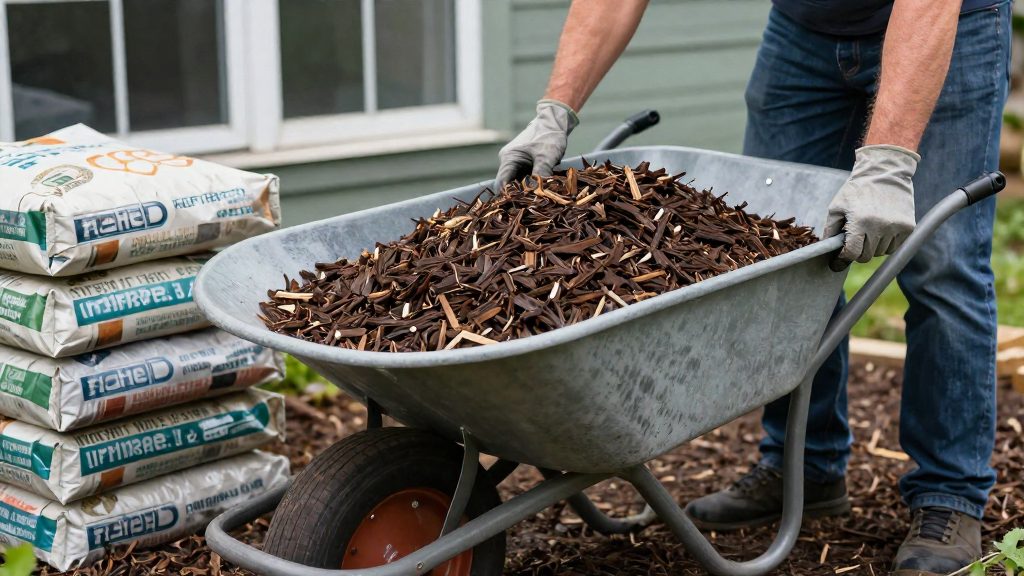
Take a rectangular bed 20 feet long and 10 feet wide, with a target depth of 3 inches.
- Area: 20 × 10 = 200 square feet.
- Volume in cubic feet: 200 × 3 ÷ 12 = 50 cubic feet.
- Volume in cubic yards: 50 ÷ 27 = 1.85 cubic yards. The shortcut gives the same result: 20 × 10 × 3 ÷ 324 = 1.85.
Ordering exactly 1.85 cubic yards leaves no buffer. Mulch settles over the season, rain and wind move it, and few beds are perfectly level. Adding about 10% to the calculated volume is a practical margin for these losses. For this bed, 1.85 × 1.10 gives about 2.04 cubic yards. Round up to the smallest quantity your supplier delivers. Add more if the bed slopes or if roots lie close to the surface, because mulch is more likely to thin or wash away in those areas.
What depth should mulch be in a flower bed?
For most flower beds, a layer of 2 to 3 inches is the usual target. According to University of Illinois Extension (2018), the recommended depth for landscape mulch is two to three inches. That range is thick enough to help suppress weeds and keep moisture in the soil, yet thin enough that water and air still reach the roots. Choose the depth within that range according to the material:
- Fine, dense materials such as finely shredded bark or compost pack down and hold water, so stay toward the lower end.
- Coarse wood chips let more air and water through, so they can sit toward the upper end.
- Layers far thicker than the target can keep soil wet and limit air to roots, so avoid piling mulch deeper than the plan.
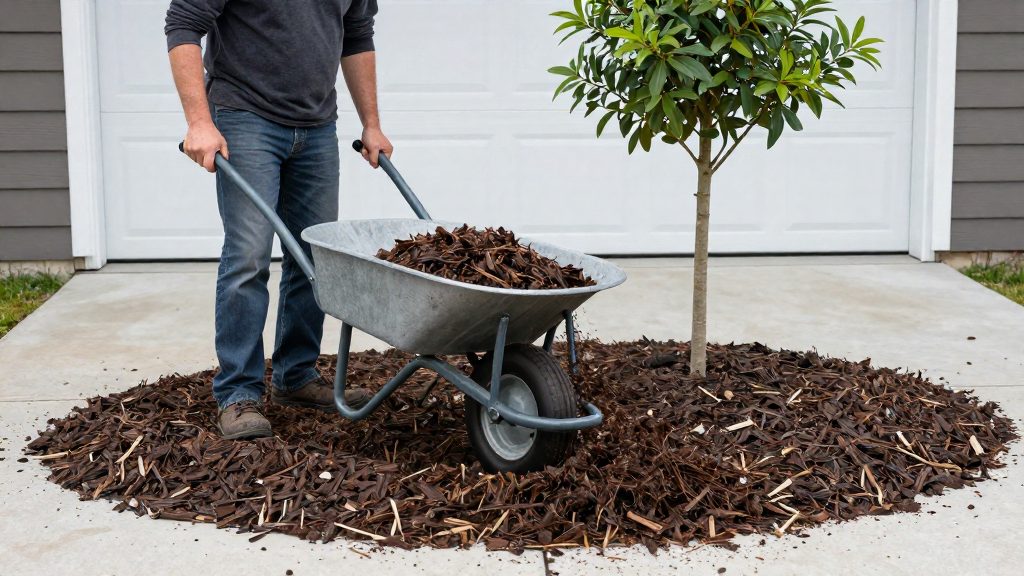
Around trees and shrubs, the guidance differs slightly. According to Iowa State University Extension and Outreach (last updated 2022), a depth of 3 to 4 inches suits well-drained sites and 2 to 3 inches suits heavy soils, and the mulch should be kept at least 6 inches away from the trunk. Use these figures for woody plants inside a bed, and the 2 to 3 inch target for the rest of the planting.
How much area does one cubic yard cover at each depth?
Because one cubic yard holds 27 cubic feet, the area it covers equals 324 divided by the depth in inches. The table below uses that relationship.
| Depth | Area covered by one cubic yard |
|---|---|
| 1 inch | 324 sq ft |
| 2 inches | 162 sq ft |
| 3 inches | 108 sq ft |
| 4 inches | 81 sq ft |
The table is useful for a quick estimate. A bed of 108 square feet at 3 inches needs exactly one cubic yard, but once the 10% margin is added it needs 1.1 cubic yards, so the order should be increased.
How do you handle curved or irregular beds?
Split the bed into simple shapes, calculate the area of each, add the areas together, and then apply the depth to the total. The shapes you are most likely to need are these:
- Rectangle: length × width.
- Triangle: base × height ÷ 2.
- Circle: 3.14 × radius × radius. For a half-circle, divide the result by 2.
For a kidney-shaped or freeform bed, sketch the outline on graph paper, place one or two rectangles inside it, and measure the leftover edges as triangles. Measure the radius from the centre of a round bed to its edge. When the outline is complicated, it is better to slightly overestimate the area than to run short partway through spreading.
How many bags make a cubic yard?
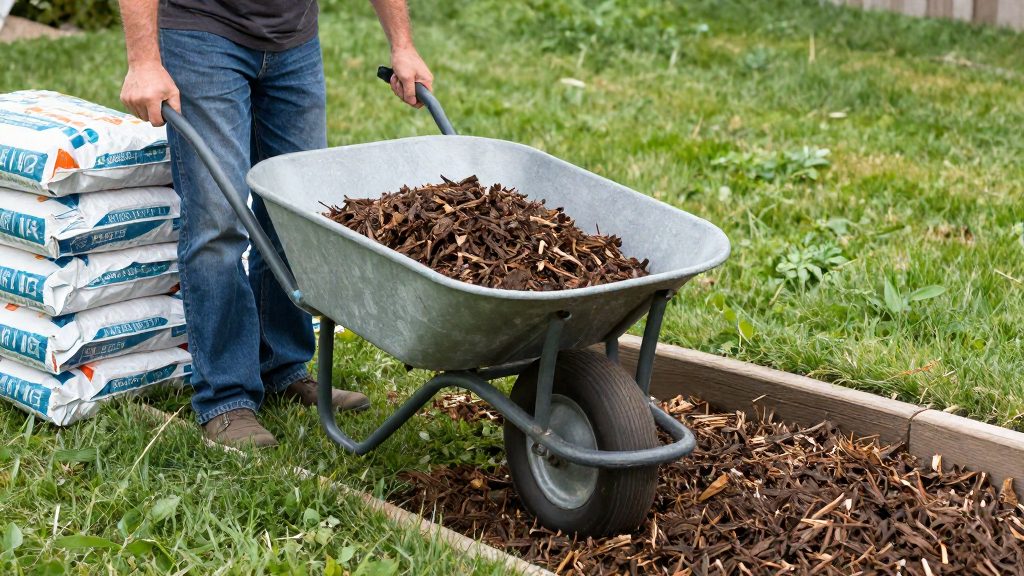
A cubic yard holds 27 cubic feet. If your bags are labelled 2 cubic feet each, one cubic yard equals 13.5 bags. Bag sizes vary, so always check the volume printed on the bag. To convert a total order, multiply the cubic yards by 27 and divide by the bag size in cubic feet. For the worked example, 2.04 cubic yards equals about 55 cubic feet, which means about 28 bags of 2 cubic feet. Bags suit small beds, but a large order is much easier to spread from a bulk delivery.
How do cubic yards compare with cubic metres?
Canadian suppliers may quote metric volumes, so it helps to know the conversion. One cubic yard equals 0.7646 cubic metres, and one cubic metre equals about 1.31 cubic yards. The yard is defined as exactly 0.9144 metres, so the cube of that value gives the exact conversion. The NIST Guide for the Use of the International System of Units (SP 811, 2008 edition) sets out the SI framework and the relationship between US customary and metric units. For the worked example, 2.04 cubic yards is about 1.56 cubic metres. Confirm which unit the supplier is quoting before placing an order, and never mix the two in one calculation.
When should you top up instead of replacing mulch?
Topping up is the right choice when the existing layer has thinned but is still clean and loose. Calculate only the missing depth, which is the target depth minus the current depth. For the same 20 × 10 ft bed with 1 inch of mulch remaining, bringing the layer up to 3 inches requires 2 inches of new material: 200 × 2 ÷ 324 × 12 ÷ 12 simplifies to 400 ÷ 324 = 1.23 cubic yards, or about 1.36 with the margin.
Replace the layer rather than topping it up when the old mulch is matted, compacted, mouldy or breaking down into a dense mat, because new material on top will not drain or breathe properly. If the bed already sits above the target depth, remove some of the old mulch first. Avoid adding a new layer over an old one year after year, since the layers build up and push the mulch above the planned depth.
What precautions apply when spreading mulch?
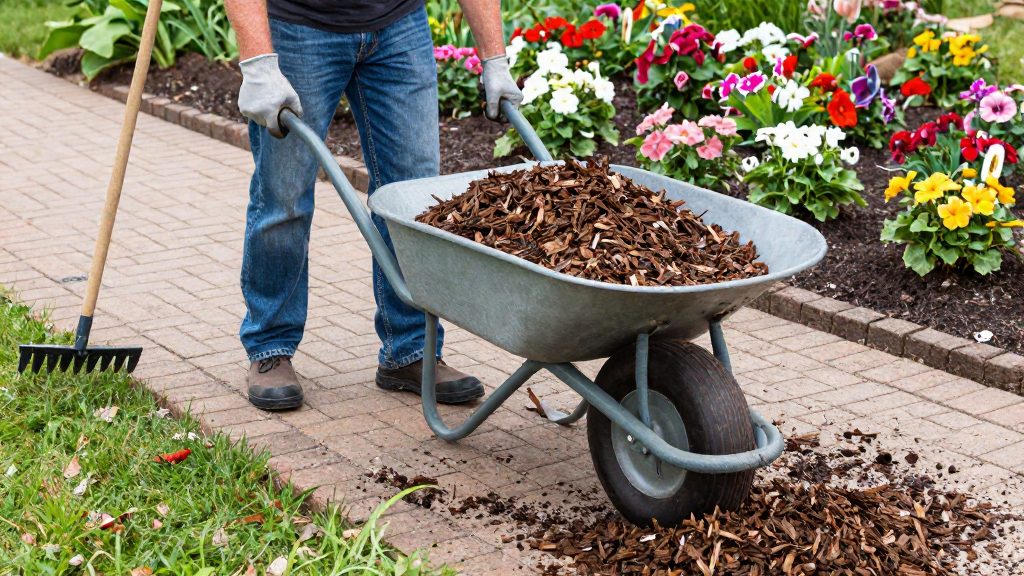
Bags and wheelbarrow loads are heavy, so lift with your legs, keep loads small, and use a wheelbarrow or tarp to move bulk material over longer distances. Wear gloves, and consider a helper for large deliveries. Before spreading, pull out weeds and their roots so they cannot grow through the layer.
Keep mulch away from plant stems and crowns. Do not build it into a mound or cone around stems, because damp material held against the stem can encourage rot. Pull the layer back from the base of each plant, and keep it clear of the trunks of trees and shrubs as described above. Check the path of the delivery truck and the drop-off area before the order arrives, so the material can be placed without damaging lawns or planting beds.
Frequently asked questions
Does the formula change if my bed slopes?
The formula stays the same, but measure the flat footprint of the bed and add a larger margin than usual. Mulch tends to wash toward the lower edge, so check the layer after the first heavy rain and top up the low side if needed.
Should mulch be kept away from the wall of my house?
Yes, it is sensible to leave a clear gap between the mulch and the foundation and wood siding. Check local rules and building guidance for fire safety and moisture, since they vary by region and by house construction.
What should I do with leftover mulch?
Keep it covered and dry so it stays loose and can be used for a later top-up. Unused mulch can also go on a path or a different bed, as long as the depth is adjusted to suit that planting.
Do vegetable gardens need the same mulch depth as flower beds?
Often a thinner layer is used, but the right depth depends on the crop and on how the soil warms in spring. Follow the planting or seed guidance for the vegetables you are growing, and keep the mulch clear of young seedlings.