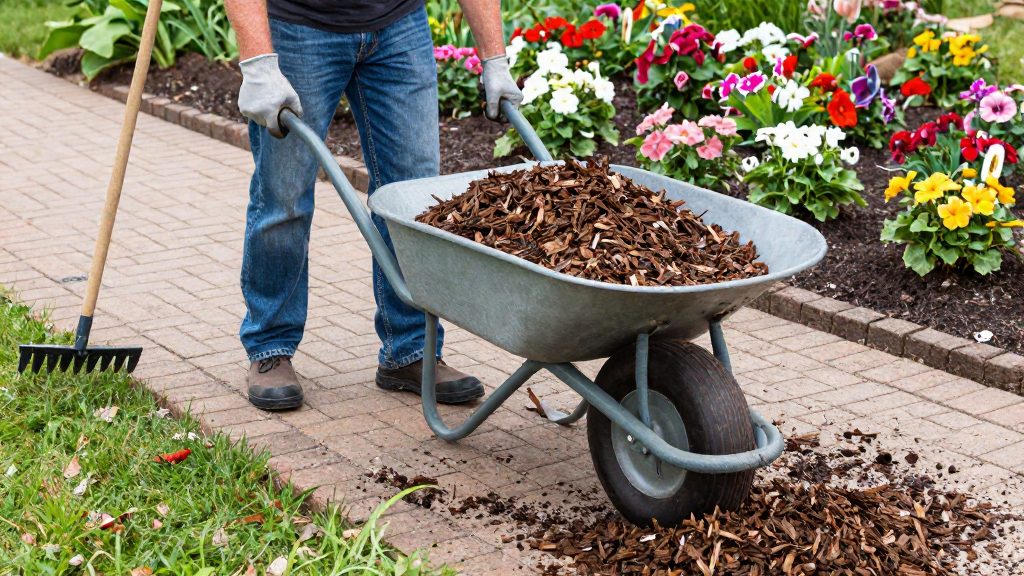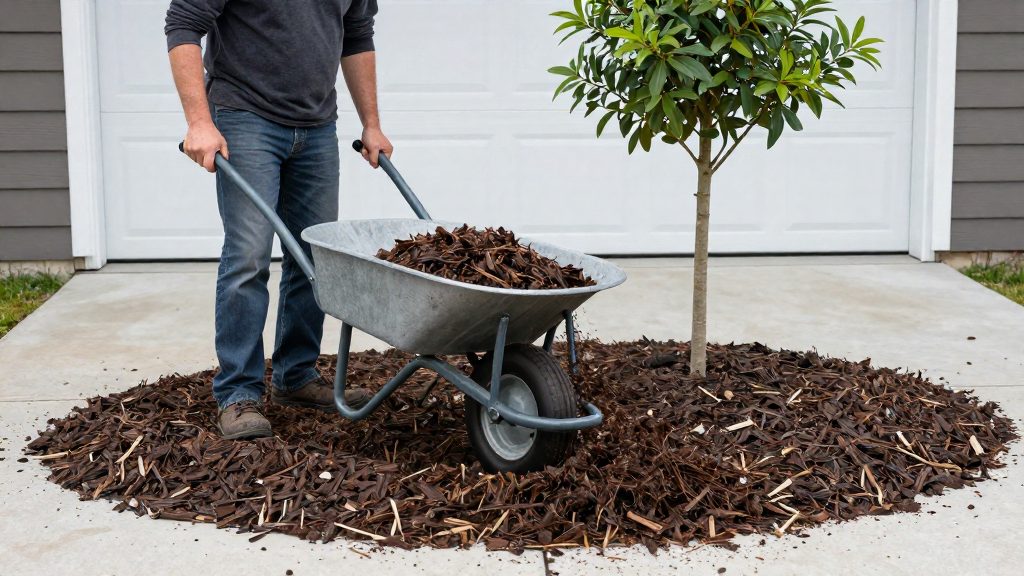
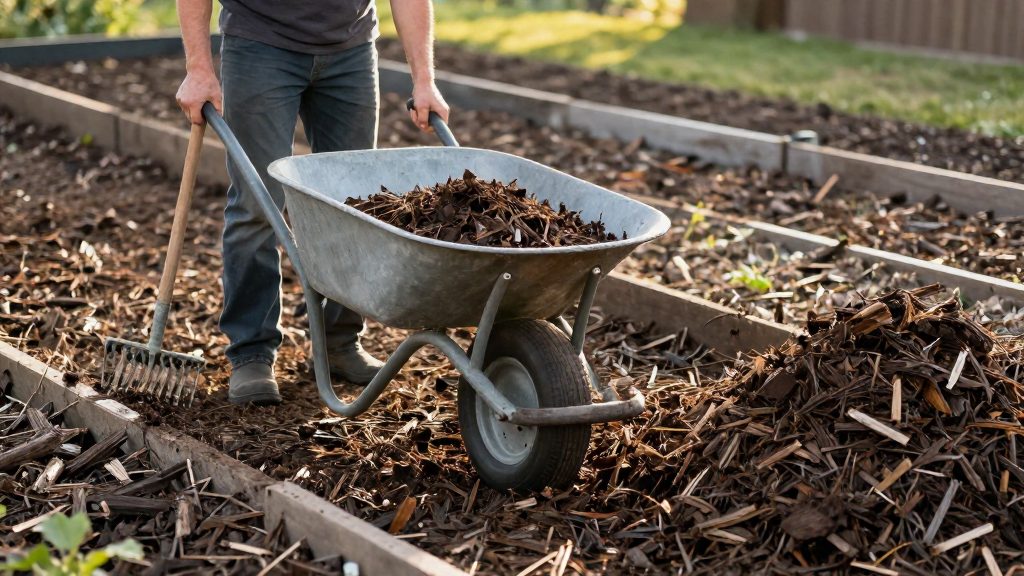
For most trees on well-drained ground, spread wood chips or shredded bark about 7.5 to 10 cm (3 to 4 inches) deep, out to the drip line, which is the outer edge of the branches. Keep the material at least 15 cm (6 inches) from the trunk. On heavy soils, use 5 to 7.5 cm (2 to 3 inches) instead. To estimate the quantity, multiply the area of the ring by the depth, then convert the result into bags or cubic metres. The steps below explain each part, with a worked example for a ring that reaches 2 metres from the trunk.
How deep should the mulch layer be?
Depth depends mainly on drainage. Iowa State University Extension and Outreach (2022) recommends a layer of 3 to 4 inches (about 7.5 to 10 cm) of wood chips or shredded bark on well-drained sites around trees and shrubs. On heavy soils, it advises 2 to 3 inches (about 5 to 7.5 cm), because a deeper layer can waterlog the soil and limit the movement of oxygen into it. Before you choose a figure, observe how quickly water leaves the ground after a heavy rain. If the surface stays soggy for a long time, treat the site as heavy and use the shallower range.
The type of material changes the target as well. HortMag (2026) advises about 3 inches (7.5 cm) of coarse mulch, such as bark chips, and about 2 inches (5 cm) of fine mulch, such as shredded bark. The official sources consulted do not give a combined figure for fine material on heavy soil. In that case, start at the shallow end of both ranges and add more only if the layer is clearly too thin after you have spread it.
When should you top up instead of spreading a new layer?
If the bed already has mulch, do not spread a full new layer on top of it. HortMag (2026) advises adding only enough to bring the total back up to the target depth. To measure the existing layer, push a ruler or a straight stick down until it meets the soil, then read the depth. Add only the difference between what you measured and the target. This keeps the layer from getting too thick, which is the mistake the depth guidance is meant to prevent.
How wide should the ring be?
Extend the mulch out to the drip line wherever you can. HortMag (2026) recommends this approach, and where it is not practical, it suggests a ring at least 1.2 metres (4 feet) across. The word across means diameter. A 1.2 m ring therefore reaches only 0.6 m from the centre of the trunk, which is a minimum and not an ideal. As the canopy grows, the drip line moves outward, so a ring that was right when the tree was planted may need widening over the years.
Why keep mulch away from the trunk?
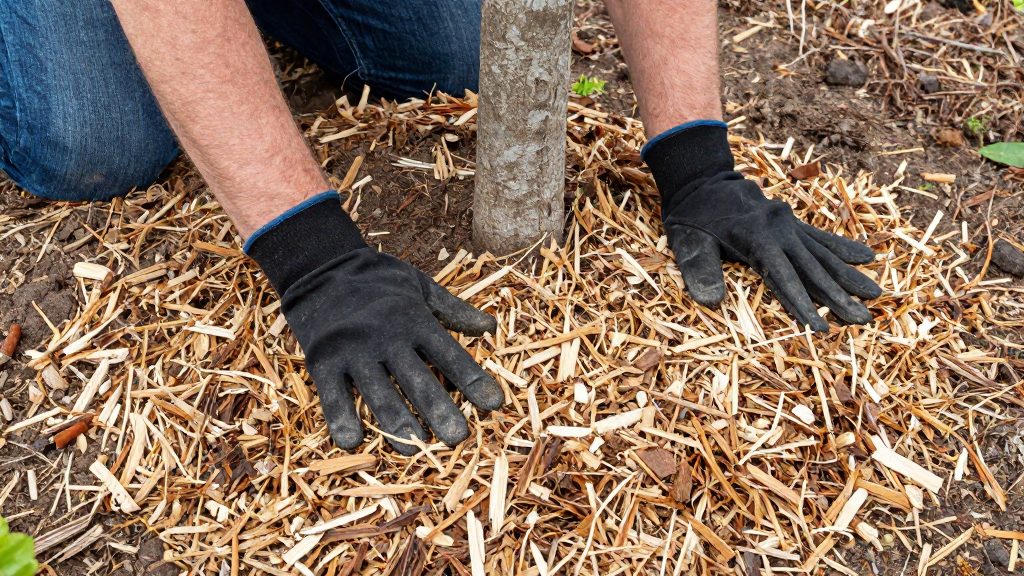
Iowa State University Extension and Outreach (2022) advises keeping mulch at least 6 inches (about 15 cm) from tree trunks. Mulch piled against the trunk can encourage fungal cankers, root rots and rodents. HortMag (2026) gives a related instruction that can look contradictory at first: bring the mulch up to the base of the root flare, which is the swollen section where the trunk meets the roots, but never cover it.
The two rules fit together once you separate distance from height. The 15 cm clearance is the horizontal limit: the material stops at least that far from the trunk. The root flare rule is the vertical limit: near the trunk, the top of the layer may rise to the level where the flare begins, but no mulch should sit on the flare itself. In practice, the layer thins as it approaches the trunk, ends on bare soil at least 15 cm out, and leaves the flare exposed to air. Do not pile material into a cone, which is the shape commonly called a mulch volcano.
How do you work out the volume?
The volume of the ring is its area multiplied by the depth. Because the ring has a hole in the middle where the trunk stands, the area is the outer circle minus the inner circle. In plain text, the formula is: volume in cubic metres = π × (outer radius × outer radius − inner radius × inner radius) × depth in metres.
The outer radius is the distance from the centre of the trunk to the drip line. The inner radius is the distance from the centre of the trunk to the edge of the 15 cm clear zone, which equals the trunk radius plus 15 cm. Measure the trunk at about its base to find its radius, then add 0.15 m.
Here is a worked example. Suppose the trunk is about 20 cm across, so its radius is 0.10 m, and the inner radius of the mulched area is 0.10 + 0.15 = 0.25 m. The drip line is 2.0 m from the centre of the trunk. The area is π × (2.0 × 2.0 − 0.25 × 0.25) = π × (4.00 − 0.0625) = π × 3.9375, which is about 12.37 m².
On well-drained ground, with a depth of 7.5 to 10 cm (0.075 to 0.10 m), the volume is 12.37 × 0.075, which is about 0.93 m³, up to 12.37 × 0.10, which is about 1.24 m³. On heavy soil, with a depth of 5 to 7.5 cm (0.05 to 0.075 m), the volume is 12.37 × 0.05, which is about 0.62 m³, up to 12.37 × 0.075, which is about 0.93 m³. Because the layer thins toward the trunk, these figures slightly overestimate what you will actually spread. If you are using the minimum 1.2 m ring instead of the drip line, put 0.6 m in place of the outer radius and repeat the same steps.
How many bags or cubic metres should you buy?
Convert your calculated volume into the unit printed on the bag. One cubic metre equals 1,000 litres. Divide the volume in litres by the volume of one bag, also in litres, and round up to a whole number of bags. Using the well-drained example above, a volume of 0.93 m³ is 930 litres, and a volume of 1.24 m³ is 1,240 litres. Check the volume printed on the bag or in the supplier’s documentation, because bag sizes vary and the figure on the label is the only one that matters for the count. If you buy loose material by the cubic metre, order the figure you calculated and round up slightly to allow for an uneven surface.
When should you check with an arborist or a local authority?
Adding mulch is low risk, but a few situations call for expert advice before you work. If the tree leans, if the trunk is cracked or oozing, or if you find signs of cankers, have a certified arborist assess the tree before you change the soil around it. Do not dig around the roots to look for a hidden root flare, because damaged roots can weaken the tree. Ask an arborist to locate it instead.
If the tree stands on public land, such as a boulevard or a municipal park, check with your municipality before you change the ground around it. The official sources consulted do not specify a national Canadian rule for the dimensions of tree rings, so local bylaws and the guidance of your municipality or provincial extension service are the reliable references for any work on public ground.
Frequently asked questions
Can I use leaves or grass clippings instead of wood chips?
The official sources consulted do not give depths for leaves or grass clippings. The figures above apply to wood chips, bark chips and shredded bark. Ask your local extension service before using other materials.
How often should I add mulch?
The official sources consulted do not give a fixed interval. Measure the existing depth each season and top up only the missing amount.
Does the same clearance apply to shrubs?
For shrubs, HortMag (2026) advises leaving a small band of bare soil around the stems rather than piling mulch against them. The sources consulted do not give a metric figure for that band.