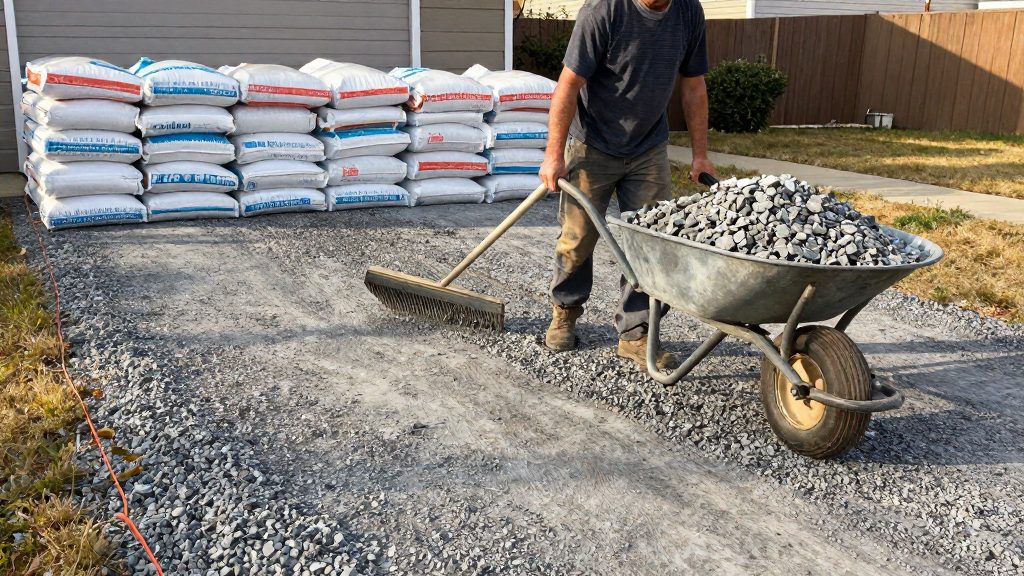
For a driveway 20 feet long, 10 feet wide and 6 inches deep, you need 100 cubic feet of gravel. That is about 3.7 cubic yards, or 2.8 cubic metres. Adding about 10% for compaction and spreading losses brings the total to roughly 4.1 cubic yards (3.1 cubic metres). If you order in whole yards, round up to 5. The 10-foot width is only an example: measure your own width, and every other figure follows from it.
How do you calculate the volume of gravel?
Gravel is bought by volume, so start with the shape of the area to fill. Measure length and width in feet, and depth in inches. Convert depth to feet by dividing inches by 12, so 6 inches becomes 0.5 feet. Then multiply:
length × width × depth = cubic feet
Divide cubic feet by 27 to get cubic yards. To get cubic metres, multiply cubic feet by 0.0283. If you measure in metres from the start, the same formula gives cubic metres directly. A depth of 15 centimetres is 0.15 metres.
Keep all three measurements in the same unit before you multiply. Mixing feet, inches and metres in one calculation gives a result that can be badly wrong, so convert everything first.
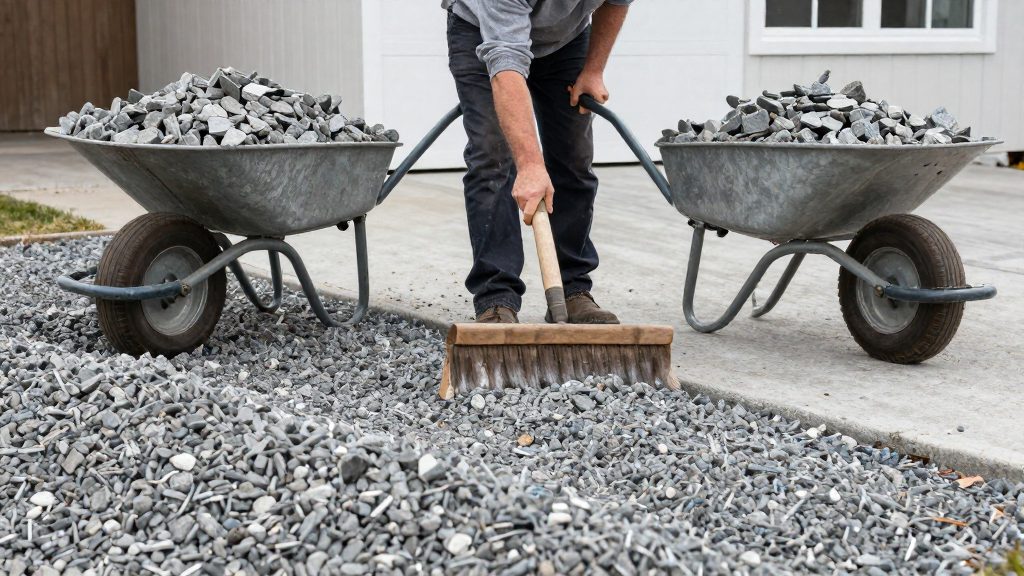
How much gravel does a 20 × 10 foot driveway need?
Take a driveway 20 feet long, 10 feet wide, finished at 6 inches deep:
- Depth: 6 inches ÷ 12 = 0.5 feet.
- Volume: 20 × 10 × 0.5 = 100 cubic feet.
- In cubic yards: 100 ÷ 27 = about 3.7 cubic yards.
- In cubic metres: 100 × 0.0283 = about 2.8 cubic metres.
- With about 10% extra: about 4.1 cubic yards, or about 3.1 cubic metres.
- Rounded up to whole yards: 5 cubic yards, or about 3.8 cubic metres.
The rounding step matters. Suppliers who deliver by the full yard will charge for the fifth yard even if the last part is not needed, so check how your supplier sells before you order.
What depth should the gravel be?
ArcSite’s gravel driveway calculator, a commercial tool, describes 4 to 6 inches as typical for a gravel driveway. It notes that heavier loads, such as recreational vehicles, may require more. Depth changes the volume in direct proportion. The same 20 × 10 foot driveway at 4 inches needs about 2.5 cubic yards before extra, or about 2.7 with 10% added, which rounds up to 3 yards. At 6 inches it needs 5 yards once rounded.
The official sources consulted do not specify a total depth for a residential driveway. Where gravel sits on a prepared base, or where the ground is soft, the total build can be deeper and made of several layers. In that case, calculate each layer separately with the same formula, using that layer’s own depth. Compact each layer before adding the next one.
How do you measure the depth on site?
Ground is rarely level, so one measurement is not enough. Set string lines or stakes along the edges, then check the depth at several points: near the entrance, at the middle and near the street end. Dig a small test trench where the ground looks lowest and measure from the finished grade to the bottom of the excavation. Then use the average depth in the formula.
Measure the finished depth, not the depth of loose stone on the truck. Gravel is compacted once it is spread and rolled, so the layer will be thinner than when it was tipped.
How much extra gravel should you order, and why?
ArcSite’s guidance includes about 10% extra for compaction. Gravel does not spread or settle evenly, and some stone is lost at the edges or left in the truck bed. The extra is a margin, not a guess. Apply the 10% to the calculated volume, then round up to the next whole yard if your supplier sells by the yard, or use the metric figure if they sell by the cubic metre.
If you later find that the ground needs more stone, calculate the missing volume the same way, using the area that needs topping up and the depth to be added.
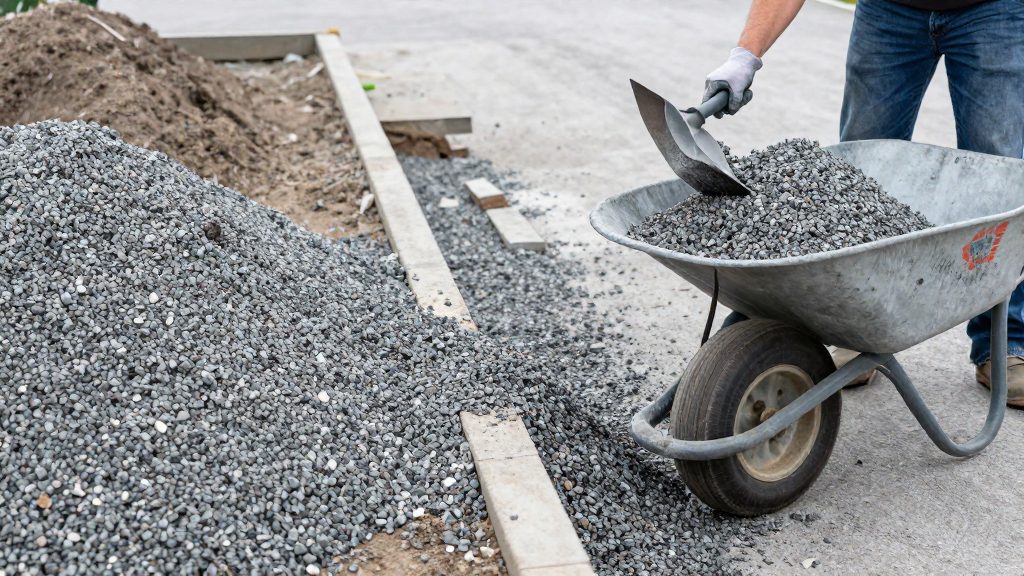
When does the width change the amount?
Volume scales in a straight line with width. For a 12 foot wide driveway at 6 inches: 20 × 12 × 0.5 = 120 cubic feet, about 4.4 cubic yards, or about 4.9 with 10% extra. That still rounds up to 5 yards. At 14 feet wide, the figure is 140 cubic feet, about 5.2 cubic yards, or about 5.7 with extra, so 6 yards once rounded.
For a tapered or curved driveway, divide the area into simple rectangles or triangles, calculate each piece, and add the volumes together. Measuring the width at several points and averaging them gives a usable estimate for most driveways.
How do you turn the volume into weight?
Gravel is often sold by weight, so you may need a tonnage as well as a volume. Weight equals volume multiplied by the material’s bulk density, expressed in tonnes per cubic metre or tons per cubic yard. Bulk density depends on stone type, particle size and moisture content. The official sources consulted do not give one figure that applies to all gravel, so do not reuse a number from a different material.
Ask the supplier for the bulk density of the product you are buying, or for the weight shown on the delivery ticket. Check the load limit of your vehicle or trailer before hauling loose stone yourself, and never load a vehicle beyond its rated capacity.
When do you need to request a utility locate?
Before any digging for a base or a trench, find out where buried services run. In Ontario, the one-call service, now Ontario Dig Authority, asks homeowners to request a locate at least 5 business days before a single-address project, or 10 business days for a multi-address or large project. The service is free. Do not start digging until every notified owner has replied. Other provinces and territories run their own one-call services, so check the one that covers your address.
Excavation also creates hazards on the surface. Keep spoil piles and the delivery truck well back from the edges of the excavation. Do not stand behind a truck while it is tipping, and keep children and pets away from the work area. Wear gloves, sturdy boots and eye protection when raking or shovelling stone, and use hearing protection when running a plate compactor.
Frequently asked questions
Does soft or clay-heavy ground change how much gravel I need?
It can call for a deeper or more layered build, but the official sources consulted do not set a depth for it. Ask a local contractor or the material supplier to assess the ground before you order.
How often does a gravel driveway need topping up?
The sources consulted give no fixed interval. Top up when ruts, washouts or bare patches appear, and calculate the volume for only the area that needs it.
Do I need a permit to build or change a gravel driveway?
Rules are set by your municipality and vary by place. Check with your local government before changing the grade, drainage or entrance where the driveway meets a public road.