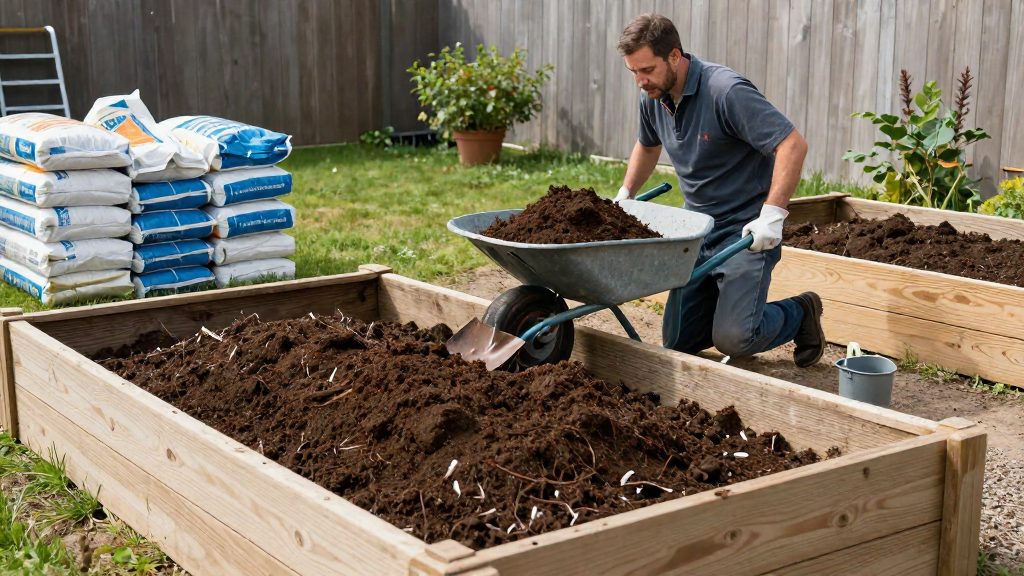
To work out how much topsoil a raised bed needs, calculate the total volume of the bed, then take the share of that volume that is topsoil in your mix. For a bed measuring 1.2 m × 2.4 m and filled to 30 cm, the total is 0.86 cubic metres, or about 1.13 cubic yards. With a mix of 40% topsoil, 40% compost and 20% sand, the bed needs about 0.35 cubic metres of topsoil, roughly 0.45 cubic yards. The steps below show how to get these figures for your own frame, how to choose the depth, and what to check before the soil goes in.
How do you calculate the volume of soil for a raised bed?
Measure the inside of the frame, so the thickness of the boards does not inflate the figure. Then apply two steps, using one unit for every measurement:
area = length × width volume = area × depth
In metric, convert the depth from centimetres to metres by dividing by 100, so a 30 cm fill becomes 0.30 m. Bulk soil is often quoted in cubic yards as well as cubic metres, so it helps to know both conversions. One cubic yard equals 0.764555 cubic metres, so cubic metres ÷ 0.764555 gives cubic yards. In imperial units, cubic feet ÷ 27 gives cubic yards.
Here is the metric example:
1.2 m × 2.4 m = 2.88 m² (area) 2.88 m² × 0.30 m = 0.864 m³ (volume of finished fill) 0.864 m³ ÷ 0.764555 = about 1.13 cubic yards
The same logic in imperial units: a 10 ft × 8 ft bed filled to 6 inches (0.5 ft) gives 80 square feet × 0.5 ft = 40 cubic feet, and 40 ÷ 27 = about 1.48 cubic yards.
The Old Farmer’s Almanac topsoil calculator follows this method. You enter the length and width in feet, or the total area, then the depth, and the tool reports the result in both cubic feet and cubic yards. Check its output against your own arithmetic before ordering. Round the total up to a convenient figure, and read the section on settling below before deciding how much margin to add.
How deep should a raised bed be?
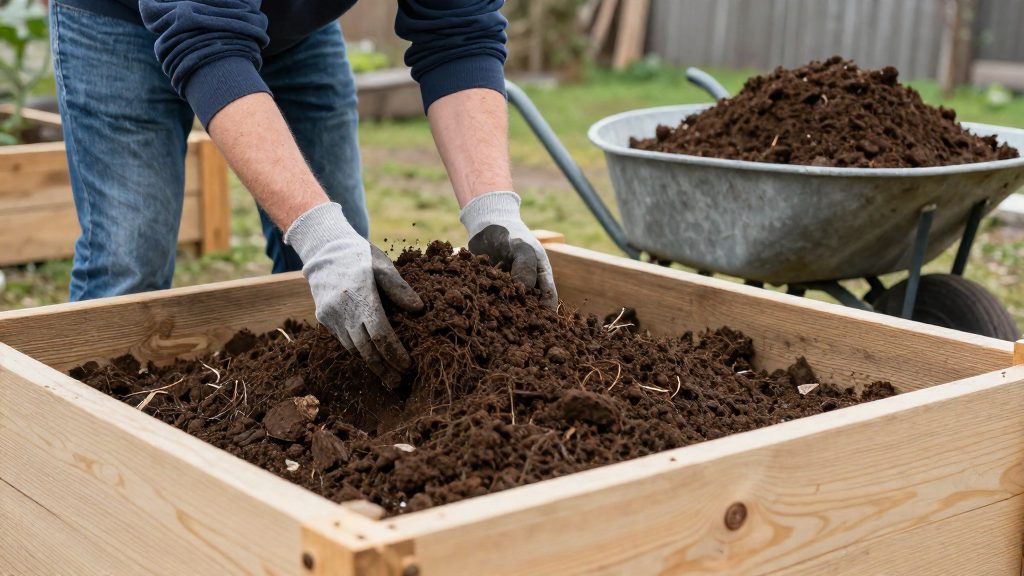
Depth sets how much soil roots can use and how much water the bed holds between waterings. The Old Farmer’s Almanac describes 6 to 12 inches (about 15 to 30 cm) as typical for raised beds, and advises erring on the deeper side when in doubt. Ask Extension (2024) answered a homeowner’s question on the same point: ‘I think 12 inches is the minimum’, and ‘the deeper the raised bed the better’. The 30 cm figure is therefore the more cautious target, and the 15 cm end of the range is a compromise to choose only when you know the crops are shallow-rooted and the site drains well.
Root crops such as carrots and potatoes need loose soil to a greater depth than leafy greens, so plan for the deeper end of the range if you grow them. The official sources consulted do not give a specific depth for individual root crops, so check the growing guidance for each crop you plan to plant.
Beds set on a hard surface, such as concrete, asphalt or a patio, need particular care. Roots have no soil to grow into below the bed, and water can collect at the base. The official sources consulted do not give a separate depth figure for that case. Before you choose a depth, check with your local extension office, and confirm that the base of the frame has openings or a drainage layer that lets excess water leave.
Which soil mix should fill the bed?
Topsoil on its own is rarely the whole answer. The Old Farmer’s Almanac gives a raised-bed mix of 40% topsoil, 40% compost and 20% sand. With that split, the topsoil volume is the total bed volume × 0.40.
For the 0.864 m³ example, 0.864 × 0.40 = 0.35 m³ of topsoil, or about 0.45 cubic yards. The same split gives 0.35 m³ of compost and about 0.17 m³ of sand.
The University of Maryland Extension (2019) states that raised beds made of 20% to 50% plant-based organic matter, by volume, typically produce healthy vegetable gardens. The 40% compost in the recipe above falls inside that range. If you buy topsoil with no compost, you will need to add organic matter yourself to reach it, and the amount you add changes the topsoil figure in the calculation.
Why should you allow extra soil for settling?
A freshly filled bed drops as the mix settles, and it drops further after heavy watering. Loose compost and sandy mixes shrink as they consolidate, so the depth you measure on the day of filling will not be the depth you have a month later. The official sources consulted do not specify a settling percentage, so choose a margin yourself and include it in your order from the start, rather than guessing at the end.
After the first few waterings, measure the depth again at several points across the bed. If it has dropped noticeably, top up with the same mix and level the surface. Doing this in the first season avoids planting roots into a shallow layer.
When should you test the soil before filling the bed?
Test the ground when the site may contain contamination, for example where its history is uncertain or where older structures have stood. The Government of Manitoba’s public guidance on backyard gardening states that, if precautions are taken, the health risks of gardening, even in contaminated soil, are low to very low, unless contamination levels are very high. The same guidance notes that soil testing can cost about as much as precautionary measures such as building a raised bed garden. For that reason, a bed filled with clean soil is often the practical choice, and testing is most useful when you need to know whether the native ground under a bed poses a risk.
If a test shows elevated levels, contact your local public health unit before planting. The official sources consulted do not give a single national threshold that applies across Canada, so local advice is the reliable guide. Whatever the results, wash vegetables thoroughly before eating them, and keep children from putting soil in their mouths, since the Manitoba guidance identifies both as common routes of exposure.
How do you handle bulk soil safely?
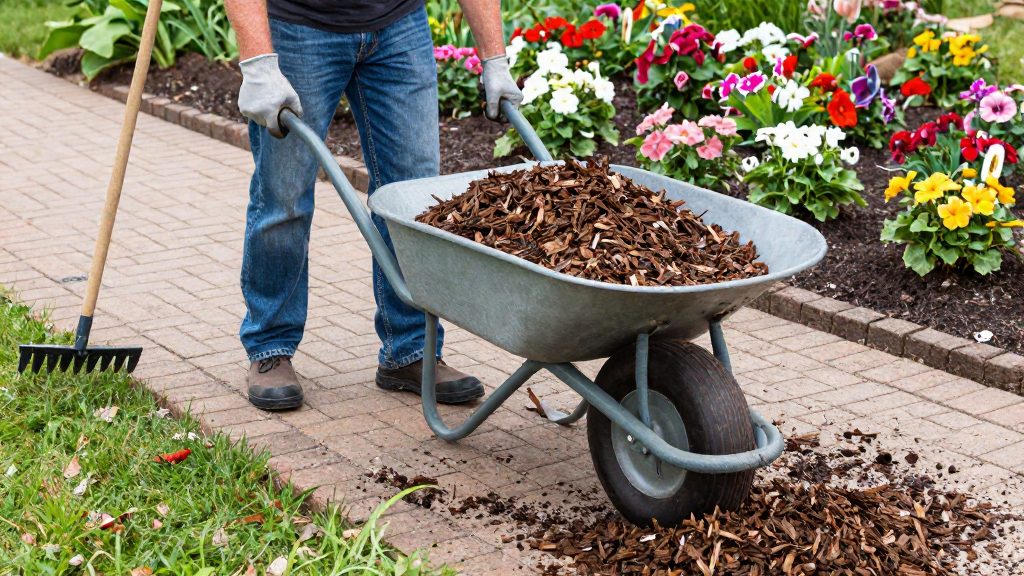
Wet soil and compost are heavy, and a large delivery can strain a back. Ask for the load to be placed as close to the bed as possible, move it in small amounts with a wheelbarrow, and bend at the knees rather than the waist. Do not overfill the barrow.
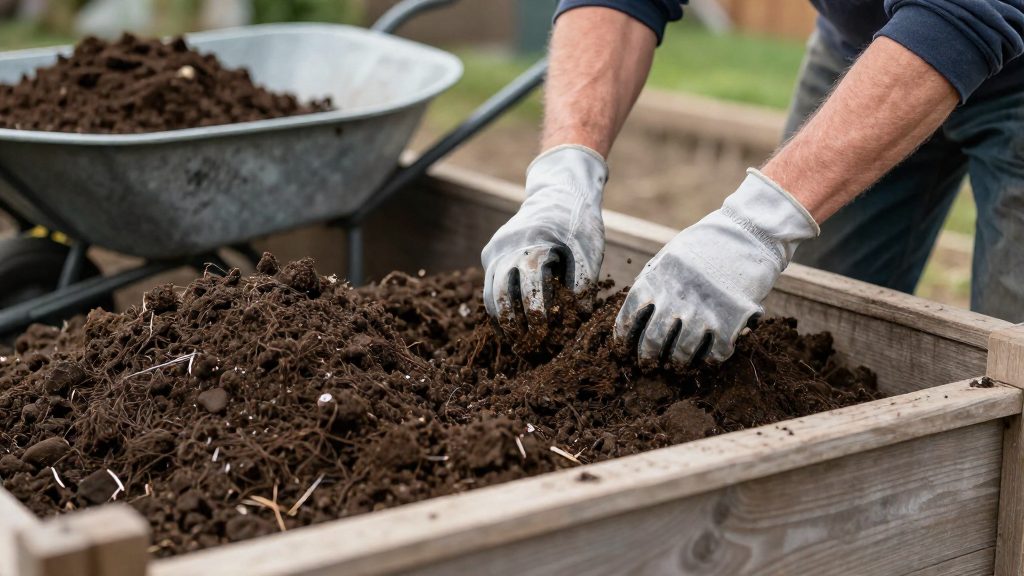
Wear gloves when handling soil and compost, and a dust mask when the material is dry and dusty. Keep children and pets away from the pile while you fill the bed.
Before you dig the ground under or around the frame, contact your provincial underground-utility locate service to have buried lines marked. Finally, check that the frame is level and stable before filling. A frame that holds a heavy fill with no bracing can bow outward, so inspect it after the first filling and reinforce it if needed.
Frequently asked questions
Can I place a raised bed directly on a lawn?
The official sources consulted do not specify whether grass must be removed first. Cut the grass short, check the base of the bed for drainage, and confirm the approach with your local extension office.
Can I reuse soil from an old garden in a new bed?
The official sources consulted do not give a rule for reused soil. If the old soil comes from ground with an uncertain history, test it before mixing it in, and contact your local public health unit about any results.
How do I work out the number of bags to buy?
Divide the total volume you calculated by the volume printed on the bag, using the same unit for both, then round up to a whole number of bags.