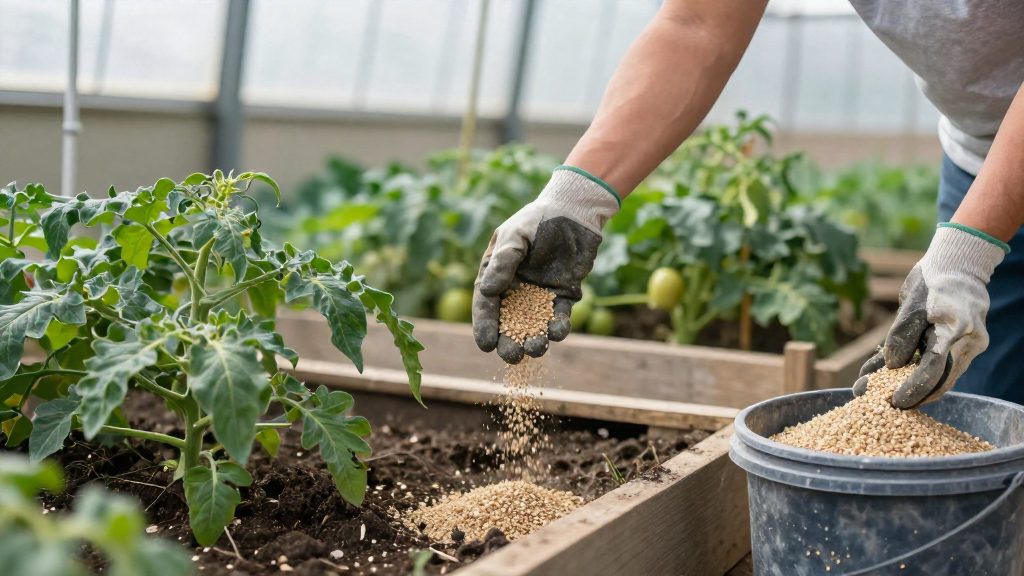
For a vegetable garden where no soil test has been done, the general starting point published by Penn State Extension is 1.75 pounds of 10-10-10 fertilizer per 100 square feet for the growing season. Converted to metric for this article, that is about 85 g per m², or roughly 0.85 kg per 10 m². It is a Pennsylvania-based default, not a Canadian recommendation, so treat it as a starting point and confirm it with a soil test. The sections below show how to convert the rate to any grade of fertilizer, how to size it for your bed, and what to check before you spread anything.
How much fertilizer does a vegetable garden need without a soil test?
The Penn State figure is a general rate for a season, not a rate for a particular crop. Iowa State University Extension and Outreach likewise states that actual rates should come from a crop recommendation or a soil test. The figure also assumes you do not know what your soil already contains, which is why the soil test section matters more than any conversion. Because the original rate is given per 100 square feet, which is about 9.3 m², every calculation in metric starts by converting that area. Keep the unit consistent from the first step to the last, because mixing square feet and square metres is the most common source of error when people adapt a published rate.
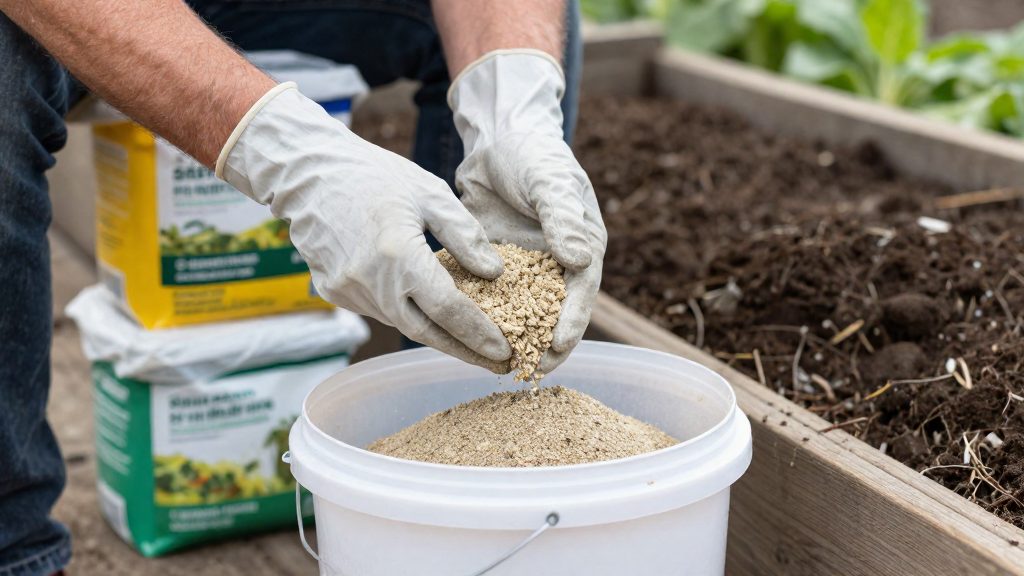
How do you read the grade on a fertilizer bag?
The three numbers on a Canadian fertilizer bag are the guaranteed minimum percentages of total nitrogen (N), available phosphoric acid and soluble potash (K), in that order. Section 15 of the federal Fertilizers Regulations requires the guaranteed analysis to state these minimums in per cent (Justice Laws Website). A bag labelled 20-10-20 therefore guarantees at least 20% nitrogen, 10% phosphoric acid and 20% potash. The three numbers often do not add up to 100%. The rest is filler and secondary or micronutrients, and Iowa State warns against assuming the remainder is nutrient. For the calculations here, only the first number, nitrogen, is needed.
How do you convert the rate to a different fertilizer?
Work from nitrogen, because the Penn State rate is set by the nitrogen it supplies. The 10-10-10 rate provides 0.175 lb of nitrogen per 100 square feet, which is about 8.5 g of nitrogen per m². Divide that amount by the nitrogen fraction of your bag, which is the first number written as a decimal:
product per m² = nitrogen per m² ÷ nitrogen fraction
For a 20-10-20 bag, the fraction is 0.20, so 8.5 g ÷ 0.20 gives about 43 g of product per m², half the 10-10-10 amount. Penn State reaches the same result, about 0.88 lb per 100 square feet. Always use the grade printed on your own bag, and recalculate if it differs from the example.
How do you calculate the amount for your bed?
Iowa State gives a three-step method: divide the nitrogen rate by the fertilizer’s nitrogen fraction to get the product rate per unit of area, measure the bed, then multiply the product rate by the area. In metric, the area is length × width in metres. For a bed 4 m long and 3 m wide, the area is 12 m².
With the 10-10-10 rate, 85 g × 12 m² gives about 1.03 kg, so the whole bed needs about 1.0 kg of 10-10-10.
With a 20-10-20 bag, the bed needs 8.5 g × 12 m², or about 103 g of nitrogen. Dividing by 0.20 gives about 0.51 kg of product.
Iowa State also lists general nitrogen rates of 0.10, 0.15 and 0.20 lb per 100 square feet, roughly 5, 7 and 10 g of nitrogen per m². It presents these as examples of the calculation, not as vegetable-specific rates, so use them only to see how a different target changes the result.
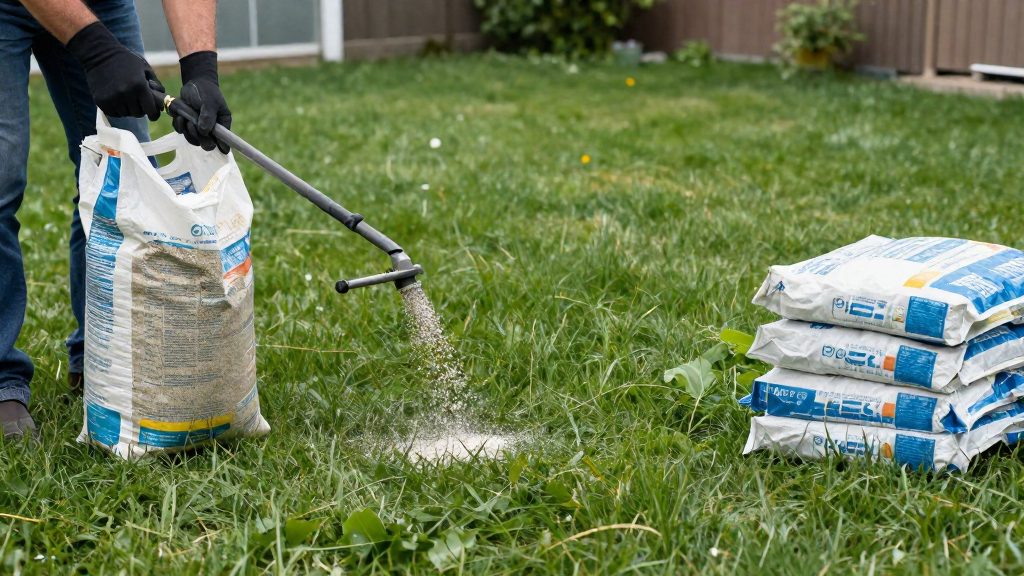
Weigh the product on a kitchen scale rather than estimating by volume, because granules of different products do not pack to the same density. Spread it evenly over the bed in a grid so that no strip receives more than its share.
How do you handle several beds or two products?
Add the areas of all beds first. Penn State notes that if you use more than one fertilizer, you add the nutrient amounts together. For example, a 12 m² bed and a 6 m² bed (3 m × 2 m) total 18 m². At the 10-10-10 rate, that is 85 g × 18 m², or about 1.5 kg. If you split the garden between two products, calculate the nitrogen each one supplies for its own area, add the totals, and note the grade of each bag so the record stays accurate for the next season.
Why should you test the soil before you apply fertilizer?
Penn State’s advice is direct: do not guess, soil test. A test shows what the soil already holds, so the rate can be adjusted instead of applied by default. In Ontario, soil tests are run by commercial laboratories accredited by OMAFRA, and the provincial guidance says the tests support fertilizer decisions for annual and perennial crops. That guidance is written for field and commercial crops and does not mention home gardens, but its sampling advice applies to a backyard bed. Take basic-test cores to about 15 cm, sample in a zigzag across the area, and avoid fertilizer bands, dead furrows, roadsides and piles of lime, manure or compost. Use a plastic pail rather than galvanized metal, because zinc contamination can skew micronutrient results. Outside Ontario, the official sources consulted do not list accredited laboratories, so check with your provincial agriculture ministry or a local laboratory before sending a sample.
When should you change the amount?
A soil test can change both the amount and the product. If the report shows a nutrient already high, do not add more of it; Iowa State’s example is phosphorus. If the test recommends a nitrogen rate different from the default, the test result replaces the 10-10-10 figure in every calculation above. OMAFRA suggests resampling once every two or three years, because the levels in a bed change as crops are grown and organic material is added. The official sources consulted do not specify how to divide the amount across the season or whether to side-dress, so follow the product label and your test report for timing.
What safety precautions apply at home?
Health Canada’s garden safety guidance (archived copy, last updated 2006-05-04) advises storing garden chemicals out of sight and out of reach of young children. That page does not name fertilizers, so the storage and handling instructions printed on the product label are the reference for your bag. In practice, keep the product in its closed original container, away from children and pets. Wear gloves and wash your hands after handling it, measure with a dedicated scoop rather than a kitchen utensil, and sweep up spills from paving so they do not wash away with the next rain. If someone swallows fertilizer, contact a poison centre or a health professional immediately and have the product label with you.
Frequently asked questions
Can I use the same amount for tomatoes, carrots and beans?
The official sources consulted do not give crop-specific rates. The figures in this article are general garden starting points, so use a crop recommendation or your soil test report for each crop.
Can I apply fertilizer to a raised bed filled with purchased soil mix?
The official sources consulted do not address raised beds or bagged soil mixes. Follow the instructions of the mix supplier and the fertilizer label, and calculate the amount from the bed’s area as shown above.
How should I store leftover fertilizer until next season?
Keep it dry, closed in its original container and out of reach of children and pets, and follow the storage instructions on the label. The official sources consulted do not give a maximum storage period.