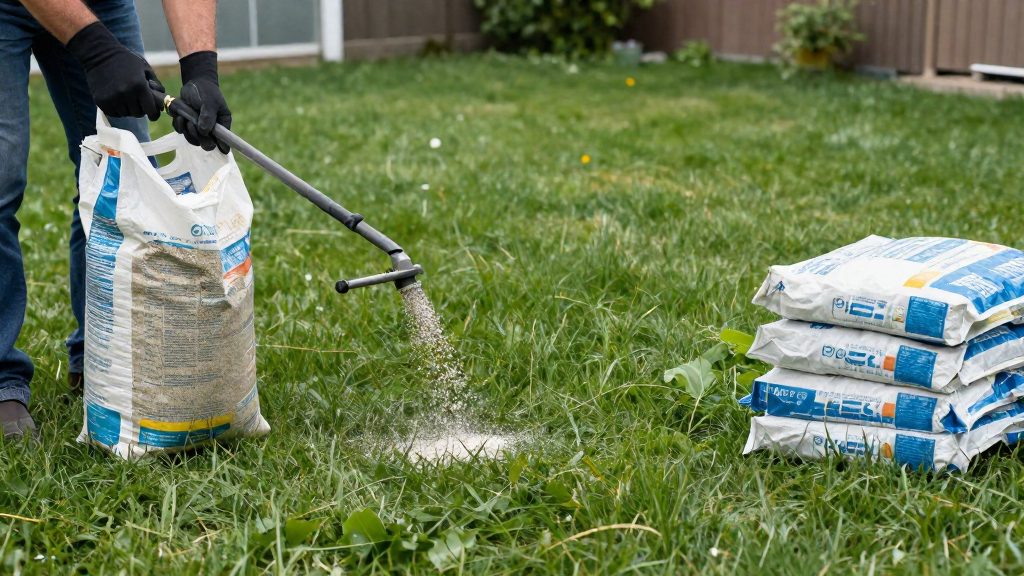
There is no single amount of fertilizer per square foot of lawn that suits every yard. The amount starts from a nitrogen target, and the bag weight follows from that target and the nitrogen share printed on the bag. According to Iowa State University Extension and Outreach (2025), the rate ranges from 0.50 to 1 pound of actual nitrogen per 1,000 square feet, and the right point in that range depends on when you apply and the quality of lawn you want. To get the product weight, divide the nitrogen target by the nitrogen share, a calculation worked through below.
How much nitrogen does a lawn need per square foot?
Nitrogen drives the growth and colour of grass, so it is the figure to plan around. Iowa State gives its range per 1,000 square feet, which works out to 0.0005 to 0.001 pound of actual nitrogen per square foot. “Actual nitrogen” means the nitrogen content itself, not the weight of the product you buy. Mixing up the two is an easy way to apply too much or too little.
The same guidance ties the rate to the time of season and the density you want, so one fixed number is not enough. Iowa is in the United States, so treat its range as a reference point, not as a Canadian rule. The University of Saskatchewan’s lawn guidance does not give a nitrogen rate per unit of area. It asks you to work from the label on the bag instead.
How do you turn a nitrogen rate into bag weight?
The formula is: product weight = nitrogen target ÷ nitrogen share on the bag. The first of the three numbers on a bag is the nitrogen share, so 20-5-10 means 20 percent nitrogen. The other two numbers give the phosphorus and potassium shares. Iowa State notes that many Iowa soils do not need added phosphorus except at seeding, and that a soil test shows what your own soil needs. Some regions also restrict phosphorus in lawn products. The official sources consulted do not set out the rules for your area, so check with your municipality or provincial environment ministry before you buy.
Here is a worked example for a 5,000 square foot lawn, a target of 0.75 pound of nitrogen per 1,000 square feet, and a 20-5-10 product.
- Nitrogen target per square foot: 0.75 ÷ 1,000 = 0.00075 pound.
- Nitrogen needed for the lawn: 0.00075 × 5,000 = 3.75 pounds of nitrogen.
- Product needed: 3.75 ÷ 0.20 = 18.75 pounds of 20-5-10.
Check the result: 18.75 × 0.20 = 3.75 pounds of nitrogen, which matches step 2. In metric units, 18.75 pounds is about 8.5 kilograms (18.75 × 0.4536). At the low end of the range, 0.50 pound of nitrogen per 1,000 square feet on the same lawn needs 2.5 pounds of nitrogen, or 12.5 pounds of the same product.
How much fertilizer per square metre is that in Canada?
Canadian lawn guidance, including the University of Saskatchewan page, often uses square feet, while many labels are metric. The conversion is straightforward. One thousand square feet is about 92.9 square metres, and one pound is about 0.4536 kilogram. So 1 pound of nitrogen per 1,000 square feet is about 0.49 kilogram of nitrogen per 100 square metres (0.4536 ÷ 92.9 × 100 = 0.49). Across Iowa State’s range, the nitrogen target becomes about 0.24 to 0.49 kilogram per 100 square metres.
For a 100 square metre lawn at the top of that range with a 20-5-10 product, the calculation is 0.49 ÷ 0.20 = 2.4 kilograms of product per 100 square metres. For a metric label, the same ratio applies: kilograms of nitrogen per 100 square metres ÷ nitrogen share = kilograms of product per 100 square metres. A 250 square metre lawn needs 2.5 times that amount, about 6 kilograms. If the product label gives its own rate, follow the label and use the conversion only as a cross-check.
When should you fertilize?
Timing changes the nitrogen rate, so decide when before you decide how much. The University of Saskatchewan’s prairie schedule lists a spring application around May 15 with 27-14-0 or 26-13-0, then 34-0-0 around July 1 and again around August 15. These dates are given without a year and reflect prairie conditions. The page lists products by analysis rather than by amount, so you still calculate the quantity for each application from the label.
The same page advises fertilizing in spring only once the grass is actively growing and has been cut at least a couple of times. Water the lawn a day or two before fertilizing so the soil is moist, then apply when the grass is dry. On the prairies and in the far north, do not fertilize in the fall, because lush grass may not harden off properly for winter. That advice is specific to those regions. For other parts of Canada, check your local extension service.
Do grass clippings reduce how much you need?
Partly. The University of Saskatchewan says that leaving clippings on the lawn when you mow can provide up to 50 percent of the lawn’s nitrogen need, and it recommends a mulching blade for this. Because 50 percent is an upper figure and not a guaranteed saving, the official sources consulted do not give a fixed reduction to apply to the calculation. Adjust your nitrogen target within the range above, then judge the result by colour and growth over the season.
How do you spread fertilizer evenly and safely?
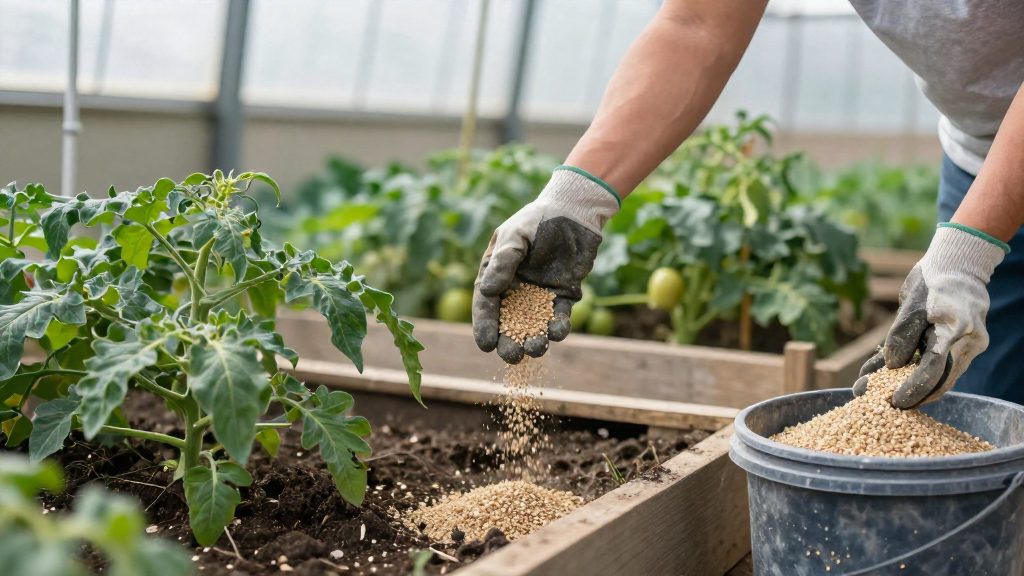
Split the total amount in two. Spread one half walking north to south and the other half walking east to west. This distributes the product more evenly and reduces the risk of scorching the grass. Afterwards, water the lawn to move the nutrients off the blades and into the soil. Sweep granules off driveways, walkways and other hard surfaces, since Iowa State recommends this to reduce runoff.
Keep the bag closed, dry and out of reach of children and pets. Wear gloves and wash your hands after handling the product. Keep children and pets off the treated area until it has been watered in and the label’s re-entry instructions allow access. Before you start, check the spreader’s setting in the manufacturer’s documentation, because the setting changes how much product reaches the lawn.
Frequently asked questions
How do I measure an irregular lawn?
Divide the lawn into simple shapes such as rectangles, triangles and circles, measure each one, and calculate each area with its standard formula. Add the parts together, then subtract any beds, patios or paths you will not fertilize.
Do I need a soil test before buying fertilizer?
A soil test shows which nutrients your soil lacks. Iowa State notes that many Iowa soils do not need added phosphorus outside seeding, but your soil may be different, so the test is the only reliable way to know.
What should I do if the lawn turns yellow or brown after fertilizing?
Stop further applications until the grass recovers, water the area if the product label allows it, and contact a local extension service or check the manufacturer’s documentation to identify the cause.
Can I use the same amount on a newly seeded lawn?
The official sources consulted do not give a separate rate for new seeding. Iowa State mentions phosphorus at seeding only, so follow the manufacturer’s documentation and local extension advice for newly seeded areas.