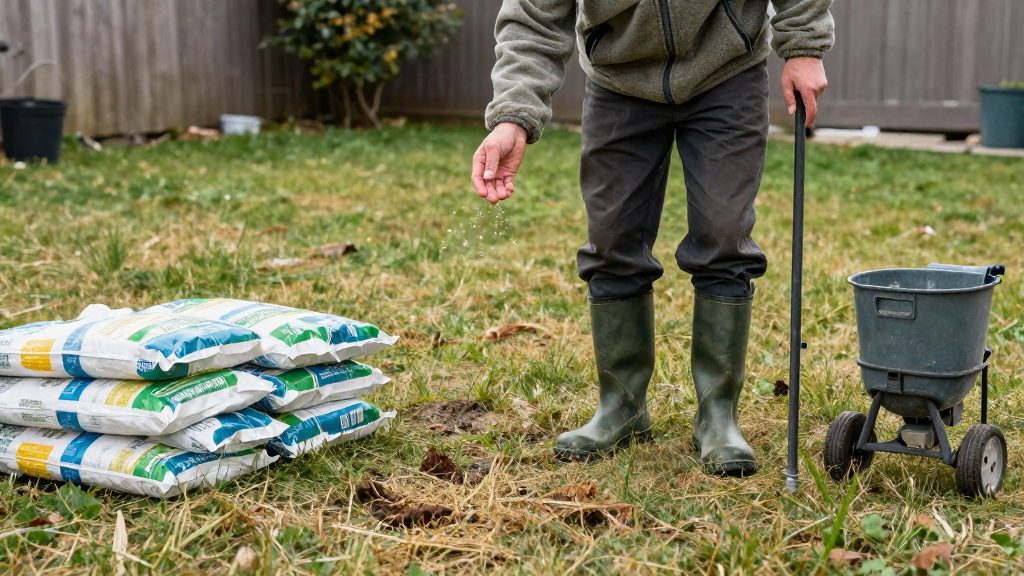
To overseed a lawn, multiply the seeding rate for your grass type by the area you are sowing, then divide by 1,000 when the rate is given per 1,000 square feet. Overseeding rates are about half the rate used for a new lawn, because existing turf already covers most of the ground. For a circular lawn with a 50 ft radius, which covers about 7,854 sq ft, a rate of 2.5 lb per 1,000 sq ft needs about 19.6 lb of seed, or roughly 8.9 kg.
How do I calculate the seed I need?
Start by measuring the area you will sow. For a rectangle, multiply length by width. For a circle, use pi × radius², so a 50 ft radius gives pi × 50 × 50, or about 7,854 sq ft. For an irregular lawn, split the space into simple rectangles and circles, measure each part and add the results. Subtract permanent areas such as garden beds, paving and the footprint of a shed, because they will not receive seed.
Then apply the formula with the rate for your grass type:
Seed needed (lb) = rate (lb per 1,000 sq ft) × area (sq ft) ÷ 1,000
In the 50 ft radius example, the calculation is 2.5 × 7,854 ÷ 1,000 = 19.6 lb (19.635 lb exactly). The same method works with any rate in the table further down. Published examples are not always arithmetically consistent: the Omni Calculator worked example gives 39.35 lb for a rate of 5 lb per 1,000 sq ft over 7,854 sq ft, but 5 × 7,854 ÷ 1,000 is 39.27 lb. Always check a final figure with your own calculation before buying.
Rounding up slightly is a practical way to absorb measuring error. The official sources consulted do not specify a waste allowance, so keep any extra small and based on measurements you have checked.

Why is the overseeding rate about half the new-lawn rate?
Overseeding puts seed into a lawn that is already growing. The new seed only has to fill thin patches and gaps, not build a full stand from bare soil. According to Cooperative Extension (eXtension) (2023), tall fescue needs 6 to 8 lb per 1,000 sq ft for a new planting, against 3 to 4 lb per 1,000 sq ft for overseeding. That guidance covers tall fescue only.
The Omni Calculator table shows the same pattern across several grass types. In every row, the overseeding rate is half the new-lawn rate:
| Grass type | New lawn (lb per 1,000 sq ft) | Overseeding (lb per 1,000 sq ft) |
|---|---|---|
| Kentucky bluegrass | 4 | 2 |
| Fine fescue | 5 | 2.5 |
| Creeping red fescue | 5 | 2.5 |
| Tall fescue | 10 | 5 |
| Buffalo grass | 3 | 1.5 |
The tall fescue row does not match the extension figures. The calculator lists 5 lb for overseeding and 10 lb for a new lawn, while the extension expert gives 3 to 4 lb and 6 to 8 lb. The gap is too wide to ignore. Where sources disagree, use the rate printed on the seed label, which is the manufacturer’s documentation for that product, and check it against local extension guidance. Treat any table, including this one, as a starting point rather than a final answer.
How do I convert the result to kilograms per 100 square metres?
Many Canadian homeowners measure in metres, and some seed labels give metric coverage, so it helps to convert once and reuse the figure. One square foot is 0.0929 m², and one pound is 0.4536 kg. A rate of 1 lb per 1,000 sq ft therefore equals about 0.49 kg per 100 m² (0.4536 kg ÷ 92.9 m² × 100). This is a unit calculation made for this article, not a figure taken from the sources listed.
Use the metric form of the formula:
Seed needed (kg) = rate (kg per 100 m²) × area (m²) ÷ 100
For the 50 ft round lawn, 7,854 sq ft is about 729.7 m². At 2.5 lb per 1,000 sq ft, the rate is about 1.22 kg per 100 m², so the seed needed is 1.22 × 729.7 ÷ 100 = 8.9 kg. That matches the imperial result.
A second example uses a rectangular lawn of 12 m by 9 m, which gives 108 m². Tall fescue overseeding at 3 to 4 lb per 1,000 sq ft converts to about 1.5 to 1.95 kg per 100 m². Across 108 m², that means about 1.6 to 2.1 kg of seed (108 × 1.5 ÷ 100 = 1.62 kg; 108 × 1.95 ÷ 100 = 2.11 kg). Small rounding differences are normal, so compare the total with the coverage printed on your seed label before buying.
When should I overseed in Canada?
The timing in the extension guidance is written for a cool-season lawn in a US climate. According to Cooperative Extension (eXtension) (2023), early to mid-September is the best window for cool-season grass, because the soil is still warm while nights are cooling and bringing dew and rain. The same guidance notes that seeding later in the year is possible but needs close attention to irrigation. Under the conditions described, fescue germinates in about 10 days.
The seedbed should stay moist but not sopping wet, since that supports rapid germination. Waterlogged soil and soil that dries out between waterings both work against the new seed, so check the surface daily during the germination period and water lightly when it starts to dry.
For Canada, the right dates depend on your region, elevation and the first expected frost, so the September window does not transfer directly to every province. The official sources consulted do not specify Canadian dates for overseeding. Check your provincial agriculture ministry or a university extension program for timing in your zone. If your calendar is tight, a late sowing carries more risk, because the seed may not establish before cold weather arrives.
Can you use too much seed?
Yes, and more seed does not automatically produce a better lawn. Sowing well above the calculated amount adds cost, and it can leave young seedlings competing for the same light, water and nutrients. The official sources consulted do not specify a maximum rate for overseeding. Stay close to the rate for your grass type and the seed label, and avoid a second heavy pass unless you have a clear reason for it.
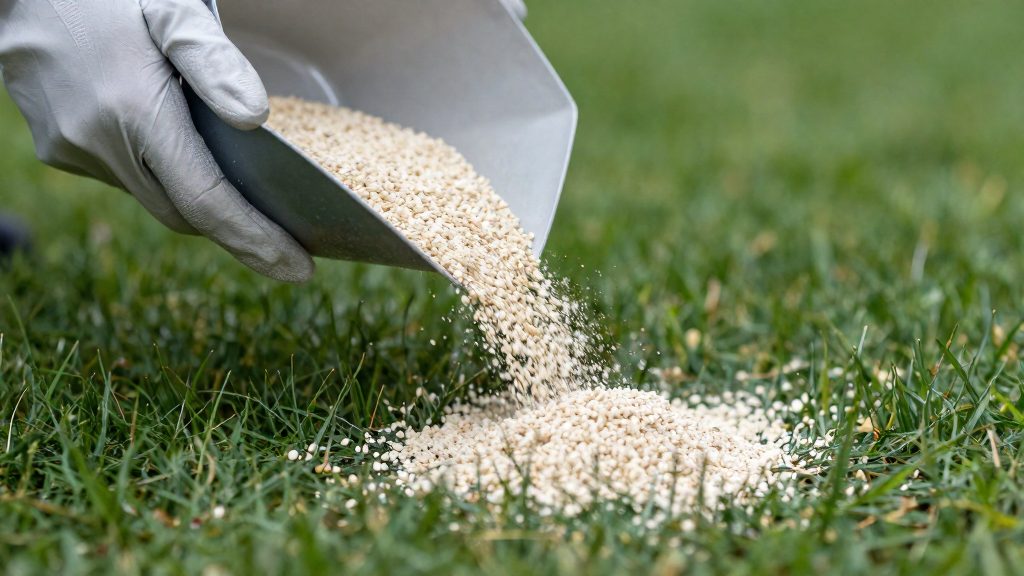
Some seed is coated or treated. If yours is, follow the handling instructions on the label, wear gloves while sowing, wash your hands afterwards, and keep children and pets off the seeded area for as long as the label or manufacturer documentation advises.
Frequently asked questions
Can I mix grass types when overseeding?
The official sources consulted do not specify whether mixing is suitable for your lawn. Choose a seed type that matches the grass already growing, and check the seed label or manufacturer documentation.
Does the overseeding rate change in spring?
The official sources consulted do not specify spring rates. Use the rate for your grass type from the seed label, and confirm timing with local extension guidance.
Do I need to aerate the lawn before overseeding?
The official sources consulted do not specify whether aeration is needed. Check the manufacturer documentation and local guidance for your type of lawn.
What if most of my lawn is bare?
If most of the lawn needs replacing, treat the job as a new lawn and use the new-lawn rate instead. In the Omni Calculator table, that rate is about double the overseeding rate, for example 5 lb instead of 2.5 lb per 1,000 sq ft for creeping red fescue.